You bought an electric vehicle to save money and reduce your environmental impact. But relying on public charging stations eats into both those benefits. You’re spending time you don’t have waiting for your car to charge, paying premium rates at commercial stations, and dealing with the anxiety of whether you’ll find an available charger when you need one.
A home EV charging station changes that completely. Plug in when you get home, and your car charges while you sleep. You wake up to a full battery every single morning. No more planning your day around charging stops or paying inflated public station rates.
The cost difference is significant. Home charging can cut your fuel costs by 50% compared to gasoline, and you’re paying residential electricity rates instead of commercial charging fees. For Fire Island homeowners, where newer construction typically means 200-amp electrical panels, installation is often straightforward. You get the convenience of home charging without the complexity of major electrical upgrades.
Your property value increases too. As EV adoption accelerates across Long Island, buyers are specifically looking for homes with charging infrastructure already in place. You’re not just installing a charger—you’re adding a feature that makes your home more attractive to the growing number of EV drivers in Suffolk County.
We’ve been serving Suffolk County since 2004. We’ve installed EV charging stations for Fire Island homeowners who need the work done correctly, on code, and without surprise costs at the end.
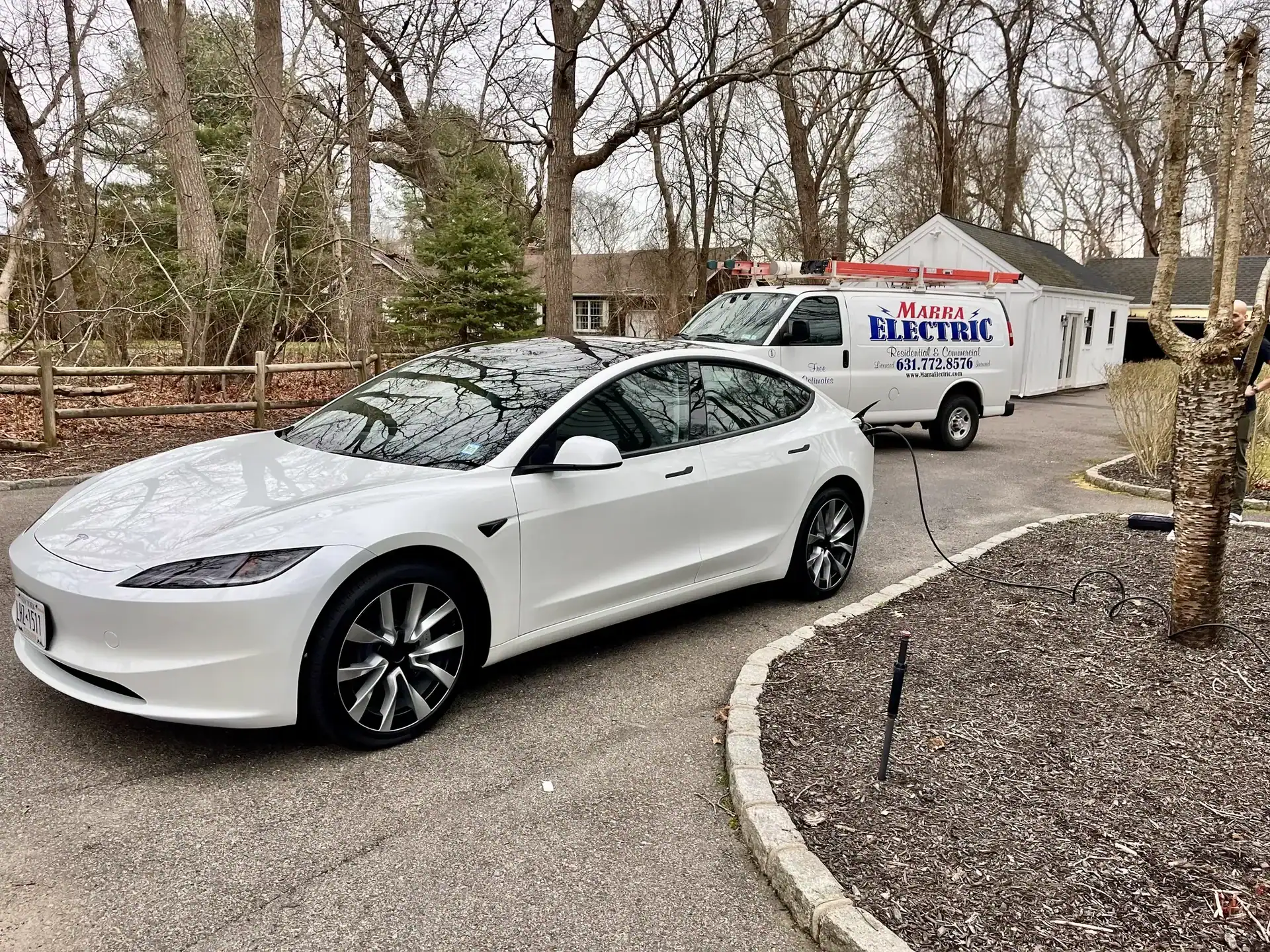
Our team shows up in marked vehicles, in uniform, and gives you the total price before starting any work. That’s not standard in this industry, but it should be. You’ll know exactly what you’re paying for a complete, permitted installation that meets New York electrical code requirements.
We’ve earned the Angie’s List Super Service Award seven consecutive years because we do what we say we’ll do. Fire Island properties present specific considerations—coastal conditions, seasonal access, and local code requirements—and we’ve handled them all. When you’re investing in home charging infrastructure, you need an electrician who understands both the technology and the local environment.
First, we assess your electrical panel and charging location. Most Fire Island homes built after 1990 have 200-amp panels, which typically handle a Level 2 EV charger installation without upgrades. We run a load calculation to confirm your panel capacity and determine exactly what’s needed. You get a written estimate with the full cost before any work begins.
Next, we pull the required permit. New York law requires permits for new electrical circuits, including EV charger installations. Skipping this step can void your homeowner’s insurance and create code violations. We handle the permitting process as part of the installation.
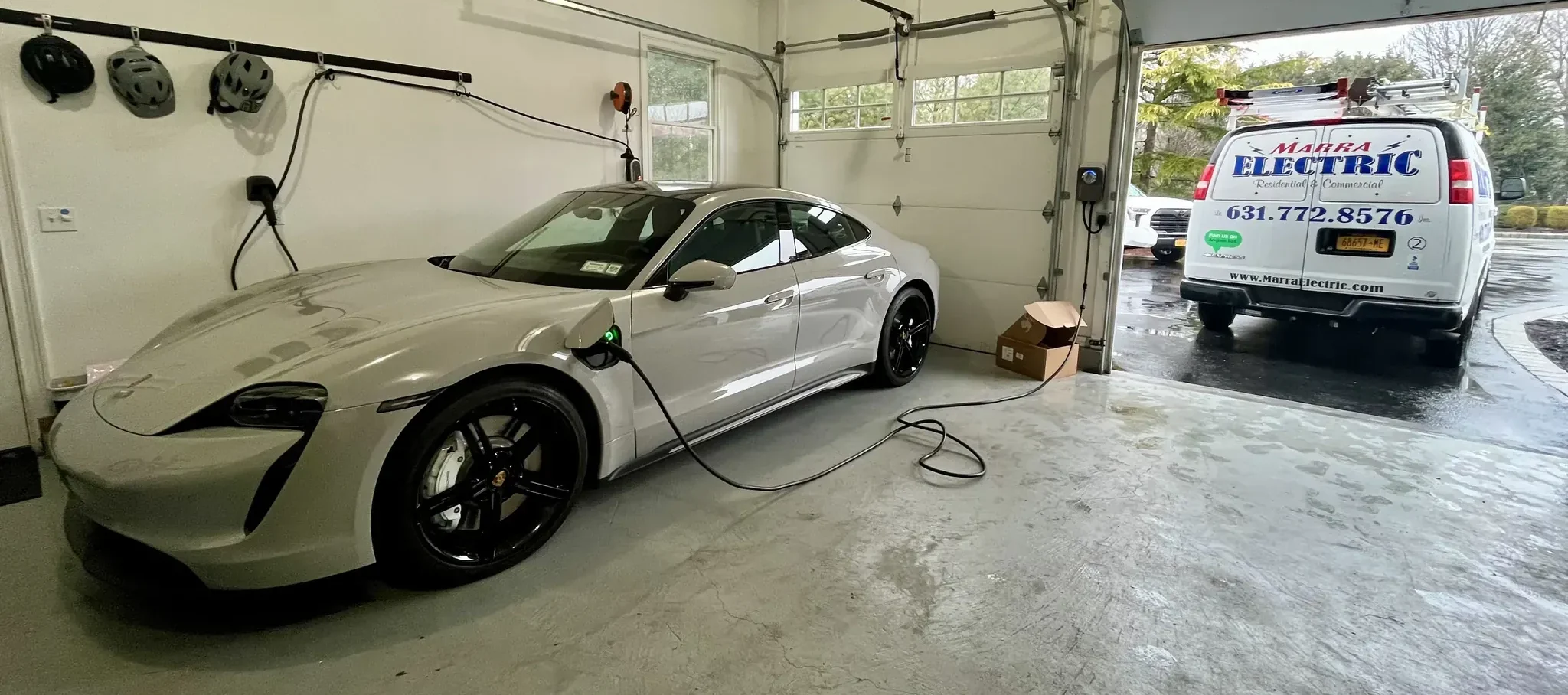
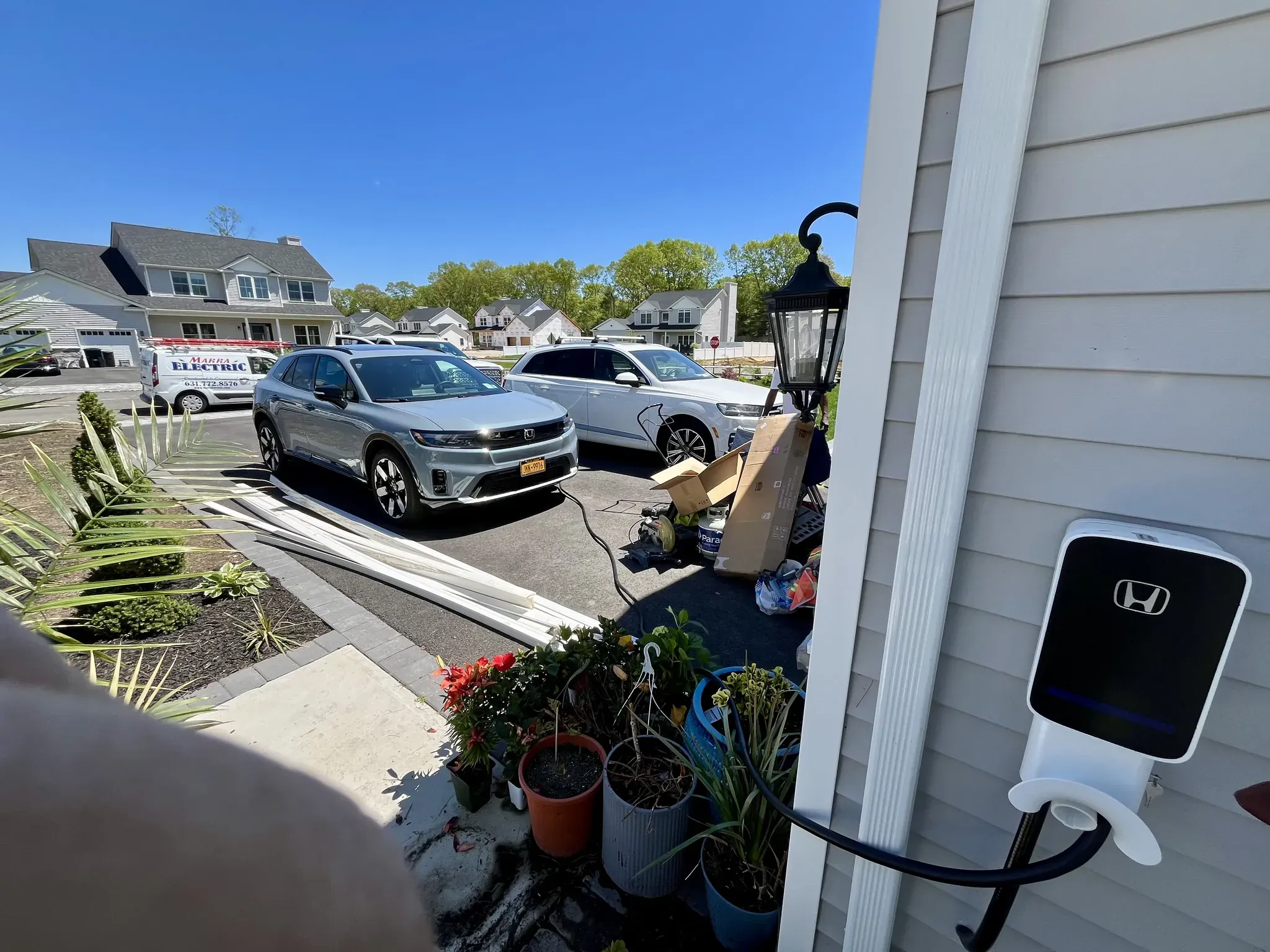
Then we install the dedicated 240-volt circuit from your panel to the charging location. This includes running the appropriate gauge wire, installing the circuit breaker, and mounting your chosen charging unit. Whether you’re installing a Tesla Wall Connector, ChargePoint Home Flex, or another Level 2 charger, we ensure it’s mounted securely and wired to manufacturer specifications.
Finally, we test the complete system and show you how to operate your new charger. The inspection happens after installation, and we’re there to address any inspector requirements. Once approved, you’re charging at home that same day.
Ready to get started?
Your electric car charger installation in Fire Island, NY includes everything needed for a complete, code-compliant system. We install the dedicated 240-volt circuit with the correct wire gauge for your specific charger model. Most Level 2 chargers require a 40 or 50-amp circuit, and we size everything according to National Electrical Code requirements.
The installation includes the circuit breaker, conduit where required by code, and professional mounting of your charging unit. We install chargers in garages, carports, or exterior locations—wherever makes sense for your property and parking situation. Coastal Fire Island conditions mean we use appropriate weatherproof materials for outdoor installations.
You also get the permit and inspection coordination. We submit the permit application, schedule the inspection, and handle any follow-up the inspector requires. This isn’t optional—it’s required by New York law, and it protects both your insurance coverage and your safety.
For homes that need panel upgrades, we handle that too. About 20% of New York homes require some level of electrical service upgrade for EV charging. If your home still has a 100-amp panel common in pre-1990 construction, we’ll identify that during the assessment and provide clear pricing for the upgrade work. A 200-amp panel upgrade typically runs $1,500 to $3,000 in suburban Long Island, and it increases your home’s overall electrical capacity for future needs beyond just EV charging.
Most Fire Island homeowners pay between $500 and $1,500 for a complete Level 2 EV charger installation. That covers the dedicated 240-volt circuit, breaker, wire, conduit, labor, permit, and inspection. The final cost depends on the distance from your electrical panel to the charging location and whether your panel has available capacity.
If you need a sub-panel to create additional circuit space, expect $800 to $2,500 total. Full electrical service upgrades from 100-amp to 200-amp panels run $2,500 to $6,000 in the Fire Island area. About 80% of homes don’t need a panel upgrade—just a new circuit.
We provide upfront pricing after assessing your specific situation. You’ll see the complete cost in writing before we start any work. No surprise bills when the job is done.
Yes. New York law requires an electrical permit for any new circuit installation, including EVSE installation in Fire Island, NY. This isn’t optional, and it’s not something you want to skip.
An unpermitted installation can void your homeowner’s insurance if there’s ever a fire or electrical issue. It’s also a code violation that can create problems when you sell your home. Buyers doing home inspections will ask about permits for electrical work, and missing permits can delay or kill a sale.
We handle the entire permit process as part of your installation. We submit the application, coordinate the inspection, and make sure everything passes. The permit cost is included in your total price, and the inspection confirms your installation is safe and code-compliant. That’s the protection you need when you’re adding a high-draw appliance like an EV charger to your electrical system.
Most installations take four to eight hours for the actual electrical work. That’s for a straightforward circuit installation from your panel to the charging location. We typically complete the work in a single day.
The timeline extends if you need a panel upgrade. A 200-amp service upgrade adds one to two days to the project. We’ll give you a specific timeline during your estimate based on what your home requires.
Permit processing and inspection scheduling add a few days to the overall timeline, but they don’t require you to be present. We submit the permit, complete the installation, and schedule the inspection. Once the inspector approves the work, you’re charging immediately. From your first call to a fully operational charging station, most Fire Island homeowners are up and running within one to two weeks.
Level 1 chargers plug into standard 120-volt outlets and add about 3 to 5 miles of range per hour of charging. That’s the cord that came with your EV. It works, but it’s slow. If you drive 40 miles a day, you’re looking at 8 to 12 hours to recharge.
Level 2 chargers run on 240-volt circuits—the same voltage as your electric dryer. They add 25 to 30 miles of range per hour. That same 40-mile daily drive recharges in about 90 minutes. Most EV owners install Level 2 chargers because the speed difference is dramatic.
For Fire Island residents, Level 2 installation makes sense. You’re likely driving to work in other parts of Suffolk County, running errands, and using your vehicle daily. Level 2 charging means you plug in when you get home and wake up to a full battery every morning, regardless of how much you drove the day before. Level 1 charging works for people who drive very little, but most drivers find it too limiting for daily use.
Yes, but it depends on the model. The Tesla Wall Connector now works with any EV that uses the standard J1772 charging plug—which is most non-Tesla electric vehicles. Tesla updated the Wall Connector to include a J1772 adapter, making it compatible across brands.
If you’re installing the older Tesla-specific connector, it only works with Tesla vehicles unless you buy a separate adapter. Most Fire Island homeowners installing chargers for non-Tesla EVs choose universal Level 2 chargers like the ChargePoint Home Flex, JuiceBox, or Grizzl-E. These work with any electric vehicle and offer the same charging speeds.
The electrical installation is identical regardless of which charger brand you choose. We install the 240-volt circuit to code, and you mount whichever charging unit fits your vehicle and budget. If you’re planning to own different EV brands over time, a universal charger gives you more flexibility. If you’re committed to Tesla vehicles, their Wall Connector integrates with the Tesla app for monitoring and scheduling.
Your electric bill will increase, but you’re replacing gasoline costs with electricity costs—and electricity is cheaper. The average EV uses about 30 kilowatt-hours to drive 100 miles. In New York, residential electricity averages around $0.20 per kWh, so that’s $6 for 100 miles of driving.
A gas car averaging 25 miles per gallon uses 4 gallons to drive 100 miles. At $3.50 per gallon, that’s $14 for the same distance. You’re cutting your fuel costs roughly in half by charging at home.
Many Fire Island residents can reduce costs further by charging during off-peak hours. Some New York utilities offer time-of-use rates that discount electricity used overnight. If you charge your EV between 11 PM and 7 AM, you might pay $0.12 per kWh instead of $0.20. That drops your cost to about $3.60 for 100 miles. Your total monthly increase depends on how much you drive, but most homeowners see $30 to $60 added to their electric bill while eliminating $150 to $300 in gas station visits.
Other Services we provide in Fire Island