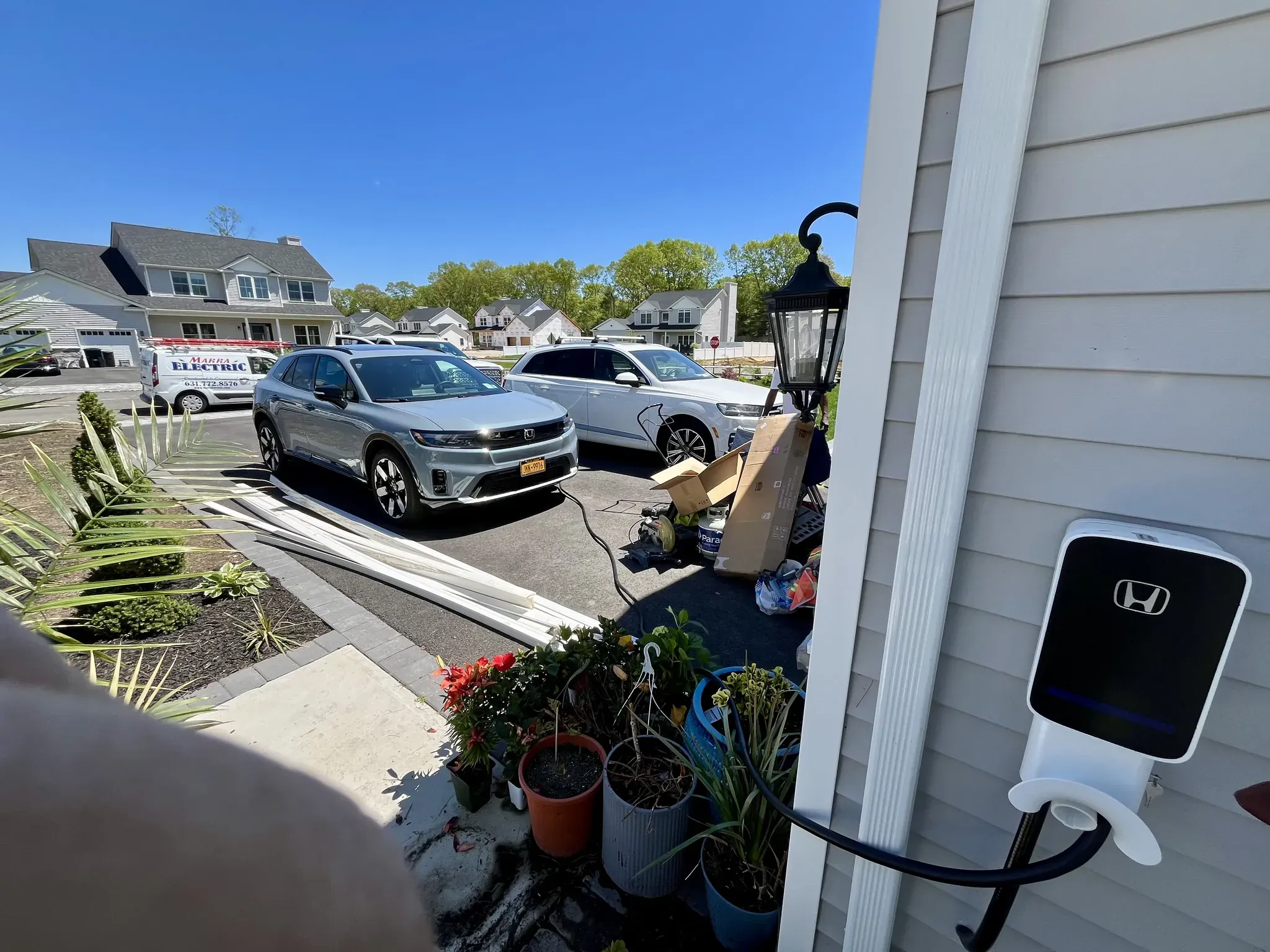
Two silver Honda electric vehicles are parked in a NY suburban driveway near a house. A Honda EV charger, expertly installed by a residential electrician Suffolk County, is mounted on the garage wall. It is a sunny day with plants and boxes nearby.
Commercial EV Charger Installation Suffolk County, NY

Charging Infrastructure That Actually Works for Your Property

You need commercial EV charger installation in Suffolk County that handles the electrical complexity, navigates the rebates, and gets your tenants or employees charging without the runaround. We bring over 20 years of licensed electrical experience to every Level 2 charger, panel upgrade, and multi-unit dwelling project across Suffolk County, NY.

Why Choose Us

What You Get with Marra Electric

Licensed Electrical Contractors Only

Every commercial EV charger installation is performed by our fully licensed and insured electricians who know Suffolk County codes inside and out.

Upfront Pricing Before Work Begins

You'll know exactly what your commercial EV charging station costs before we touch a wire. No surprise bills, no hidden fees.

Over 20 Years in Business

Since 2004, we've handled electrical projects across Suffolk County with a track record that speaks for itself.

Free Estimates on All Projects

Get a clear assessment of your commercial EV charger installation needs without spending a dime to find out what's involved.

Business EV Charging Station Installation in Suffolk County, NY

From Apartments to Office Parks—We Handle It All

Commercial EV charger installation in Suffolk County, NY covers a lot of ground. You might be a property manager dealing with tenant requests at a 50-unit apartment building. Maybe you run a retail plaza and want to attract EV drivers who'll spend 30 minutes shopping while their car charges. Or you're managing a corporate office where half your staff just bought Teslas and they're asking where they're supposed to plug in.

Whatever your situation, the electrical work is the same. You need adequate power capacity, proper permitting, code-compliant installation, and someone who can explain what's happening without the sales pitch. That's what we do. We assess your current electrical setup, determine whether you need panel upgrades or can work with what you have, pull the permits, install the charging equipment, and make sure everything passes inspection the first time.
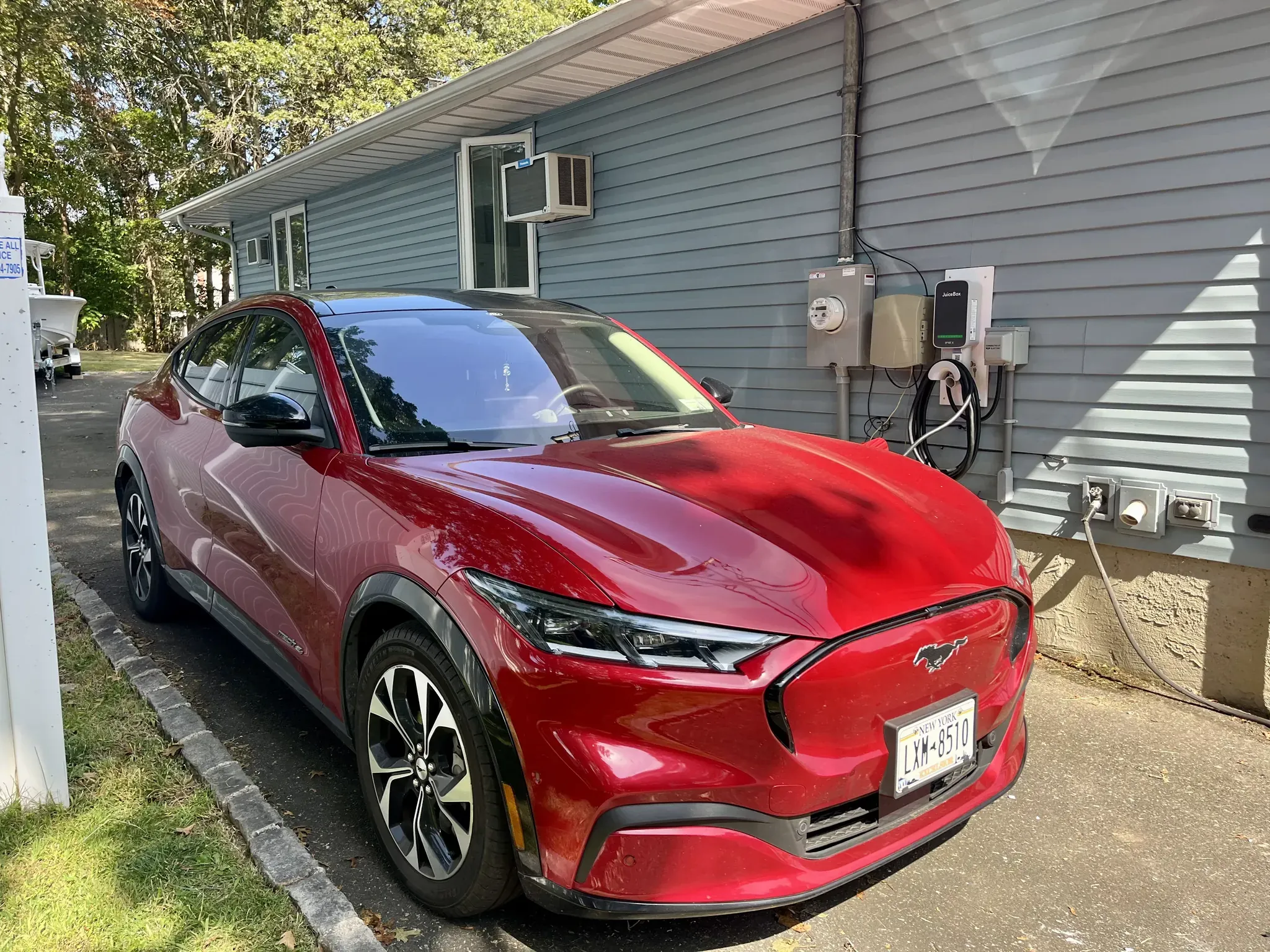
A red Ford Mustang Mach-E electric SUV is parked next to a gray NY house with an EV charging station installed by a residential electrician Suffolk County and air conditioning units in the windows. Trees are visible in the background.
Multi-Unit Dwelling EV Charging Suffolk County, NY

What You Actually Gain from Installing Charging Stations

This isn't about being trendy. It's about staying competitive, meeting tenant expectations, and positioning your property for what's already happening across Long Island.

20+ Years Serving Suffolk County
350+ Five-Star Google Reviews
#35607 NY Licensed & Insured
Know Your Costs
You stop losing prospective tenants and employees to properties that already offer EV charging as a standard amenity.
Safety First
Your property value increases because buildings with charging infrastructure are easier to market, lease, and refinance.
Equipment Protection
You qualify for substantial rebates—up to $4,000 per port through NYSERDA Charge Ready NY, plus federal tax credits.
Root Cause Fixed
You avoid the scramble when New York's building codes make EV-ready parking mandatory for new construction and major renovations.
Plain English
Your tenants or employees can actually charge at home or work, which is where 80% of EV charging happens.
Code Compliant
You create potential revenue streams if you choose to charge for usage instead of offering it as a free amenity.

Every benefit above is delivered on every job we take.

Get a Free Estimate

Ready to get started?

Our licensed crew is standing by for free estimates and 24/7 emergency service across Suffolk County.

No Obligation Same-Day Available Free Estimates
Workplace EV Charging Station Suffolk County, NY

The Electrical Work Behind Every Charging Port

Most commercial EV charger installations in Suffolk County use Level 2 charging equipment. These units operate on 208-240 volts and can add anywhere from 12 to 80 miles of range per hour depending on the charger's output and the vehicle. That's the sweet spot for workplace charging, apartment buildings, retail locations, and anywhere people park for more than an hour.

The installation itself involves more than mounting a box on the wall. We evaluate your existing electrical panel to see if it can handle the additional load. A 40-amp Level 2 charger pulls serious power, and if you're installing multiple units, that adds up fast. Some properties need panel upgrades. Others can use load management systems that distribute power intelligently across multiple chargers without overloading the system.

Then there's the permitting. Suffolk County requires electrical permits for this work, and inspections have to pass before the chargers go live. We handle that process so you're not stuck figuring out which forms go where. Once everything's approved and installed, your charging stations are ready to use, and your tenants, employees, or customers can start plugging in.
Learn More
Fleet EV Charger Installation Suffolk County

What's Included in a Commercial Installation

When we handle your commercial EV charger installation in Suffolk County, you're getting a full-scope project. We start with a site assessment to understand your electrical capacity, parking layout, and how many charging stations make sense for your property. If you're working with limited panel capacity, we'll recommend solutions like load management software or panel upgrades.

Next comes equipment selection. We'll walk you through the options—wall-mounted versus pedestal units, networked chargers that let you track usage and set pricing, or simpler plug-and-charge setups. If you're applying for rebates through NYSERDA or PSEG Long Island, we make sure the equipment qualifies.

Installation includes running conduit, wiring the chargers to your electrical panel, mounting the units, and configuring any network features. We coordinate inspections, handle any corrections if needed, and make sure you have documentation for your rebate applications. By the time we're done, your charging infrastructure is operational, compliant, and ready for however many vehicles you're supporting.
Learn More

Get a Free Estimate Today

Our licensed crew serves all of Suffolk County with transparent pricing and guaranteed work.

Why Marra Electric

NY Licensed & Fully Insured — #35607
Upfront written estimates — no hidden fees
No subcontractors — our crew does your job start to finish
100% satisfaction guaranteed on every job
24/7 emergency service across Suffolk County
NY Electrical License #35607 Fully insured on every job
Apartment EV Charger Installation Suffolk County

How We Get Your Charging Stations Installed

Step 01 of 03

Site Assessment and Planning

We evaluate your electrical panel, parking layout, and power capacity to determine what your property can support and what upgrades you might need.

Step 02 of 03

Equipment Selection and Permitting

We help you choose the right chargers for your needs, pull the necessary permits, and make sure everything qualifies for available rebates.

Step 03 of 03

Installation and Inspection

Our licensed electricians install the charging equipment, complete the electrical work, and coordinate inspections so your stations go live without delays.

FAQ

Common Questions About This Service

Most Level 2 commercial EV charger installations in Suffolk County range from $6,000 to $15,000 per charger, including equipment and installation. That number can go higher if you need panel upgrades, transformer work, or extensive trenching to reach your parking areas. The good news is that rebates can cover a significant portion of those costs. NYSERDA's Charge Ready NY program offers up to $4,000 per charging port, and if your property is in a disadvantaged community, you can get an additional $500 per Level 2 charger. The federal 30C tax credit covers 30% of installation costs up to $100,000 per port through June 30, 2026. PSEG Long Island also runs a Make Ready Program that helps offset infrastructure costs. When you factor in these incentives, your out-of-pocket cost drops considerably. We provide free estimates that break down equipment, labor, and any electrical upgrades you'll need, so you know exactly what you're looking at before committing to anything.

It depends on your current electrical capacity and how many chargers you're installing. A single Level 2 charger typically requires a dedicated 40-amp circuit, which many commercial panels can handle without upgrades. But if you're installing multiple chargers—say, five or ten units for a multi-unit dwelling or office parking lot—you're adding significant load to your system. We start every project with a load calculation to see if your existing panel can support the additional demand. If it can't, you have a few options. You can upgrade your electrical panel to a higher amperage service, which gives you room to grow. Or you can use load management systems that intelligently distribute power across multiple chargers, allowing you to install more units without exceeding your panel's capacity. Load management is often the more cost-effective route, especially if you're working with an older building. Either way, we'll walk you through what makes sense for your property and budget, and we'll handle the upgrade work if it's needed.

New York offers some of the best incentives in the country for commercial EV charger installation. NYSERDA's Charge Ready NY 2.0 program provides rebates of $4,000 per charging port for public facilities, workplaces, and multi-unit dwellings. If your property is located in a disadvantaged community, you can get an additional $500 per Level 2 charger. The federal Alternative Fuel Infrastructure Tax Credit (30C) is still available through June 30, 2026, covering 30% of your installation costs up to $100,000 per charging port. PSEG Long Island runs a Make Ready Program that covers infrastructure costs like trenching, conduit, and panel work needed to support Level 2 and DC fast chargers. There's also a New York State tax credit equal to 50% of the infrastructure cost, up to $5,000, for businesses that install public or workplace EV chargers. These programs can stack in some cases, which means you could offset 40-70% of your total project cost. The catch is that most of these incentives require you to reserve funding before you start installation, so it's worth getting your application in early. We help clients navigate the paperwork and make sure their equipment qualifies for the programs they're applying to.

Timeline depends on the scope of your project. A straightforward installation—one or two Level 2 chargers with no panel upgrades—can usually be completed in a few days once permits are approved. Larger projects with multiple chargers, panel upgrades, or extensive trenching can take several weeks from start to finish. Permitting is often the longest part of the process. Suffolk County requires electrical permits for EV charger installations, and depending on the workload at the building department, approval can take anywhere from a few days to a couple of weeks. Once permits are in hand, the actual installation moves quickly. We schedule the work to minimize disruption to your property, and if you're running a business or managing tenants, we coordinate around your operating hours. If you're applying for rebates, factor in additional time for that process. Some programs require pre-approval before installation begins, and others need documentation after the work is done. We handle the coordination on our end to keep things moving, but it's smart to plan for at least a month from initial consultation to fully operational chargers, especially if you're dealing with larger installations or incentive applications.

Absolutely. Multi-unit dwellings are one of the fastest-growing segments for EV charger installations, and for good reason—over 80% of EV charging happens at home, and about 30% of U.S. households live in apartments or condos. If your tenants drive electric vehicles and can't charge at home, they're either going to ask you to install chargers or they're going to move somewhere that already has them. New York has Right to Charge laws that prevent landlords and HOAs from unreasonably blocking EV charger installations, so tenant requests are becoming more common. The installation process for apartment buildings is similar to other commercial properties, but there are a few extra considerations. You'll need to decide whether chargers are shared (first-come, first-served in designated spots) or assigned to specific units. You'll also need to figure out billing—some properties offer free charging as an amenity, while others use networked chargers that track usage and bill tenants for the electricity they consume. Load management is especially important in multi-unit dwellings because you're often working with limited electrical capacity, and you don't want to overload your system when multiple tenants plug in at the same time. We've handled plenty of apartment and condo installations across Suffolk County, and we can walk you through the options that make sense for your property.

Level 2 and DC fast charging serve different purposes, and which one you need depends on how your property is used. Level 2 chargers operate on 208-240 volts and add 12 to 80 miles of range per hour depending on the charger's power output. They're ideal for locations where vehicles are parked for extended periods—apartments, office buildings, retail centers, hotels. Most people can fully charge their EV overnight or during a workday with a Level 2 charger, and the equipment is relatively affordable to install. DC fast chargers, on the other hand, can charge a vehicle to 80% in 20 to 40 minutes. They require 480-volt, three-phase power, which means more expensive equipment and often significant electrical upgrades. Fast chargers make sense for high-traffic locations like highway rest stops, gas stations, or fleet depots where vehicles need a quick turnaround. For most commercial properties in Suffolk County, Level 2 is the right choice. It's cost-effective, meets the needs of employees and tenants, and qualifies for the same rebates and incentives as fast charging. If you're not sure which option fits your property, we can assess your usage patterns and help you make the call.