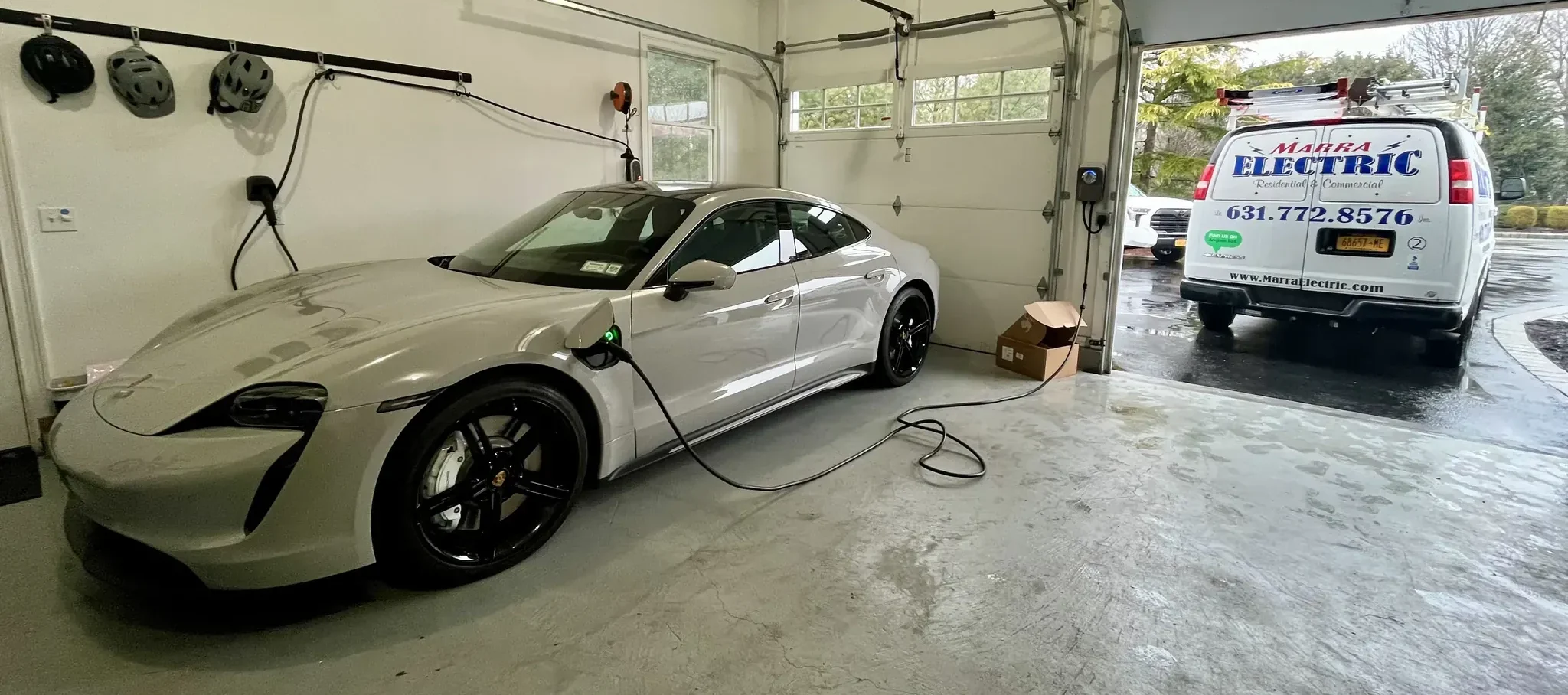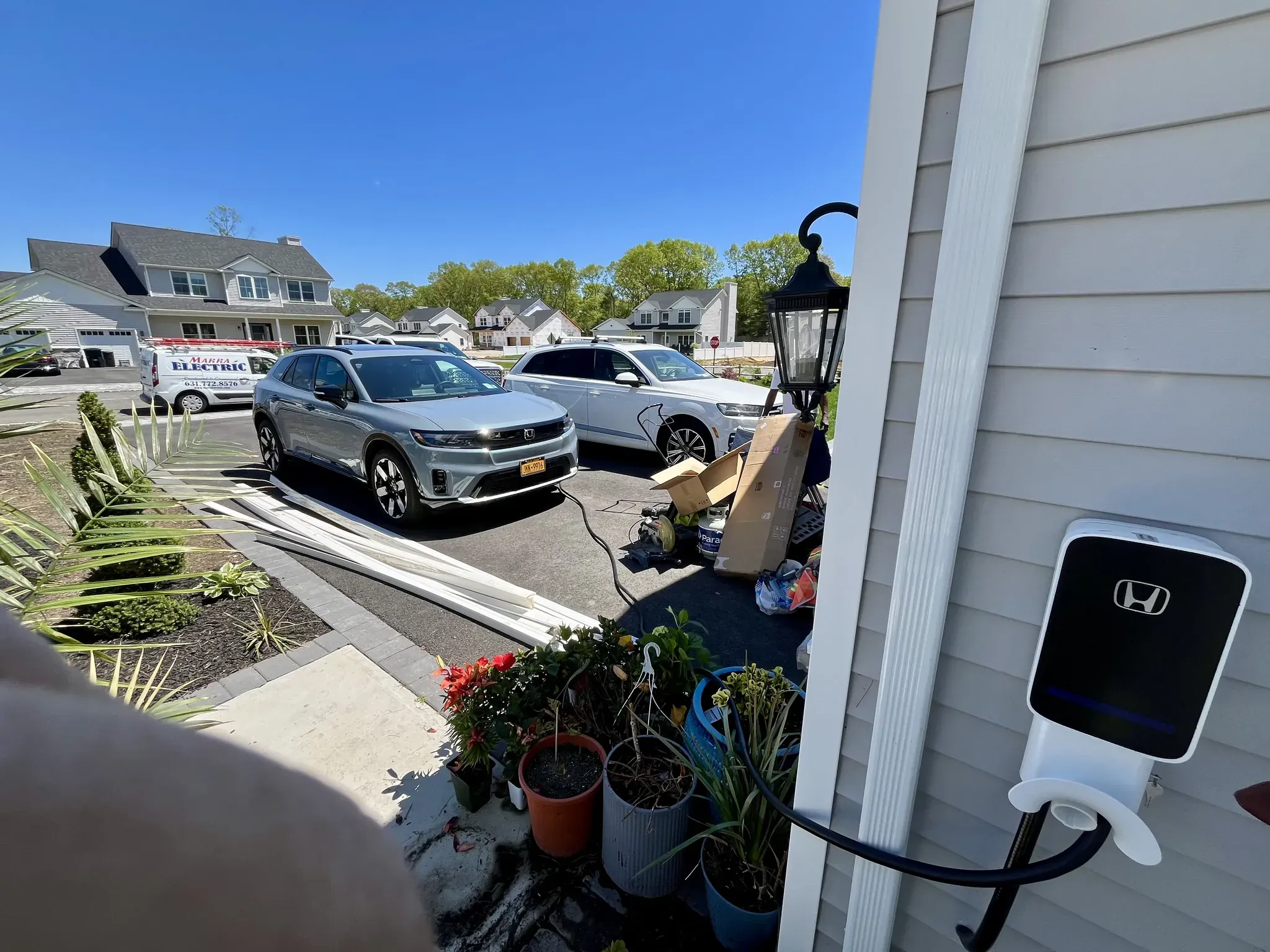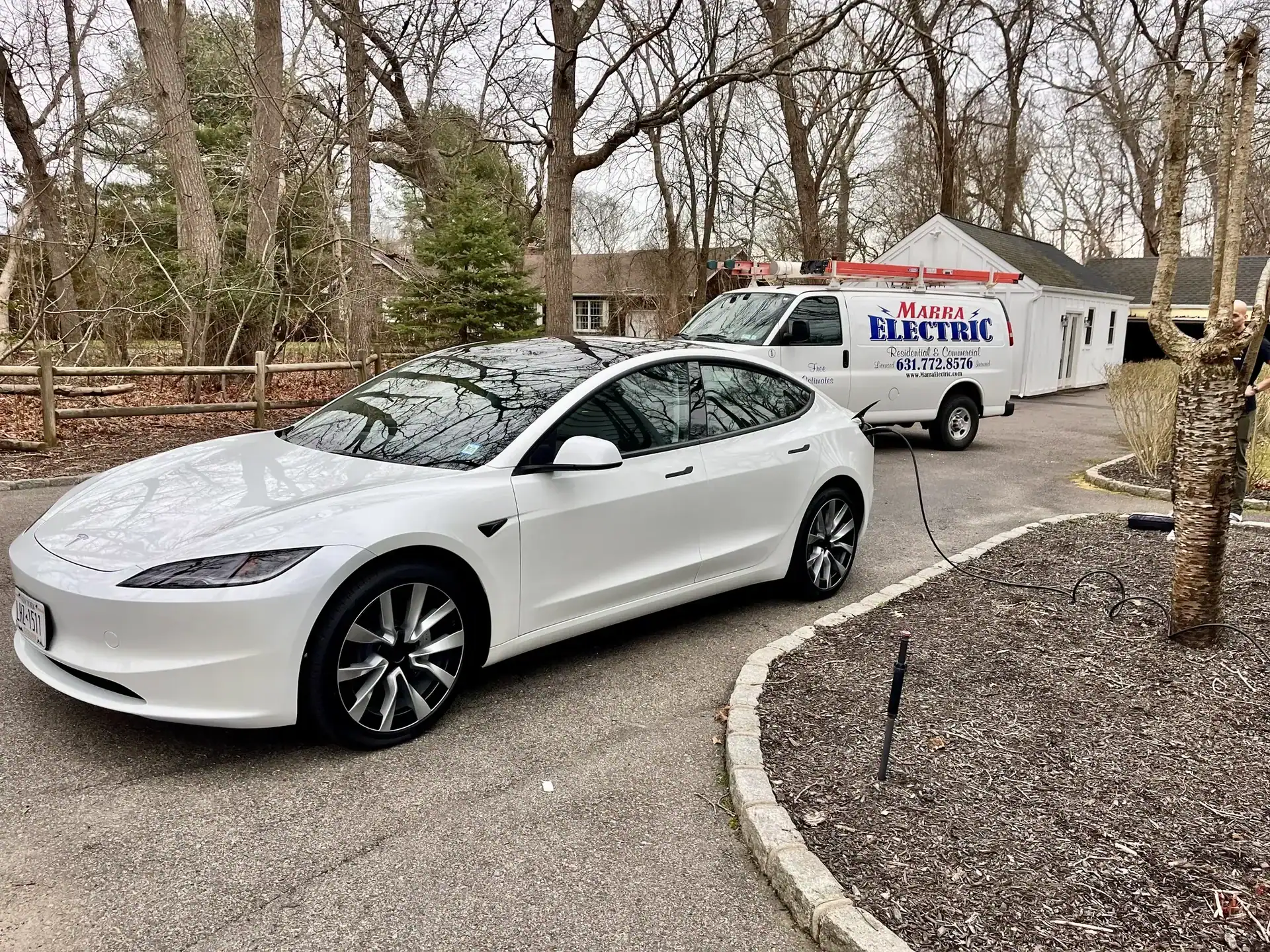
You bought an EV to simplify your life, not to plan your week around charging stations. A Level 2 home charging setup means you plug in when you get home and wake up ready for whatever the day brings—whether that’s your commute to the city or weekend trips out to the North Fork.
Most Lake Ronkonkoma homeowners add 40 to 60 miles of range per hour with a properly installed Level 2 charger. That’s a full charge overnight, even if you rolled in with 20% battery left. Compare that to the 3 to 5 miles per hour you’d get from a standard outlet, and you see why people call us before they even take delivery of the vehicle.
The difference isn’t just speed. It’s not wondering if you’ll have enough charge tomorrow. It’s not sitting at a public station in the cold. It’s the kind of convenience that makes owning an EV actually feel easier than owning a gas car—once the installation is done right.
Marra Electric has been handling residential and commercial electrical projects across Suffolk County since 2004. We’re not new to this, and we’re not figuring it out as we go. Every EV charger installation in Lake Ronkonkoma, NY we complete is backed by a New York State electrical contractor license, full insurance, and twenty years of knowing how homes in this area are wired.
Most of the houses we work on in Lake Ronkonkoma were built between the 1950s and 1980s. That means 100-amp or 150-amp panels, older wiring standards, and layouts that weren’t designed for electric vehicles. We’ve upgraded hundreds of panels in this area, coordinated with PSEG Long Island more times than we can count, and pulled permits through the Town of Islip without delays.
You’ll see our crews show up in company vehicles, in uniform, with upfront pricing and no surprise charges. We’ve earned the Angie’s List Super Service Award seven years running because we do what we say we’re going to do—on time, up to code, and without the runaround.
We start with a free on-site estimate at your Lake Ronkonkoma home. That means looking at your current electrical panel, measuring the distance from the panel to where you want the charger, and running a load calculation to see if your system can handle the additional demand. Most EV chargers pull between 30 and 48 amps continuously, and if you’re already running central air, an electric dryer, and a water heater on a 100-amp service, something’s got to give.
If you need a panel upgrade, we’ll tell you exactly what that involves—cost, timeline, and how we coordinate the temporary shutoff with PSEG Long Island. Typically that’s a 4 to 6 hour window, scheduled in advance. We handle the permit through the Town of Islip, schedule the utility disconnect, and complete the upgrade in a single day for most homes.
Once your panel is ready—or if it already was—we install a dedicated circuit for your charger, mount the unit where you want it (garage wall, exterior near the driveway, etc.), and test everything before we leave. You’ll get a walkthrough on how to use it, and we don’t consider the job done until the charger is active and you’ve successfully plugged in your vehicle.
Ready to get started?
Every electric car charger installation in Lake Ronkonkoma, NY includes permit acquisition, a dedicated 240-volt circuit sized to your charger’s specs, proper wire gauge for the distance, and a NEMA 14-50 outlet or hardwired connection depending on your charger model. If you’re installing a Tesla Wall Connector, ChargePoint Home Flex, or any other Level 2 EVSE, we size the breaker and wiring at 125% of the continuous load—that’s code, and it’s how you avoid tripped breakers or overheating down the line.
We also coordinate directly with PSEG Long Island if your panel needs upgrading. In Suffolk County, that means scheduling a disconnect, upgrading your service to 200 amps (the standard for modern homes), and getting your meter reconnected the same day. The whole process typically adds $2,000 to $3,500 to your project, but it’s not just for your EV—it’s infrastructure that supports your whole home and increases resale value.
Most Lake Ronkonkoma installations are complete in one to two days depending on whether a panel upgrade is needed. If your electrical system is already set up for it, we can often finish the charger install in a few hours. If you’re starting from a 100-amp panel with no available breaker slots, plan for the full scope—but you’ll know the timeline and cost before we start.
It depends on your current panel capacity and what else is running in your home. If you have a 200-amp service with available breaker slots, you probably don’t need an upgrade. But a lot of homes in Lake Ronkonkoma are still running on 100-amp or 150-amp panels from the 70s and 80s, and adding a 40 or 48-amp EV charger on top of central air, electric heat, and modern appliances pushes that system past its limit.
We run a load calculation during your free estimate—it’s a simple test that shows exactly how much capacity you’re using and how much you have left. If you’re already at 80% or higher, an upgrade makes sense. Not just for the charger, but for safety and for avoiding nuisance breaker trips every time you run the dryer and the AC at the same time.
The upgrade itself typically costs between $2,000 and $3,500 in Suffolk County, and that includes the new 200-amp panel, meter work, PSEG coordination, and permits through the Town of Islip. It’s a one-day job in most cases, and it future-proofs your home for whatever you add next—whether that’s a second EV, a pool, or just peace of mind.
If your panel is ready and you have the space for a dedicated circuit, most charger installations take between three and five hours. That includes mounting the unit, running the wiring, installing the breaker, making the connections, and testing everything to make sure it works. You can usually schedule it and have it done the same day.
If you need a panel upgrade first, add a day. The panel replacement itself takes four to six hours depending on the scope, and that includes the temporary PSEG shutoff. We schedule that in advance so you’re not sitting in the dark unexpectedly. Once the panel is upgraded and the meter’s reconnected, we move right into the charger install if time allows, or we come back the next day to finish.
Permits usually don’t slow things down much in Lake Ronkonkoma. We pull them as part of the process, the Town of Islip processes them quickly, and the inspection happens after the install is complete. Start to finish, you’re looking at one to two days of actual work, and most of that time you’re not even home.
We install whatever charger you want—Tesla Wall Connector, ChargePoint, JuiceBox, Grizzl-E, Emporia, all of it. The electrical work is the same regardless of brand. What matters is the amperage the unit pulls, the type of connection it needs (hardwired vs plug-in), and where you want it mounted.
Tesla Wall Connectors are popular in Lake Ronkonkoma because they’re clean-looking, reliable, and they integrate with the Tesla app. Most people hardwire them, which means a direct connection to the breaker without a plug. That’s totally fine and actually preferred in some cases because it’s one less potential failure point.
If you haven’t bought a charger yet, we can walk you through what makes sense for your vehicle and your budget during the estimate. Some chargers have better apps, some charge faster, some are better for outdoor installations. We’ve installed enough of them to know what holds up and what doesn’t, and we’ll tell you straight if something’s overkill or underpowered for what you’re driving.
If your panel is ready and the charger location is within 25 feet of it, expect to pay between $800 and $1,500 for the installation labor and materials. That covers the dedicated circuit, proper wire gauge, breaker, conduit if it’s an exterior run, and the outlet or hardwired connection. The charger itself is separate—you either provide it or we source it for you.
If you need a panel upgrade, add $2,000 to $3,500 depending on the scope. That includes the 200-amp panel, meter work, coordination with PSEG Long Island, permits, and labor. It sounds like a lot, but you’re not just paying for the EV charger—you’re upgrading your home’s entire electrical capacity, which supports everything else you plug in and adds value if you ever sell.
We give you a fixed price after the on-site estimate. No hourly guessing, no change orders unless you change the scope. You’ll know what it costs before we start, and that number doesn’t move unless you ask us to add something. That’s how we’ve stayed in business for twenty years in Suffolk County—people appreciate knowing what they’re paying before the work begins.
Yes. Any work that involves adding a new dedicated circuit or upgrading your electrical panel requires a permit through the Town of Islip. That’s not optional, and it’s not something you want to skip. If you ever sell your home, unpermitted electrical work becomes a liability. If something goes wrong and insurance finds out the work wasn’t permitted, you’re on your own.
We handle the permit as part of the installation. You don’t have to go to the building department, you don’t have to fill out forms, and you don’t have to schedule the inspection. We pull it, we coordinate it, and we make sure the work passes. It’s built into the cost and the timeline, so it doesn’t slow anything down.
The Town of Islip is pretty straightforward with electrical permits compared to some other municipalities. Processing is quick, inspections are scheduled within a few days of completion, and as long as the work is done to code—which it will be—there’s no issue. It’s just part of doing the job right, and it protects you as much as it protects us.
Yes, but probably less than you think—and definitely less than paying for gas. Charging an EV at home typically costs about half what you’d spend at a public fast-charging station, and way less than filling a tank. Most people see their electric bill go up between $30 and $60 per month depending on how much they drive and what they pay per kilowatt-hour with PSEG Long Island.
If you drive about 1,000 miles a month and your EV gets around 3 miles per kWh (pretty standard), you’re using about 333 kWh to charge. At roughly $0.18 per kWh, that’s about $60. Compare that to a gas car getting 25 mpg at $3.50 per gallon, and you’d be spending $140 on gas for the same distance. You’re saving money every month, even with the higher electric bill.
PSEG Long Island also offers time-of-use rates where electricity is cheaper overnight. If you set your charger to start after 10 PM, you can cut that cost even further. Some people drop their charging cost by 30% or more just by shifting when they plug in. We can’t set up your rate plan for you, but we can tell you how to make the most of it once your home EV charging station installation in Lake Ronkonkoma, NY is complete.
Other Services we provide in Lake Ronkonkoma