EV Charger Installation in Noyack, NY

Charge at Home Without the Guesswork or Risk

We’re licensed electricians who handle your entire electric car charger installation in Noyack, NY—from permits and panel upgrades to final inspection and first charge.
[Add Trustindex Button Here]
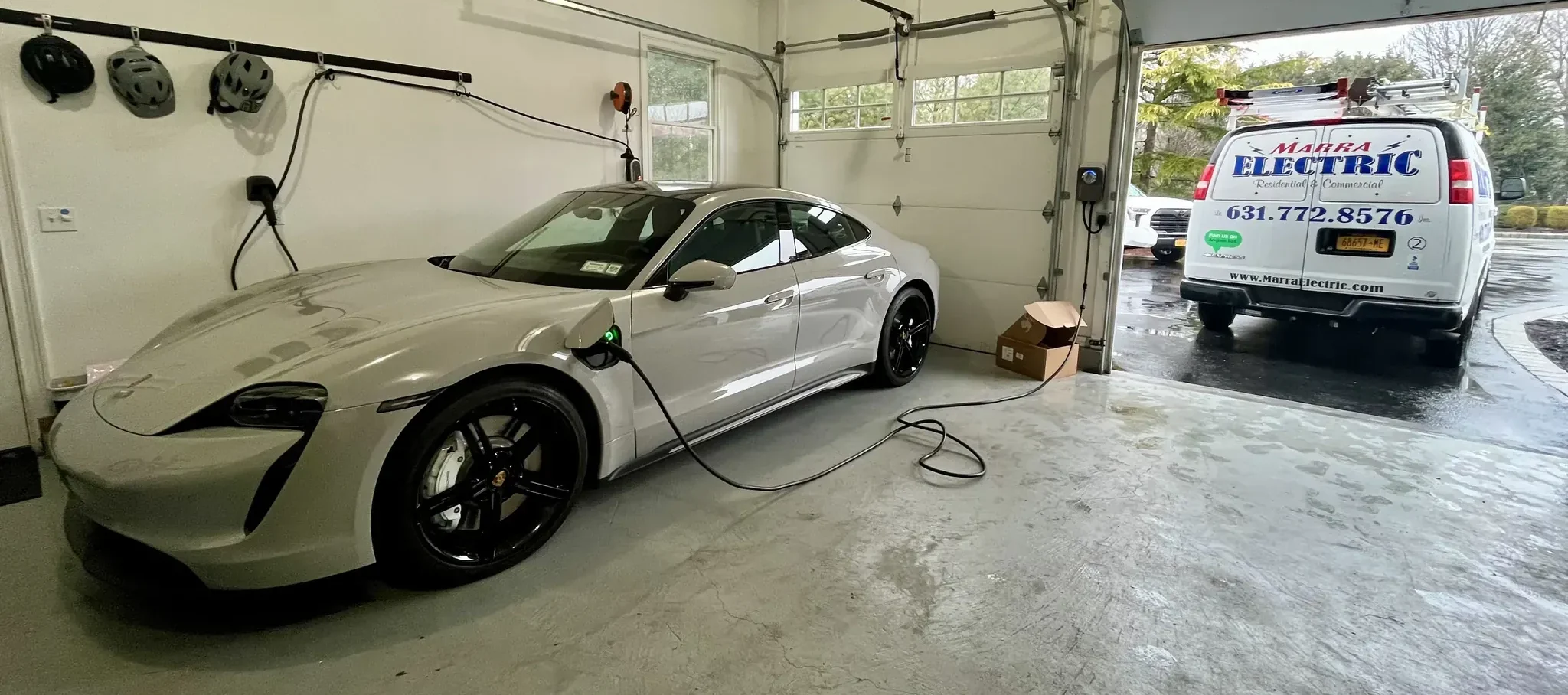
A white electric car charges in a garage, plugged into a wall outlet. Nearby, a cardboard box is on the floor. Outside, a Maria Electric commercial electrician Suffolk County service van is parked in the driveway on a rainy day.
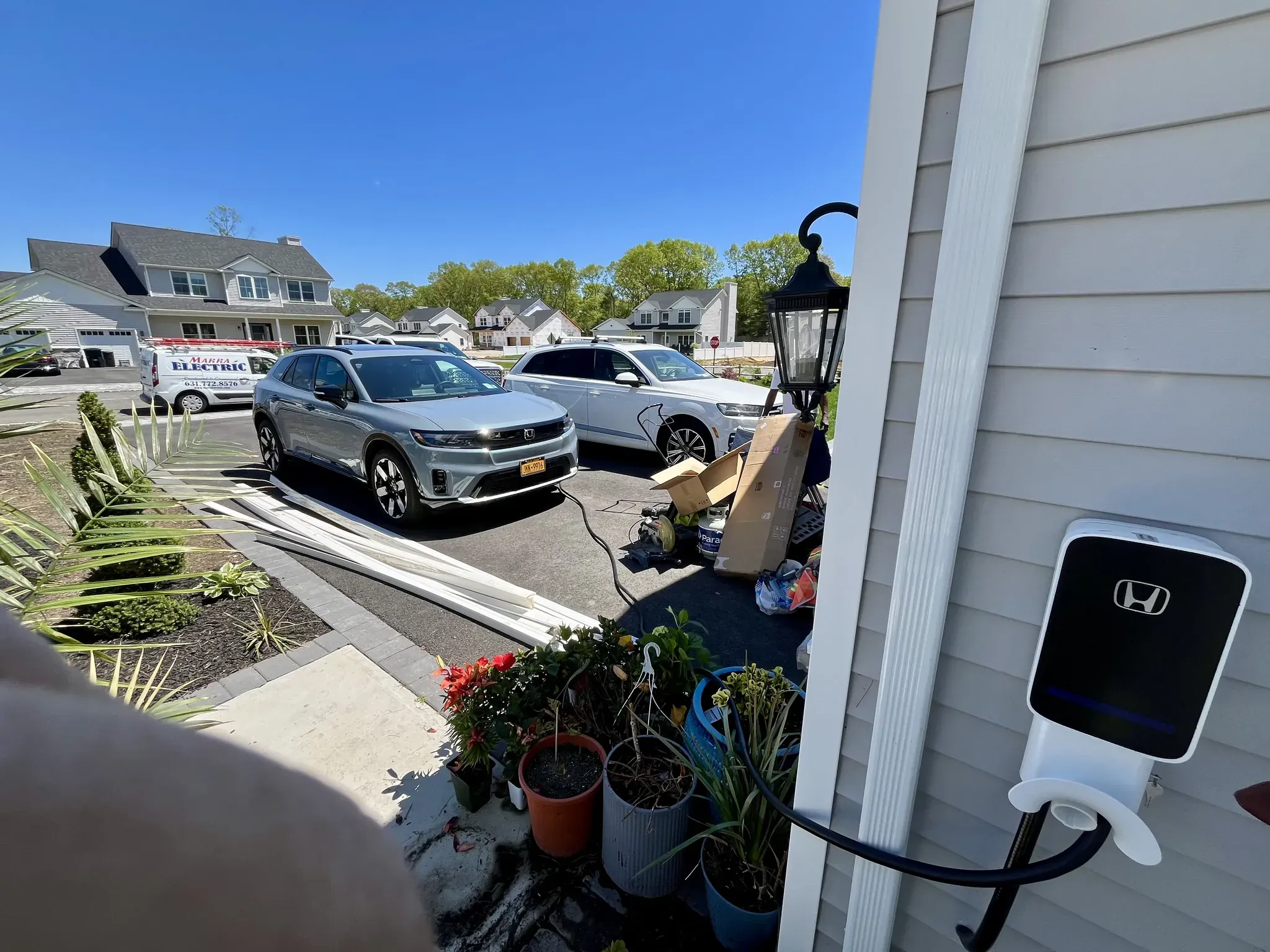
Two silver Honda electric vehicles are parked in a NY suburban driveway near a house. A Honda EV charger, expertly installed by a residential electrician Suffolk County, is mounted on the garage wall. It is a sunny day with plants and boxes nearby.

Home EV Charging Station Installation Noyack

Wake Up Fully Charged Every Single Morning

That portable charger that came with your Tesla or EV barely keeps up with your daily driving. You’re planning trips around public charging stations, waiting in lines, and paying premium rates for the convenience you thought an electric vehicle would give you.

A Level 2 EV charger installation in Noyack, NY changes that completely. You pull into your driveway, plug in, and by morning you’ve got a full charge—every time. No more range anxiety before heading to work or running weekend errands across Suffolk County.

Most Noyack homeowners save between $1,200 and $1,800 per year just on fuel costs alone. You’re charging during off-peak hours when electricity rates are lowest, never paying inflated public charging fees, and never stopping for gas again. Your driveway becomes your personal fueling station that never closes, never has lines, and never smells like petroleum.

The difference between Level 1 and Level 2 charging is the difference between trickling water from a garden hose versus filling a pool with a fire hose. Level 2 charging uses a 240-volt connection—the same power that runs your dryer—and can fully charge most EVs in just a few hours instead of waiting all night and still waking up to 60%.

Licensed EV Charger Electrician Noyack NY

Twenty Years Installing Electrical Systems in Suffolk County

We’ve been serving Noyack and all of Suffolk County since 2004. We’ve handled everything from panel upgrades in century-old homes to generator installations for seasonal properties to Tesla charger installation in Noyack, NY for the growing number of EV owners in the area.

Noyack has a unique housing profile—nearly 40% of homes here are seasonally occupied, and many properties have older electrical systems that weren’t designed for the continuous 30-50 amp draw that Level 2 chargers require. We’ve upgraded hundreds of panels across the East End, and we know exactly what your home needs before we start any work.

You’re not getting a crew that learned about EV chargers last month. You’re getting licensed electricians who’ve been doing this for two decades, who pull permits correctly the first time, and who’ve earned seven consecutive Angie’s List Super Service Awards because we show up on time, price everything upfront, and don’t leave until the job passes inspection.

A black electric car charges in a driveway, the cable plugged in. Two white Mario Electric vans—experts as a residential electrician Suffolk County—are parked on the street before suburban houses with autumn trees.

EVSE Installation Process Noyack NY

Here's Exactly What Happens From Call to Charge

You call us or request a free estimate online. We schedule a site visit to your Noyack property to assess your current electrical panel, measure the distance from your panel to where you park, and determine whether you need a panel upgrade to safely handle the charger.

Most homes in older Suffolk County neighborhoods are running 100-amp service, and adding a 40-50 amp EV charger on top of your existing load isn’t safe without upgrading to 200-amp service first. We’ll do a full load calculation right there and tell you exactly what’s required—no surprises, no upselling, just honest assessment based on National Electrical Code requirements and local Suffolk County regulations.

Once you approve the estimate, we handle the permit application with your local municipality. Some towns have streamlined EV charger permitting, others require more documentation—we know the process and we manage it entirely. Then we schedule installation at a time that works for you.

Installation day typically takes four to eight hours depending on whether we’re also upgrading your panel. We install the dedicated 240-volt circuit, mount your charging unit in the location you’ve chosen, ensure proper GFCI protection and weatherproof enclosures, and test everything thoroughly. Before we leave, we walk you through how to use your new home EV charging station and answer any questions. Then the town inspector comes out, signs off, and you’re charging that same evening.

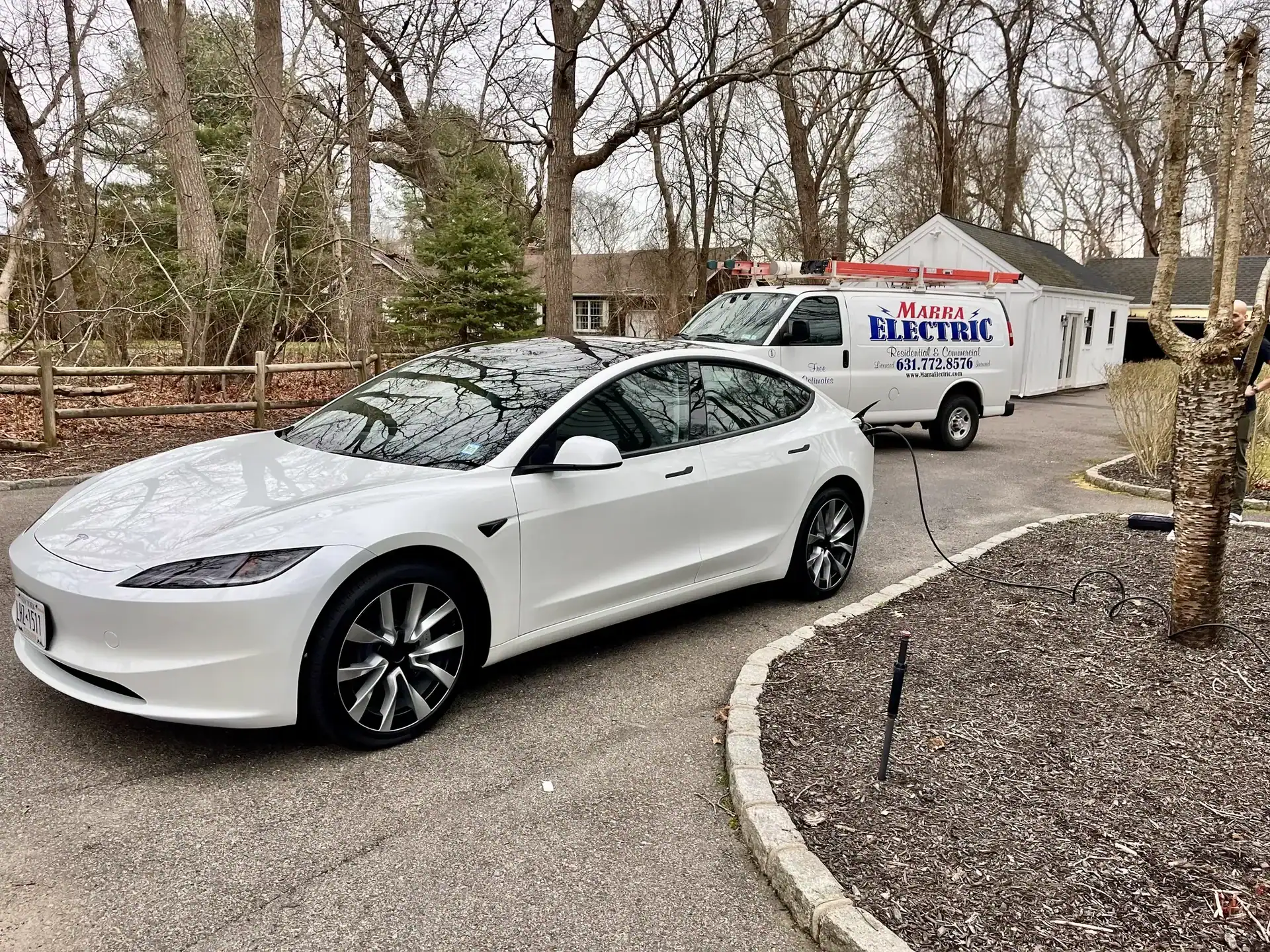
A white electric car is parked in a driveway, plugged in for charging. Nearby, a van labeled “Marra Electric,” a trusted residential electrician Suffolk County NY, is parked near a house surrounded by leafless trees and landscaping.

Explore More Services

About Marra Electric

Tesla Charger Installation Noyack NY

What's Included in Your Installation

Every electric car charger installation in Noyack, NY includes a complete electrical load assessment, permit application and management, installation of a dedicated 240-volt circuit with proper amperage for your specific charger model, GFCI protection as required by code, professional mounting of your charging unit, weatherproof enclosure if needed for outdoor installations, connection and testing, and coordination with the local inspector for final sign-off.

We install all major brands—Tesla Wall Connectors, ChargePoint Home, JuiceBox, Grizzl-E, and others. If you haven’t purchased a charger yet, we’ll recommend options based on your vehicle, your typical driving patterns, and your budget. We’re Tesla Approved Installers, which means we’re qualified to install Tesla Wall Connectors to exact Tesla specifications.

If your panel needs upgrading, we handle that too. Panel upgrades in Suffolk County typically run between $2,000 and $3,500 depending on your home’s specific requirements, and that work happens before we install the charger. You’ll have a modern, safer electrical system that can handle not just your EV charger but any future electrical needs.

Suffolk County residents have access to rebates and incentives that can offset installation costs significantly. PSEG Long Island offers rebates for EV chargers, federal tax credits are available for qualifying installations, and New York’s Drive Clean program provides additional incentives. We’ll walk you through what’s available and how to claim it—many Noyack homeowners reduce their total project cost by $1,000 to $1,500 or more.

A white electric car charges in a driveway from a wall-mounted charger, installed by a residential electrician Suffolk County, NY. Nearby are another car and a Manna Electric van. The sunny scene features trees and a house in the background.

How long does a Level 2 EV charger installation take in Noyack?

If your electrical panel can handle the additional load and doesn’t need upgrading, most installations take four to six hours from start to finish. We’re installing a dedicated 240-volt circuit, mounting the charger, making all connections, and testing everything before we leave.

If you need a panel upgrade—which is common in Noyack homes with older 100-amp service—plan on a full day or potentially two separate visits. We’ll upgrade your panel first, have that inspected, then return to install the charger. The permit process adds a few days to a week depending on your municipality’s current workload, but we manage all of that and keep you updated throughout.

You’re not waiting weeks or months. From your initial call to charging your car, most Noyack homeowners are up and running within one to two weeks, and that includes permitting, inspection, and any panel work that’s needed.

It depends on your current panel capacity and your home’s total electrical load. Most Level 2 chargers draw between 30 and 50 amps continuously, and your panel needs to safely support that on top of everything else running in your home—HVAC, water heater, appliances, lighting, and any other high-draw equipment.

Many older homes in Suffolk County are running 100-amp service, and adding an EV charger to a panel that’s already near capacity creates a fire hazard and violates code. We do a complete load calculation during your free estimate and tell you exactly whether an upgrade is necessary. If your panel is newer and you’ve got capacity, you’re good to go. If not, we’ll upgrade you to 200-amp service before installing the charger.

Panel upgrades aren’t just about the EV charger—you’re modernizing your home’s entire electrical system, which improves safety, increases property value, and gives you capacity for future needs. It’s the right way to do this work, and it’s the only way that passes inspection and keeps your homeowner’s insurance valid.

For a straightforward Level 2 charger installation where your panel has capacity and the charger location is reasonably close to your panel, expect to pay around $1,000 to $1,500 for the complete job including permits. That’s the typical range for most installations we do in Noyack and across Suffolk County.

If you need a panel upgrade, add another $2,000 to $3,500 depending on your home’s specific requirements. Longer wire runs, trenching for underground conduit, or complex installations where the charger is far from your panel can increase costs, but we price everything upfront during your free estimate so there are no surprises.

The charger unit itself is separate—those range from $400 to $700 for quality residential models, though Tesla Wall Connectors and some premium units run higher. Between PSEG rebates, federal tax credits, and New York state incentives, many homeowners recover $1,000 to $1,500 of their total project cost. We’ll walk you through what’s available and how to claim it.

Not legally, and not safely. Suffolk County requires licensed electricians to perform this work, and your town won’t issue a permit to a homeowner for EV charger installation. Even if you’re handy and comfortable with electrical work, this isn’t a DIY project.

Level 2 chargers require 240-volt dedicated circuits with specific amperage, GFCI protection, proper grounding, and weatherproof enclosures if installed outdoors. One mistake—undersized wire, improper connections, inadequate grounding—creates serious fire hazards and puts your family at risk. Your homeowner’s insurance won’t cover damage from unpermitted electrical work, and you’ll have major problems if you ever try to sell your home.

Professional installation costs around $1,000 for the labor and permits. That’s a small price for work that’s done right, passes inspection, protects your insurance coverage, and gives you a safe, reliable charging system that’ll last for years. We’ve fixed plenty of botched DIY electrical jobs, and the repair costs always exceed what professional installation would have cost in the first place.

Yes, your electric bill will go up—but you’re saving far more on gas than you’re spending on electricity. Charging an EV at home costs roughly $0.03 to $0.04 per mile, compared to $0.07 to $0.14 per mile for gasoline depending on current gas prices and your vehicle’s fuel efficiency.

Most Noyack homeowners with EVs see their electric bills increase by $30 to $60 per month depending on how much they drive, but they’re eliminating $150 to $200 in monthly gas expenses. The net savings are significant—typically $1,200 to $1,800 per year for average drivers. If you charge during off-peak hours when PSEG rates are lowest, your costs drop even further.

Your actual costs depend on your vehicle’s battery size, your driving habits, and when you charge. A Tesla Model 3 with a 75 kWh battery costs about $9 to fully charge at current Long Island electricity rates. If you’re driving 12,000 miles per year, you’re spending roughly $400 to $500 annually on electricity versus $1,800 to $2,200 on gas for a comparable gasoline vehicle.

Start with your vehicle’s onboard charger capacity—that determines how fast your car can actually accept a charge regardless of what the charging unit can deliver. Most EVs can handle 30 to 48 amps, though some newer models accept higher rates. There’s no benefit to installing a 60-amp charger if your car maxes out at 32 amps.

Consider whether you want a hardwired unit or one with a plug. Hardwired installations are cleaner and more permanent, while plug-in units give you flexibility if you move or upgrade chargers later. Think about cord length too—you want enough reach to comfortably plug in without stretching the cable, but longer cords cost more and create clutter.

Tesla owners often choose the Tesla Wall Connector because it integrates seamlessly with their vehicle and app. Other popular options include ChargePoint Home Flex, JuiceBox, and Grizzl-E—all quality units with good track records. We’ll recommend specific models based on your vehicle, your budget, and your priorities during your free estimate. The differences between quality chargers are relatively minor; what matters most is proper installation by licensed electricians who know Suffolk County codes and permitting requirements.

Other Services we provide in Noyack