EV Charger Installation in Quogue, NY

Wake Up to a Full Charge Every Morning

Your portable charger isn’t cutting it anymore. Get a Level 2 EV charger installation in Quogue, NY that actually keeps up with your daily drive.
[Add Trustindex Button Here]
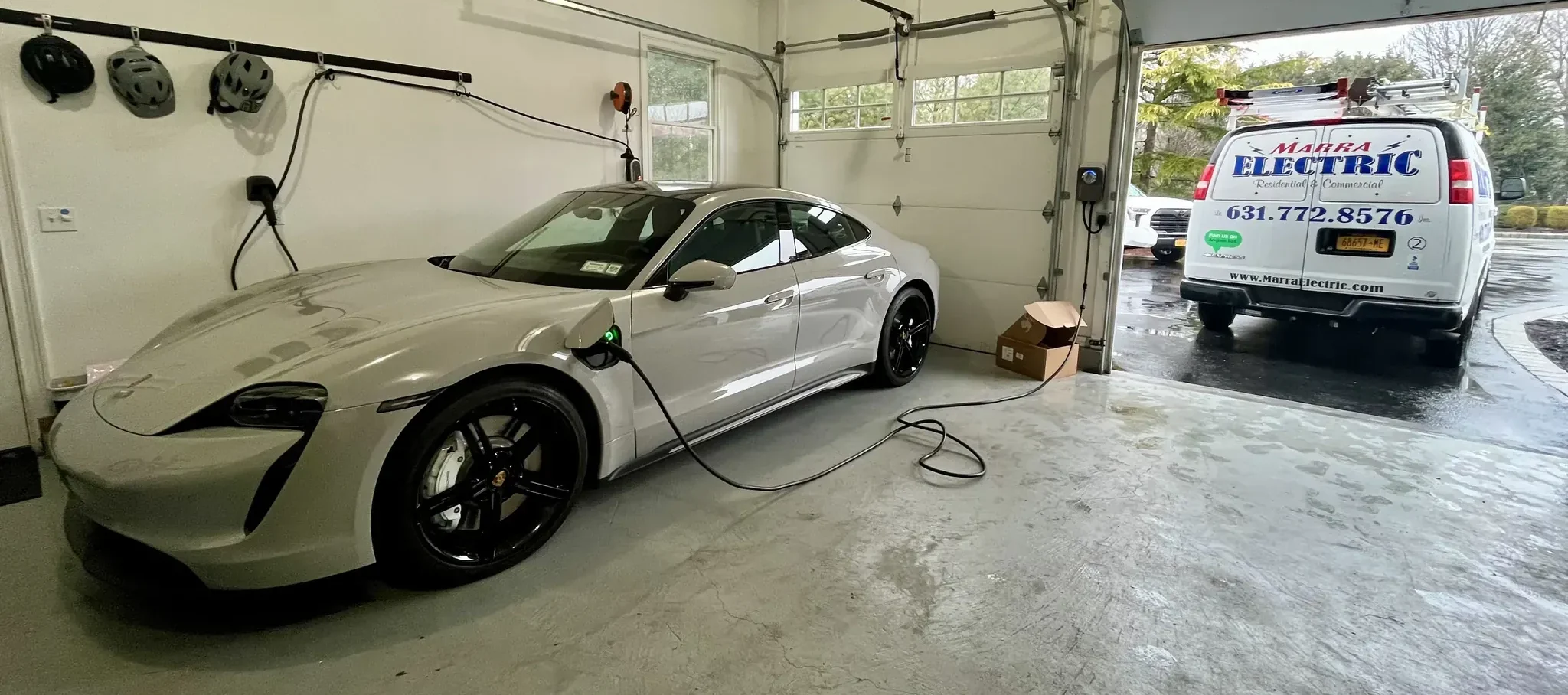
A white electric car charges in a garage, plugged into a wall outlet. Nearby, a cardboard box is on the floor. Outside, a Maria Electric commercial electrician Suffolk County service van is parked in the driveway on a rainy day.
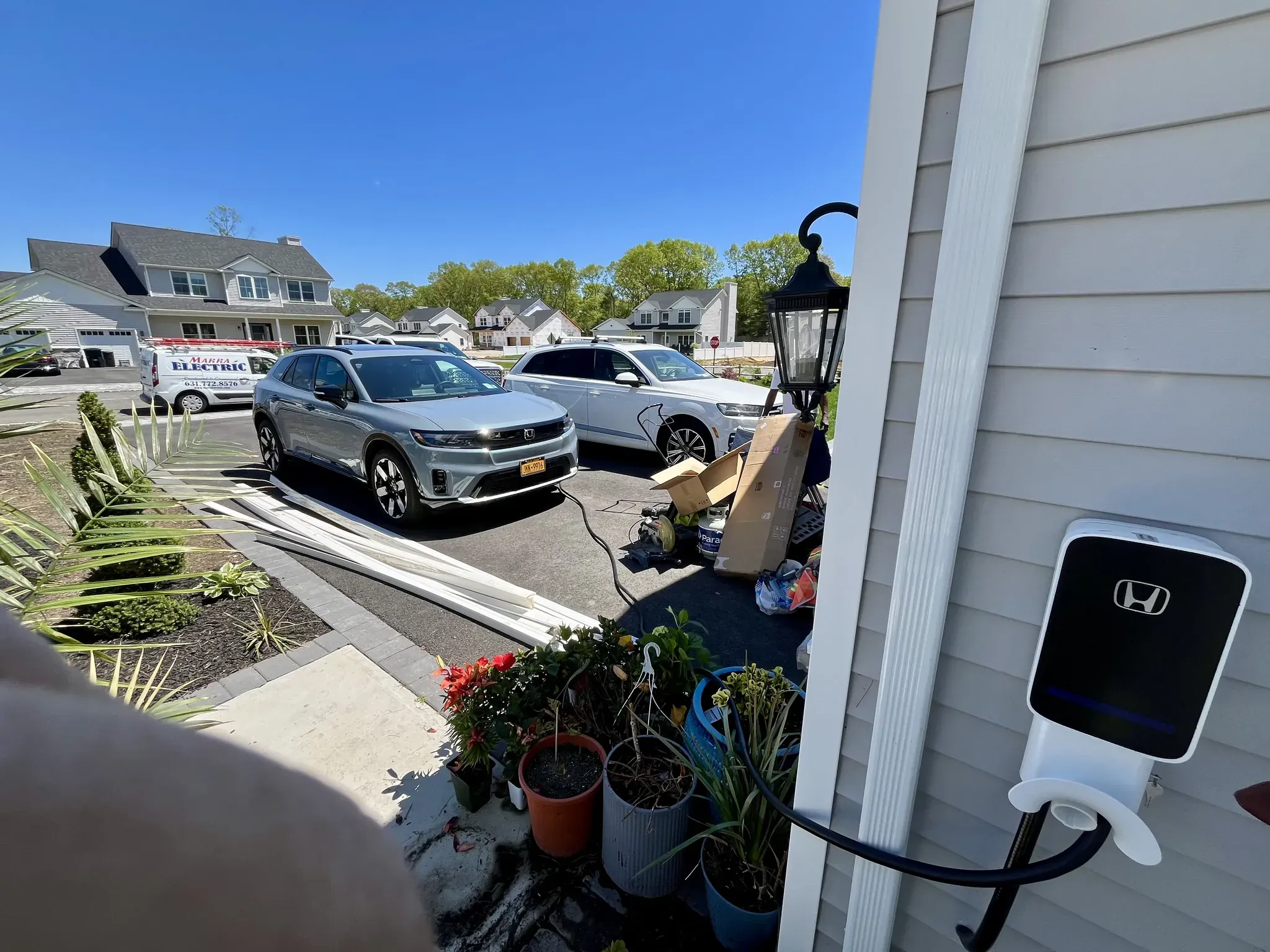
Two silver Honda electric vehicles are parked in a NY suburban driveway near a house. A Honda EV charger, expertly installed by a residential electrician Suffolk County, is mounted on the garage wall. It is a sunny day with plants and boxes nearby.

Home EV Charging Station Installation Quogue

Stop Planning Your Life Around Public Chargers

You bought an electric vehicle for convenience. But if you’re still using that Level 1 portable charger, you’re getting about 4 miles of range per hour. That means overnight charging barely covers your commute, and you’re back to mapping out charging stops like it’s a road trip.

A Level 2 EV charger installation in Quogue, NY changes that. You’ll add 25 to 40 miles of range per hour, which means your car is fully charged every morning while you sleep. No more sitting at public stations. No more range anxiety on the way home.

Your electrical panel gets checked first. If your home was built before 2000, there’s a good chance you’re running on 100-amp service, which won’t support a Level 2 charger without an upgrade. We assess that upfront so you know exactly what’s needed before any work starts.

Licensed EV Charger Electrician Quogue NY

We've Been Doing This Since 2004

We’ve been handling electrical work across Suffolk County for over 20 years. We’re not new to this, and we’re not learning on your driveway. Every Tesla charger installation in Quogue, NY we complete is done by licensed, background-checked electricians who know the local codes and permit requirements.

Quogue homeowners deal with older electrical infrastructure more often than newer developments. Many homes here were built when 100-amp panels were standard, and adding a 40 or 50-amp EV charger means upgrading that panel first. We handle that assessment, the permit application, the installation, and the inspection—all of it.

You get upfront pricing before we start. No surprises, no change orders halfway through the job. We show up in marked vehicles, we finish the work the same day when possible, and we back it with a 100% satisfaction guarantee.

A black electric car charges in a driveway, the cable plugged in. Two white Mario Electric vans—experts as a residential electrician Suffolk County—are parked on the street before suburban houses with autumn trees.

EVSE Installation Process Quogue NY

Here's What Happens From Start to Finish

First, we inspect your electrical panel. Most EVSE installation projects in Quogue, NY start here because your current setup determines everything else. If you’re on 100-amp service and already running central air, a dryer, and other high-draw appliances, you’ll need a panel upgrade to 200 amps. We’ll tell you that upfront.

Next, we map the route from your panel to where you want the charger installed. If your garage is attached and close to the panel, installation is straightforward. If it’s detached or far from the house, we may need to trench and run conduit underground. Distance affects cost, and we factor that into your estimate before starting.

Then we handle the permit. Suffolk County requires permits for Level 2 EV charger installation, and each municipality has its own process. We submit the application, schedule the inspection, and make sure everything passes the first time. You don’t have to call anyone or wait in line at the town office.

Installation day is usually the same day we start. We mount the charger, run the wiring, connect everything to your panel, and test it. Once the inspector signs off, you’re done. Plug in that night and wake up to a full battery.

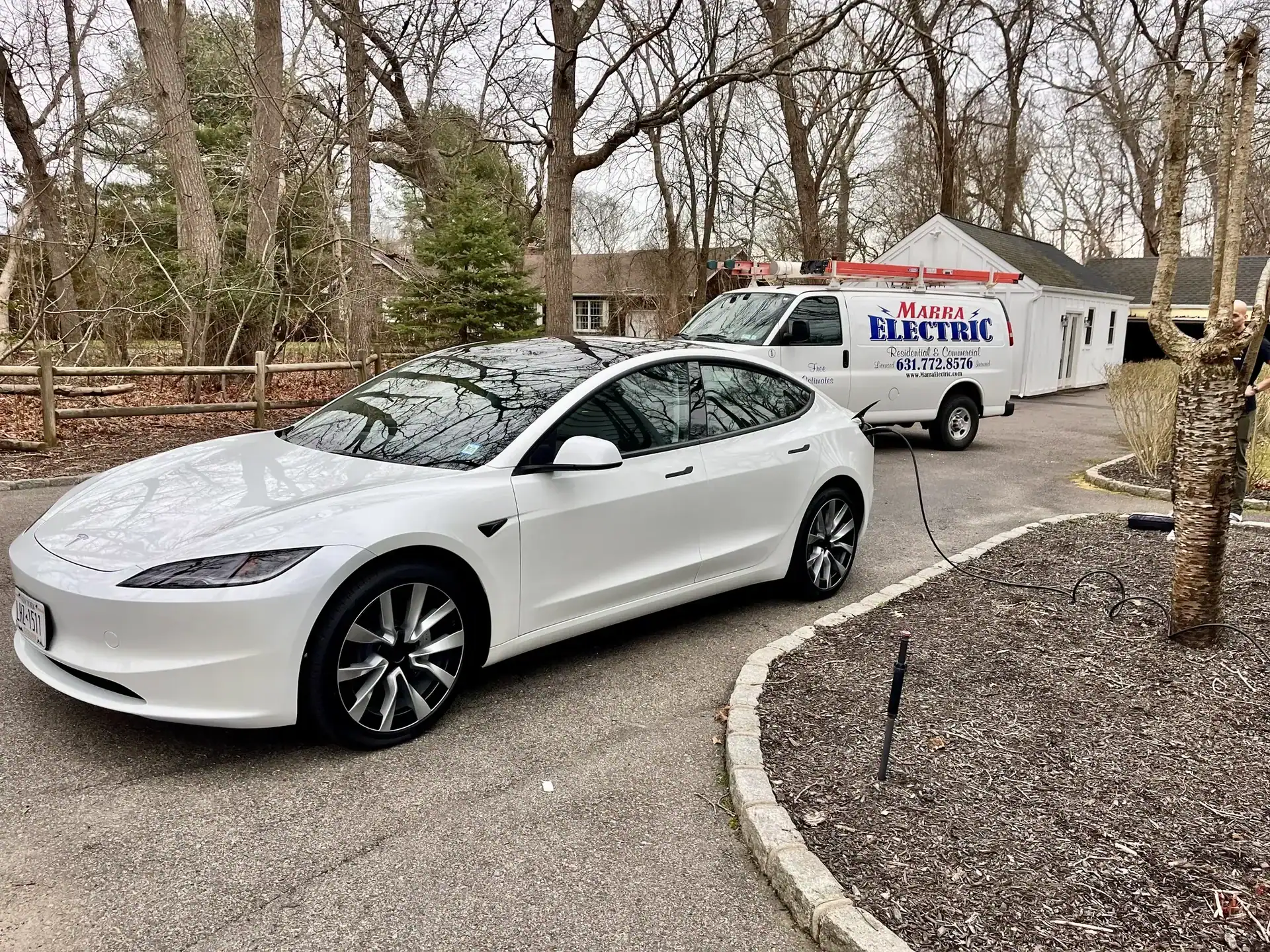
A white electric car is parked in a driveway, plugged in for charging. Nearby, a van labeled “Marra Electric,” a trusted residential electrician Suffolk County NY, is parked near a house surrounded by leafless trees and landscaping.

Explore More Services

About Marra Electric

Electric Car Charger Installation Quogue NY

What's Included in Your Installation

Every electric car charger installation in Quogue, NY includes a full panel assessment. We check your current amperage, available breaker slots, and whether your service can handle the additional load. If it can’t, we provide a clear quote for the upgrade and explain why it’s necessary.

You also get permit handling as part of the service. We’re registered with local townships, and we know exactly what Suffolk County inspectors look for. Permit fees typically run $150 to $350 depending on the scope, and we include that in your estimate. The inspection is scheduled after installation, and we’re there to walk through it with the inspector.

Quogue homeowners installing Tesla chargers get the benefit of our Tesla certification. We’ve installed hundreds of these units, and we know the specific requirements Tesla recommends for optimal charging speed and safety. Whether you’re installing a Tesla Wall Connector or a universal Level 2 charger, the process is the same—we just make sure it’s done to the manufacturer’s specs.

If your installation requires trenching for a detached garage, we handle that too. Conduit is buried to code depth, wiring is protected, and everything is sealed and inspected. You’re not coordinating between an electrician and a separate contractor. It’s all part of the same job.

A white electric car charges in a driveway from a wall-mounted charger, installed by a residential electrician Suffolk County, NY. Nearby are another car and a Manna Electric van. The sunny scene features trees and a house in the background.

How much does a Level 2 EV charger installation cost in Quogue, NY?

Most installations in Suffolk County run between $1,200 and $2,800, but your final cost depends on three main factors. First is your electrical panel. If you’re on 100-amp service, you’ll need an upgrade to 200 amps, which adds $1,800 to $2,500 to the project. Homes built before 1990 almost always need this upgrade.

Second is the distance from your panel to the charger location. If your garage is attached and within 20 feet of the panel, labor and materials stay low. If it’s detached or across the property, you’re looking at trenching, conduit, and additional wire runs. That can add $500 to $1,200 depending on distance.

Third is the permit and inspection fees. Suffolk County requires permits for this work, and fees range from $150 to $350 depending on the municipality. The inspection adds another $100 to $200. We include all of that in your upfront quote so there’s no confusion when the bill comes.

Technically, yes. Practically, no. DIY installations void your charger’s warranty, and they almost never pass inspection. Suffolk County requires a licensed electrician to pull the permit, and inspectors will ask to see proof of licensing before signing off. If you install it yourself, you won’t get the permit, which means you can’t legally use it.

There’s also the safety issue. A Level 2 charger pulls 40 to 50 amps continuously, which is more than your dryer or oven. If your wiring isn’t sized correctly, your breaker isn’t rated properly, or your connections aren’t tight, you’re creating a fire hazard. Electrical fires from improper EV charger installations are becoming more common as more people try to DIY it.

And if something goes wrong—if the charger fails, if your panel trips repeatedly, if your home insurance finds out it wasn’t installed by a licensed professional—you’re on the hook for all of it. The money you save upfront gets eaten by repairs, re-installation, or worse. It’s not worth it.

If your panel is ready and the charger location is straightforward, most installations are done in one day. We’re talking 4 to 6 hours from start to finish, including mounting the unit, running the wiring, connecting to your panel, and testing everything. You can plug in that same night.

If you need a panel upgrade, add another day. Panel upgrades take 6 to 8 hours depending on the complexity, and they require a separate inspection before we can proceed with the charger installation. We schedule both inspections back-to-back when possible so you’re not waiting weeks between steps.

Detached garages or long wire runs can extend the timeline if trenching is involved. We need to dig, lay conduit, pull wire, and backfill—all to code depth and with proper protection. That adds a day or two depending on distance and ground conditions. Weather can delay trenching, but the actual electrical work stays on schedule once the conduit is in place.

Yes. Suffolk County requires an electrical permit for any Level 2 EV charger installation, and Quogue follows those requirements. The permit ensures your installation meets New York State electrical code, which covers wire sizing, breaker ratings, grounding, and panel capacity. It’s not optional, and skipping it can cause problems when you sell your home.

The permit process starts with an application that includes your charger specs, panel details, and installation plan. We submit that to the town, pay the fee (usually $150 to $350), and schedule the rough-in inspection if needed. Once the charger is installed, the final inspection happens. The inspector checks connections, verifies wire size, tests the breaker, and signs off.

Some homeowners try to skip the permit to save money or time. That’s a mistake. If your insurance company finds out you added a high-draw appliance without a permit, they can deny claims related to electrical issues. And when you sell, the buyer’s home inspector will spot the unpermitted work, which can kill the deal or force you to rip it out and reinstall it properly.

Yes, but not as much as you’d think—and it’s still cheaper than gas. Charging a typical EV with a 60 kWh battery from empty to full costs about $7 to $9 based on current Long Island electricity rates. If you’re charging every night, that’s roughly $210 to $270 per month. Compare that to $300+ for gas if you’re driving the same distance, and you’re still saving.

Most EV owners in Quogue don’t charge from empty every night. You’re topping off 30% to 50% of the battery, which cuts that cost in half. And if you charge overnight during off-peak hours, some utility plans offer lower rates that reduce costs even further. Check with PSEG Long Island to see if you qualify for time-of-use pricing.

The federal tax credit also helps offset installation costs. You can claim 30% of your installation expenses, up to $1,000, when you file taxes. That doesn’t reduce your electric bill, but it makes the upfront investment easier to swallow. Combined with lower fuel costs, most Quogue homeowners break even on the installation within two years.

Level 1 chargers plug into a standard 120-volt outlet and add about 3 to 5 miles of range per hour. They’re fine if you drive 20 miles a day and can leave your car plugged in for 12+ hours. But if you’re commuting 60+ miles daily or you need your car ready faster, Level 1 charging won’t keep up. You’ll spend your weekends sitting at public chargers just to catch up.

Level 2 chargers run on 240 volts—the same as your dryer or oven—and add 25 to 40 miles of range per hour depending on your car and charger model. That means a full charge happens in 4 to 6 hours instead of 20+. You plug in when you get home, and your car is ready the next morning. No planning, no public charging, no range anxiety.

The trade-off is installation cost. Level 1 chargers come with your car and don’t require any electrical work. Level 2 chargers need a dedicated 240-volt circuit, a permit, and usually a panel upgrade if your home is older. But once it’s in, you’re done. You’ve got a home charging station that works as long as you own an EV, and it adds value to your property if you sell.

Other Services we provide in Quogue