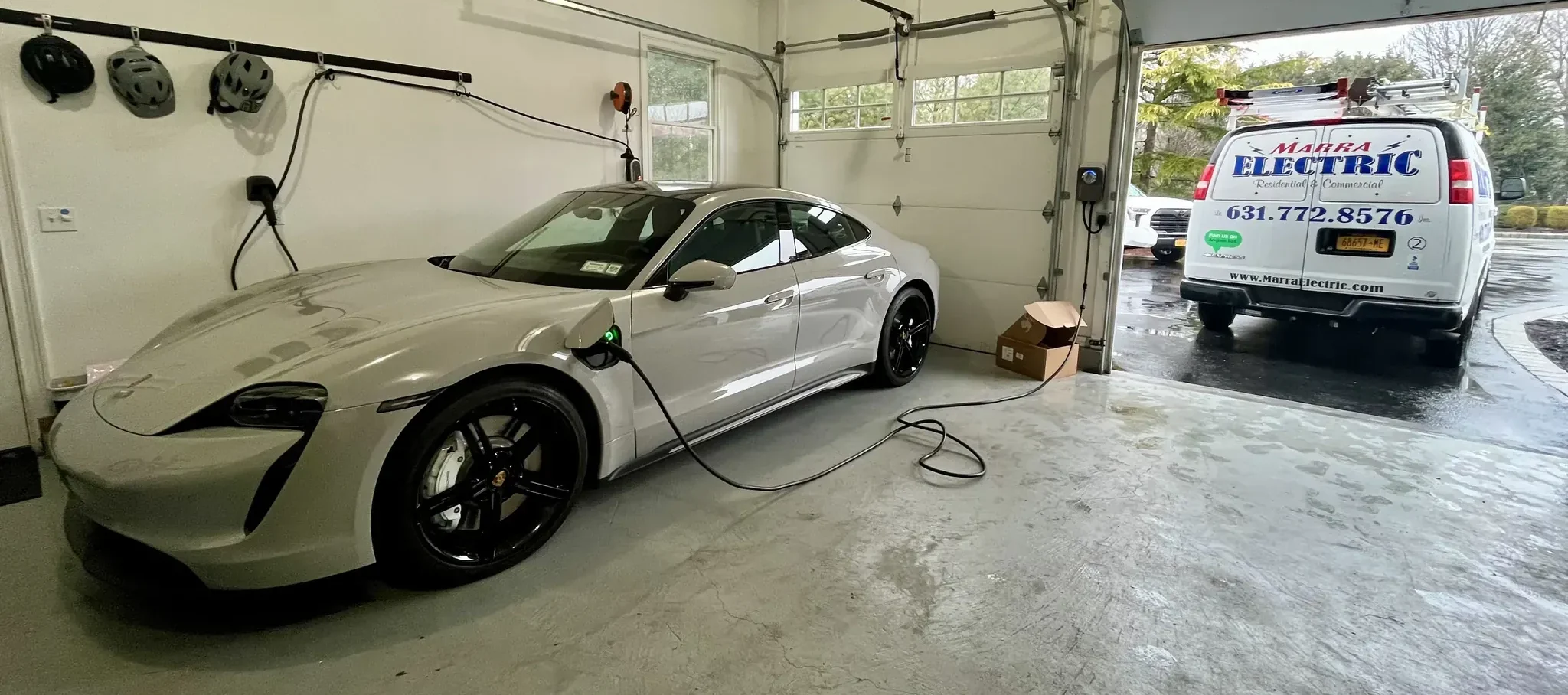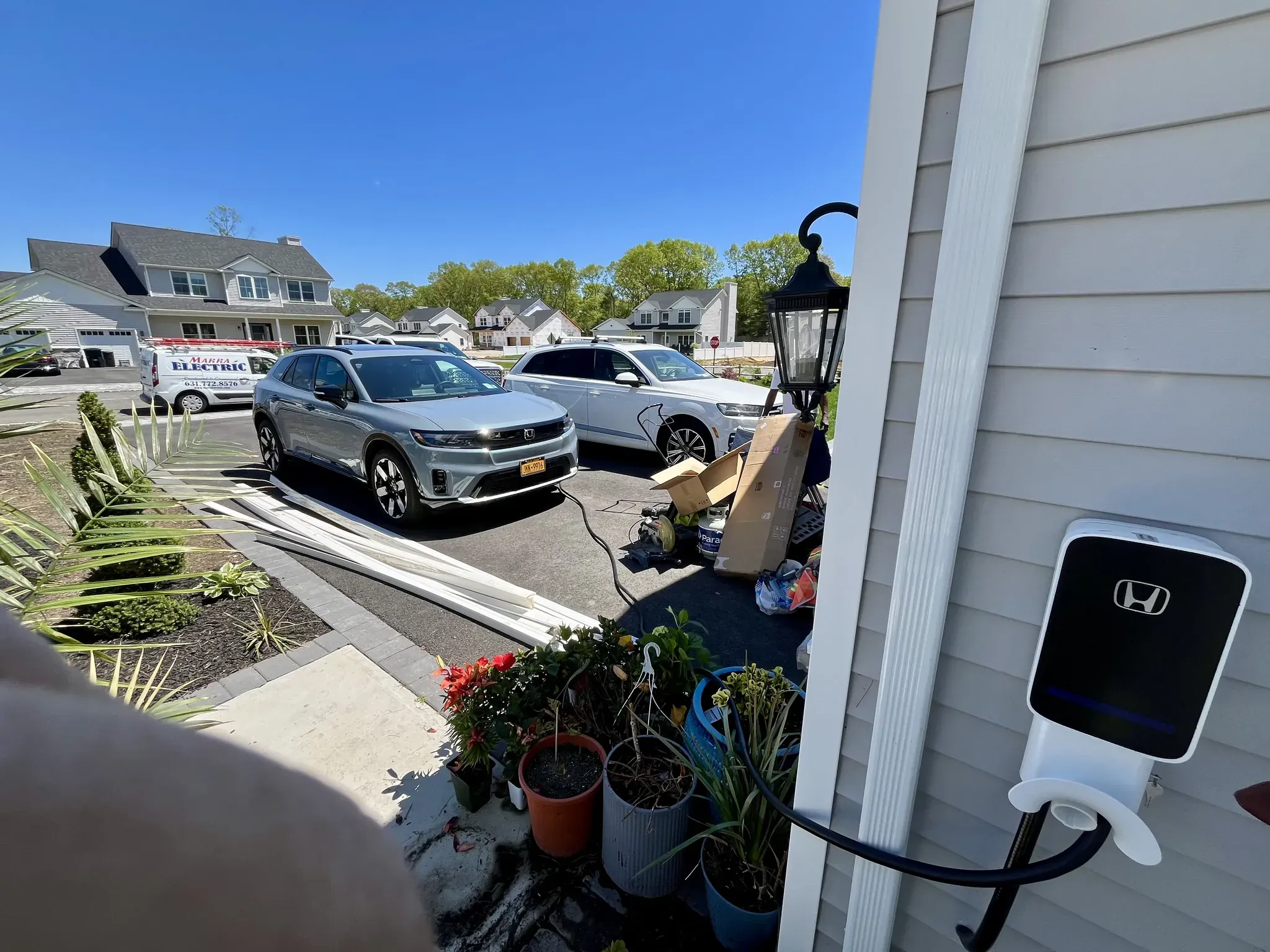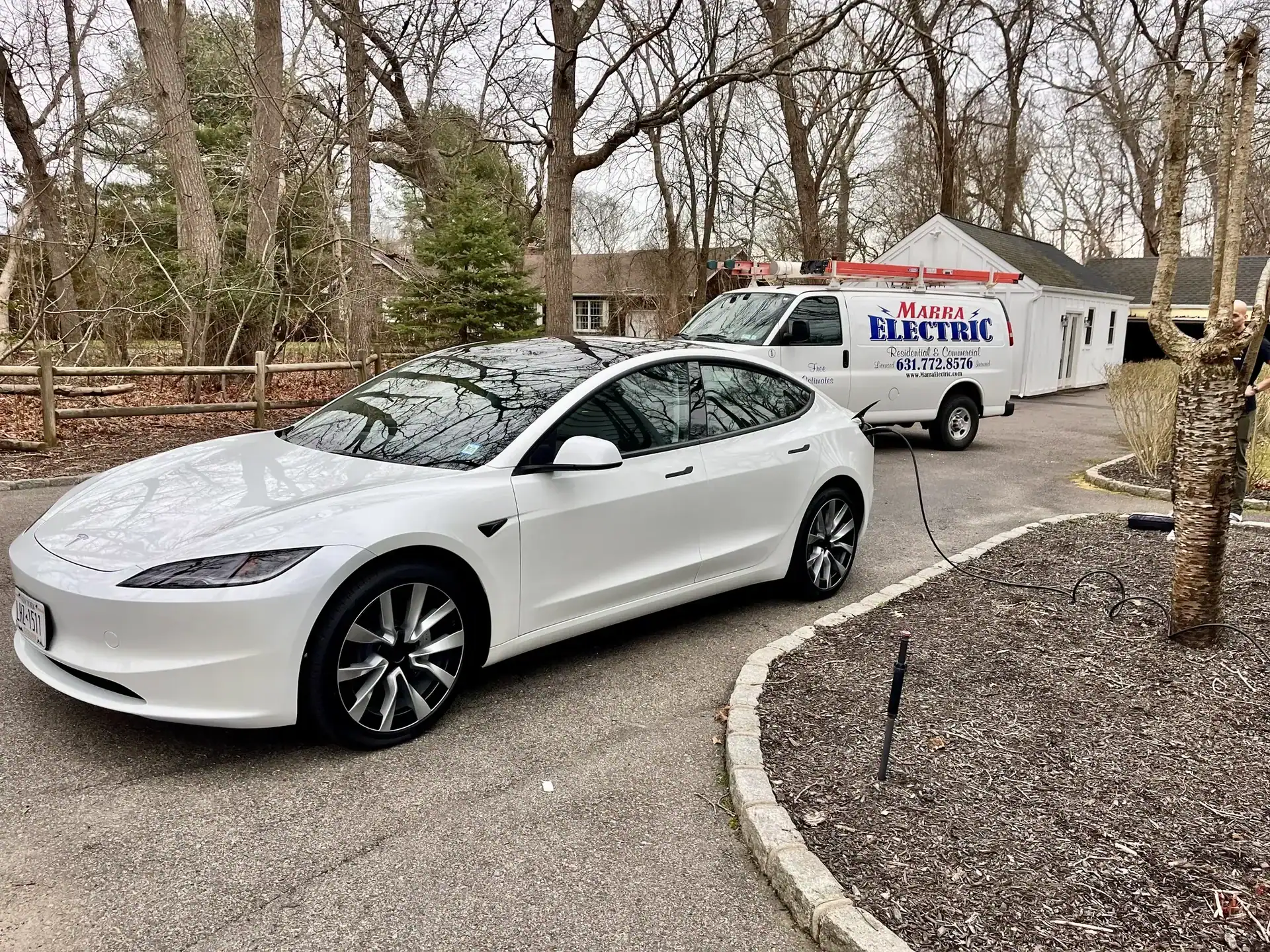
If you’re driving to Manhattan and back, that’s easily 100+ miles round trip. Your portable Level 1 charger adds maybe 4 miles of range per hour. Do the math—that doesn’t work.
A Level 2 home EV charging station installation changes everything. You’re looking at 25 to 40 miles of range added per hour, which means most EVs charge fully overnight in 4 to 8 hours. Pull into your driveway, plug in, and you’re done. No apps. No waiting at public chargers. No calculating whether you’ll make it home.
For Sagaponack homeowners, especially those commuting long distances or managing multiple vehicles, this isn’t a luxury. It’s how you make owning an EV actually practical. And when your electrical system is set up correctly from the start, you’re not dealing with tripped breakers, fire hazards, or voided insurance down the line.
We’ve been serving Suffolk County for over 20 years. We’re fully licensed, insured, and we’ve earned the Angie’s List Super Service Award seven years running. That doesn’t happen by accident.
We handle everything—permits, inspections, panel upgrades, trenching for detached garages. You’re not coordinating five different people or wondering if your installation will pass code. We know Suffolk County’s electrical requirements inside and out, and we’ve done hundreds of these installations across the area.
When you call us, you get upfront pricing, a free estimate, and a team that shows up in branded vehicles wearing uniforms. No surprises. No runaround. Just straightforward work done right the first time, with a 100% satisfaction guarantee backing it up.
First, we come out and assess your current electrical setup. Most homes in Sagaponack built before 1990 weren’t designed to handle the load from a Level 2 EV charger installation. If your panel’s already running near capacity with AC, appliances, and everything else, we’ll need to upgrade it. That’s not upselling—it’s code compliance and safety.
Once we know what your system can handle, we pull the necessary permits. In Suffolk County, nearly every EVSE installation requires a permit and inspection. We handle all of that. You don’t touch paperwork.
Then we install the charger where it makes sense—usually in your garage or outside near where you park. If your garage is detached, we trench and run conduit underground. If we need to cut concrete or restore landscaping, we do that too. Everything gets inspected, signed off, and you’re left with a charging setup that works every single night without issue.
Ready to get started?
When we do an electric car charger installation in Sagaponack, NY, you’re getting a complete electrical infrastructure evaluation. That includes load calculations, panel inspection, and a clear recommendation on whether you need an upgrade. If you do, that panel upgrade isn’t just for your EV—it supports your whole home’s electrical needs for the next 20+ years.
We also handle the charger selection. Whether you’re installing a Tesla Wall Connector or another Level 2 unit, we make sure it’s compatible with your vehicle and properly rated for your electrical system. Some chargers are hardwired. Some use a plug. We’ll walk you through what makes sense for your setup.
And because this is Suffolk County, we’re dealing with specific code requirements that differ from Nassau County or New York City. We know what inspectors are looking for. We know which municipalities have streamlined permit processes and which ones take longer. That local knowledge saves you time and headaches you didn’t even know were coming.
It depends on your current electrical setup and where you want the charger installed. If your panel has capacity and the charger goes in an attached garage with a short run, you’re looking at the lower end. If we need to upgrade your panel, trench across your property to a detached garage, or run 50+ feet of conduit, the price goes up.
Panel upgrades are common in older Sagaponack homes. Most panels installed before 1990 weren’t built to handle today’s electrical load—central AC, modern appliances, and now a 40-amp EV charger. Upgrading your panel isn’t just about the charger. It’s about making sure your entire electrical system is safe and code-compliant.
We give you a free estimate with upfront pricing. No surprises, no hidden fees. You’ll know exactly what you’re paying before we start, and that price includes permits, inspections, and any restoration work needed after installation.
Yes. Nearly every Level 2 EV charger installation in Sagaponack, NY requires an electrical permit and inspection. This isn’t optional, and it’s not something you want to skip.
Permits exist to make sure the work is done safely and meets code. If you install a charger without a permit and something goes wrong—a fire, an electrical fault, anything—your homeowner’s insurance can deny your claim. You’re also on the hook if you ever sell the house and the unpermitted work gets flagged during inspection.
We handle all the permit paperwork and scheduling. Suffolk County has different requirements than other areas, and some towns have faster review processes than others. We know the local process, so you’re not stuck waiting or dealing with rejections because something wasn’t filled out right.
Level 1 is the portable charger that came with your car. It plugs into a standard 120-volt outlet and adds about 3 to 5 miles of range per hour. If you’re only driving 20 miles a day and can leave it plugged in overnight, it works. But for most people—especially anyone commuting to Manhattan or running errands around Suffolk County—it’s painfully slow.
Level 2 chargers run on 240 volts, the same as your dryer or oven. They add 25 to 40 miles of range per hour, which means a full charge in 4 to 8 hours depending on your battery size. That’s the difference between waking up to a half-charged car and waking up to a full one, ready to go.
Level 2 installation does require a licensed electrician, a dedicated circuit, and usually a permit. But once it’s in, you’re not thinking about charging anymore. It just works, every night, without planning.
Maybe. Most EV chargers pull between 30 and 50 amps. If your panel is already running close to capacity—and many older Sagaponack homes are—you’ll need an upgrade before we can safely install the charger.
We do a full load calculation during the estimate. That means looking at what your home is currently using, what the charger will add, and whether your panel and service can handle it. If your home was built in the ’70s or ’80s and still has the original 100-amp or 150-amp panel, there’s a good chance you’ll need a 200-amp upgrade.
Panel upgrades aren’t just about the EV charger. They future-proof your home for other electrical needs—more appliances, a second EV, a backup generator, whatever comes next. And they’re required by code if your current system can’t safely support the load.
If your panel has capacity and the charger is going in an attached garage, we can usually complete the installation in one day. That includes running the circuit, mounting the charger, connecting everything, and testing it.
If you need a panel upgrade, add another day or two depending on the scope of work. If we’re trenching to a detached garage or running conduit across your property, that adds time as well—usually a few extra days depending on distance and what we’re cutting through.
Permit approval times vary by town in Suffolk County. Some municipalities turn permits around in a few days. Others take a couple of weeks. Once the permit is approved and the work is done, the inspection usually happens within a week. We coordinate all of that so you’re not chasing anyone down or waiting around wondering what’s next.
It positions your home better for buyers who already own an EV or are planning to buy one. And that’s a growing number of people. In New York State, nearly 79,000 new EVs hit the road in 2023. Suffolk County is transitioning its entire fleet to electric by 2030. This isn’t a trend that’s slowing down.
A properly installed Level 2 charger shows that your home’s electrical system can handle modern demands. It’s an infrastructure upgrade, not just a gadget. And if you’ve also upgraded your panel as part of the installation, that’s even more appealing to buyers who want a home that’s ready for the next 20 years.
The bigger value isn’t resale—it’s the $1,200 to $1,800 you save every year on fuel costs by charging at home instead of paying for gas or using expensive public chargers. That adds up fast, and it makes EV ownership actually make sense financially.
Other Services we provide in Sagaponack