EV Charger Installation in Village of the Branch, NY

Charge at Home Without the Guesswork or Risk

We’re licensed electricians who handle your electric car charger installation in Village of the Branch from panel assessment to final inspection—no surprises, no shortcuts.
[Add Trustindex Button Here]
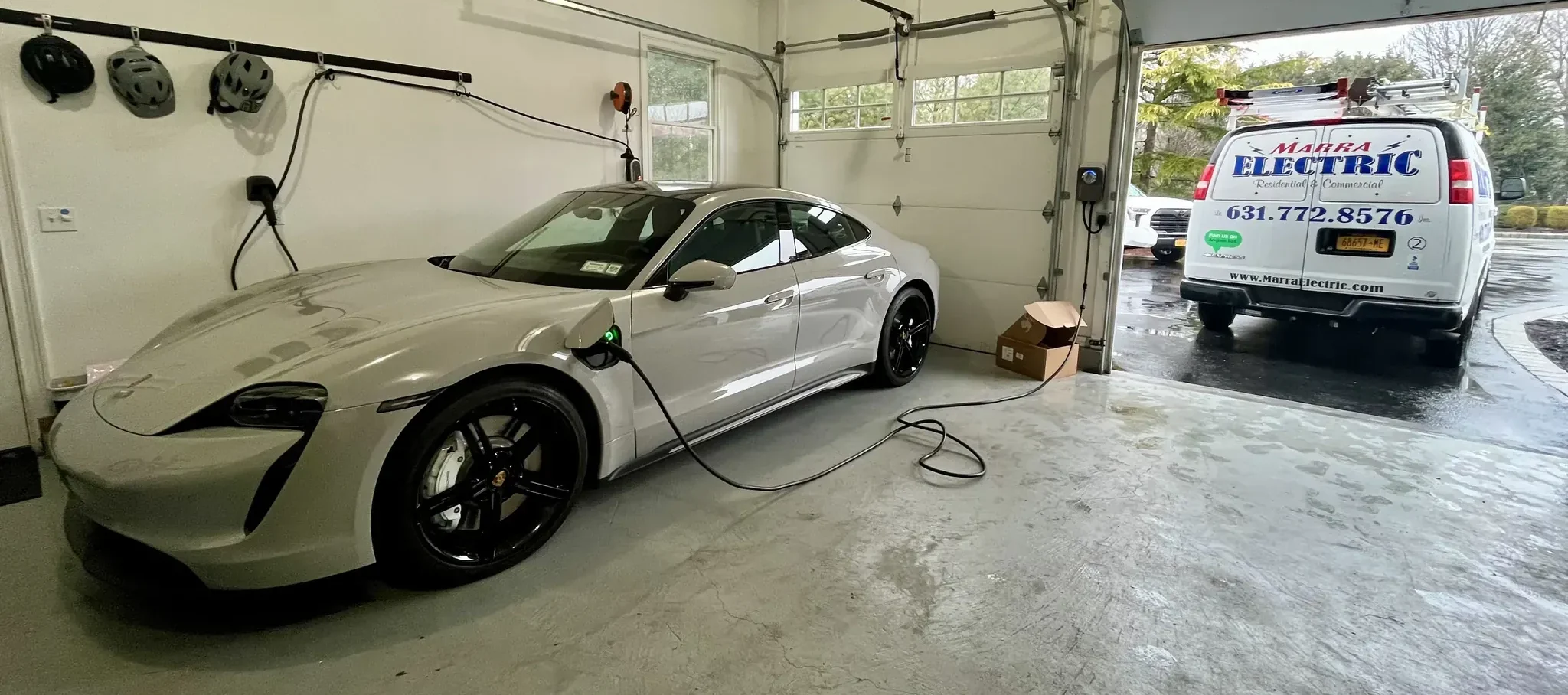
A white electric car charges in a garage, plugged into a wall outlet. Nearby, a cardboard box is on the floor. Outside, a Maria Electric commercial electrician Suffolk County service van is parked in the driveway on a rainy day.
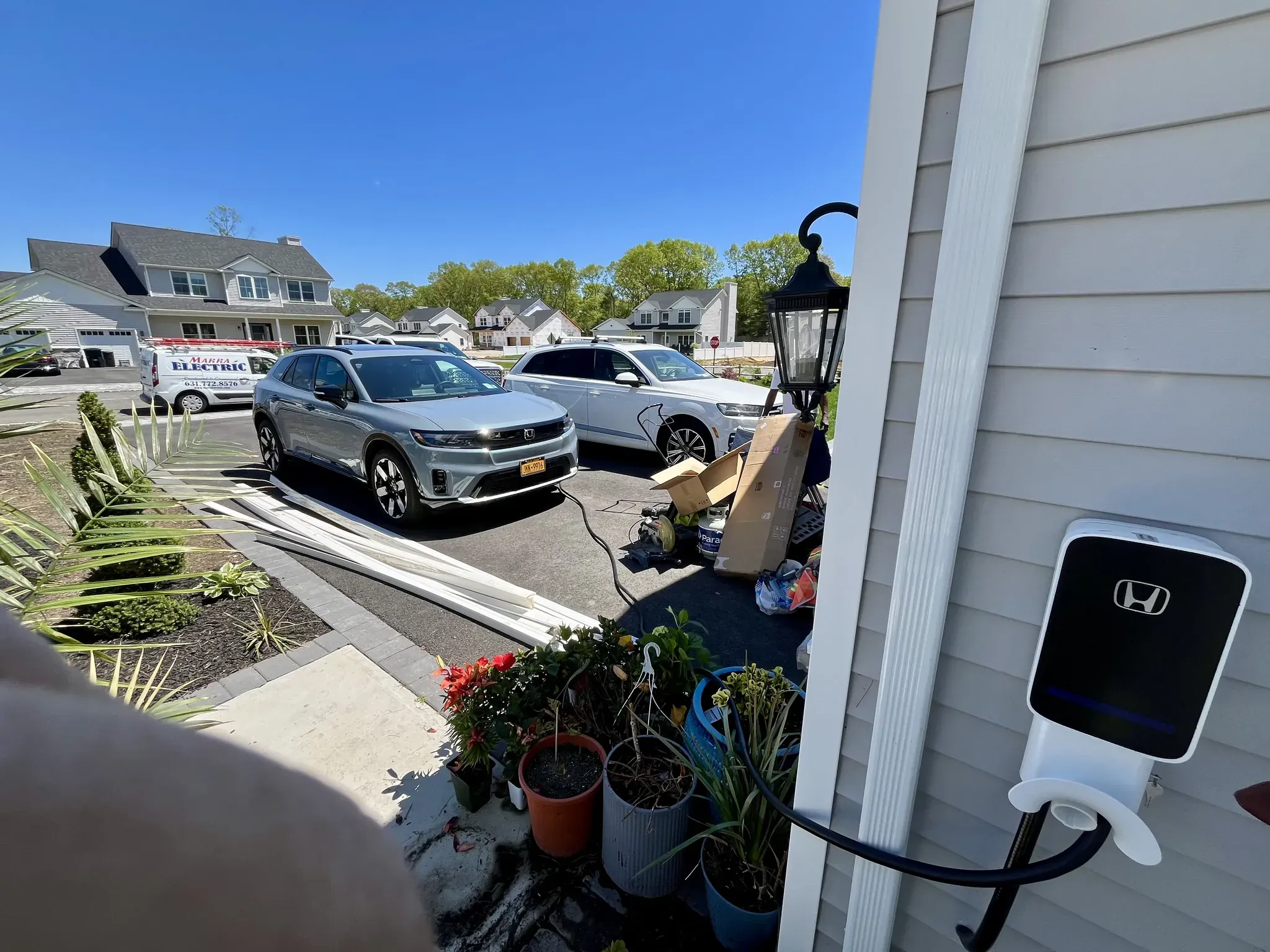
Two silver Honda electric vehicles are parked in a NY suburban driveway near a house. A Honda EV charger, expertly installed by a residential electrician Suffolk County, is mounted on the garage wall. It is a sunny day with plants and boxes nearby.

Home EV Charging Station Installation Benefits

What You Actually Get From a Proper Install

You stop planning your week around public charging stations. No more waiting in line at the mall or paying premium rates while you grab coffee. Your car charges overnight in your own driveway, and you wake up to a full battery every single morning.

Your home can handle it because the electrical panel was assessed first—not after something goes wrong. If you needed an upgrade, it was done right. The charger pulls the power it needs without tripping breakers or creating fire risks.

You’re also saving somewhere between $1,200 and $1,800 a year compared to what you were spending on gas. That’s real money. And if you sell your home down the road, you’ve added a feature that buyers with EVs are actively looking for.

The work was permitted and inspected, so your insurance stays valid and your home stays safe. That’s what a Level 2 EV charger installation in Village of the Branch is supposed to do when it’s done by someone who knows what they’re doing.

Licensed EV Charger Electrician in Village of the Branch

We've Been Doing This Since Before EVs Were Cool

We’ve been serving Suffolk County since 2004. That’s over 20 years of residential and commercial electrical work—panel upgrades, generator installs, lighting, emergency repairs, and now EV charger installations across Village of the Branch and the surrounding area.

We’re fully licensed and insured. Our team shows up in marked vehicles, wearing uniforms, and we explain what we’re doing before we do it. You get upfront pricing before any work starts, so there’s no bill shock at the end.

We’ve earned the Angie’s List Super Service Award seven years in a row. That doesn’t happen by accident. It happens when you show up on time, do the work right, and stand behind it with a 100% satisfaction guarantee. If you’re in Village of the Branch and you need a home EV charging station installation done correctly the first time, that’s what we’re here for.

A black electric car charges in a driveway, the cable plugged in. Two white Mario Electric vans—experts as a residential electrician Suffolk County—are parked on the street before suburban houses with autumn trees.

EVSE Installation Process in Village of the Branch

Here's How Your Install Actually Happens

First, we assess your electrical panel. Many homes in Suffolk County—especially older ones built before 1990—weren’t designed for the kind of continuous load an EV charger puts on the system. We run a load calculation to see if your current setup can handle it or if you need an upgrade to 200-amp service.

If an upgrade is needed, we handle that first. It’s not just about the charger—it’s about your entire home’s electrical capacity. That upgrade typically runs between $2,000 and $3,500, and it benefits everything else you plug in too.

Next, we install the charger itself. We run a dedicated circuit from your panel to the charging location, mount the unit where you want it, and make sure everything is wired to code. If you’ve got a Tesla, we’re Tesla-certified and know exactly how to install the Wall Connector.

Then we pull the permits and schedule the inspection. Almost every Level 2 EV charger installation in Village of the Branch requires a permit. We manage that process so you don’t have to. Once it passes inspection, you’re done. You’ve got a safe, legal, fully functional home charging setup.

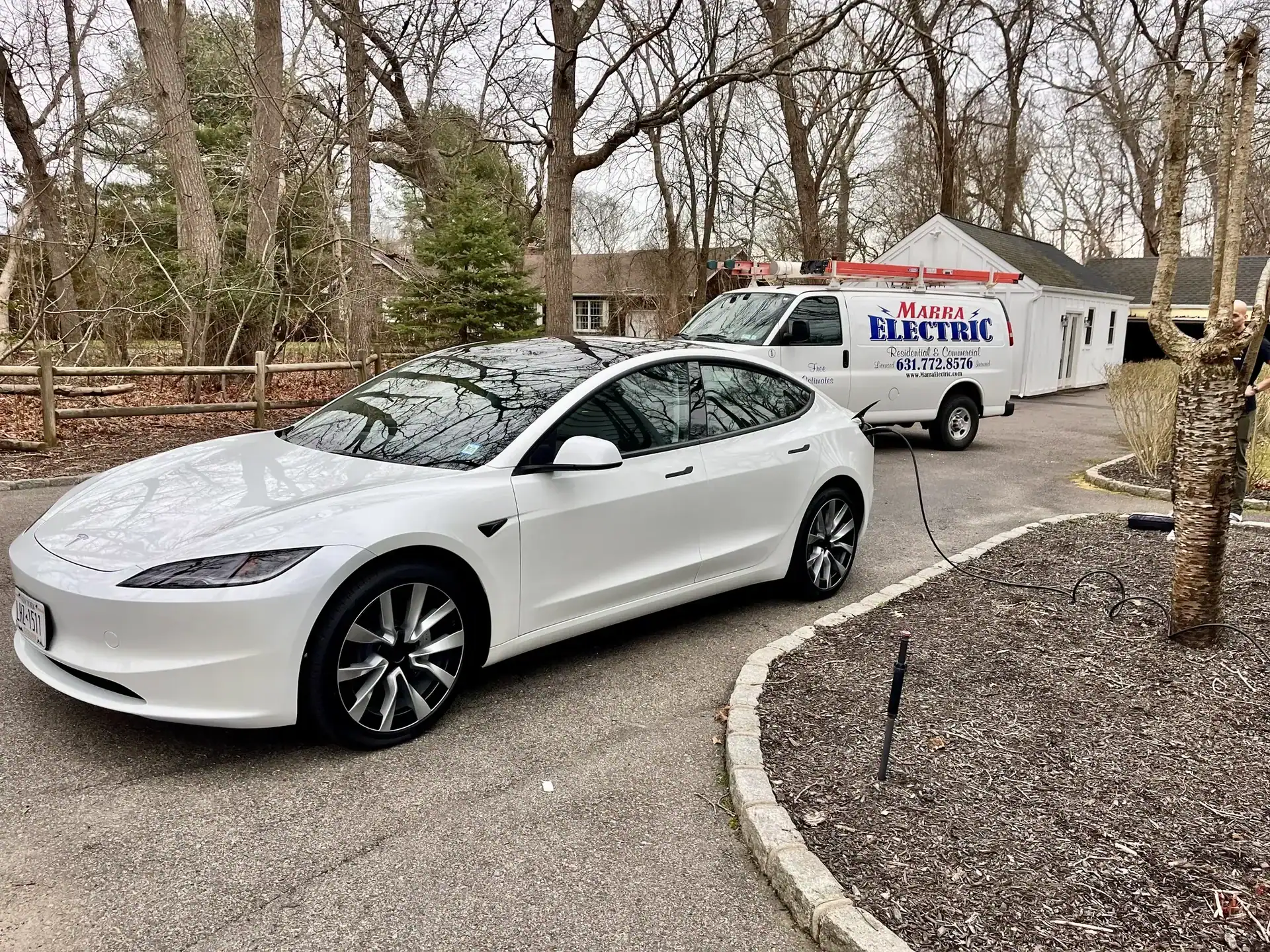
A white electric car is parked in a driveway, plugged in for charging. Nearby, a van labeled “Marra Electric,” a trusted residential electrician Suffolk County NY, is parked near a house surrounded by leafless trees and landscaping.

Explore More Services

About Marra Electric

Electric Car Charger Installation in Village of the Branch

What's Included When We Install Your Charger

You get a full electrical panel evaluation before anything else happens. We’re looking at your current load, your panel’s capacity, and whether your home can support a 40- or 50-amp circuit without issues. If it can’t, we’ll tell you exactly what needs to happen and what it costs before you make a decision.

The installation includes running the dedicated circuit, mounting the charging unit, connecting it to your panel, and testing the system. We also handle all the permitting and coordinate the inspection with the local authority. In Suffolk County, that’s not optional—it’s required for safety and code compliance.

If you’re a PSEG customer, you may qualify for rebates. PSEG offers $200 back on ENERGY STAR certified Level 2 chargers, with an additional $100 available for qualifying customers. We can point you in the right direction to claim those.

You also get access to time-of-day rates if you set up your charging schedule during off-peak hours. That can save you another $30 to $50 a month. Between the fuel savings and the rate optimization, a Tesla charger installation in Village of the Branch pays for itself faster than most people expect.

A white electric car charges in a driveway from a wall-mounted charger, installed by a residential electrician Suffolk County, NY. Nearby are another car and a Manna Electric van. The sunny scene features trees and a house in the background.

Do I need to upgrade my electrical panel for an EV charger?

It depends on your current panel and how much load you’re already pulling. A Level 2 charger is considered a continuous load, which means the circuit breaker needs to be sized at least 125% of the charger’s maximum current. Most chargers pull between 32 and 40 amps, so you’re looking at a 40- or 50-amp breaker on a dedicated circuit.

If your panel is already maxed out or you’re still running a 100-amp service, an upgrade is likely. Homes built before 1990 in Suffolk County often fall into this category. The good news is that a 200-amp panel upgrade doesn’t just support your EV charger—it gives your entire home more capacity for future needs.

We run a load calculation during the estimate to give you a clear answer. If you need an upgrade, we’ll explain why and what it costs. If you don’t, we’ll tell you that too. There’s no reason to guess.

If your panel is ready and no upgrades are needed, the actual installation usually takes four to eight hours. That includes running the circuit, mounting the charger, connecting everything, and testing the system.

If you need a panel upgrade first, add another day for that work. Then there’s the permitting and inspection timeline, which varies depending on the local authority’s schedule. In most cases, you’re looking at one to two weeks from start to finish if everything goes smoothly.

We coordinate the inspection and make sure everything is ready when the inspector shows up. Once it passes, you’re good to go. Some companies try to skip the permit to save time—don’t let them. An unpermitted install can void your homeowner’s insurance and create serious liability if something goes wrong.

Technically, you could try. Legally and safely, you shouldn’t. EV charger installations require working inside your electrical panel, running high-voltage circuits, and pulling permits that most jurisdictions won’t issue to unlicensed individuals.

If you make a mistake, you’re looking at fire risk, code violations, failed inspections, and potentially voided insurance. Electrical issues cause over 51,000 home fires every year in the U.S., and a lot of those start with DIY work that wasn’t done right.

Even if you’re handy, this isn’t the place to learn on the job. A licensed EV charger electrician in Village of the Branch has the training, tools, and insurance to do it correctly. You’re not just paying for the labor—you’re paying for the knowledge that keeps your home safe and your installation legal. The money you’d save isn’t worth the risk you’d take on.

Level 1 charging uses a standard 120-volt outlet—the same one you’d plug a lamp into. It’s slow. You’re looking at 20 to 40 hours for a full charge depending on your vehicle’s battery size. That works if you drive 30 miles a day and can leave it plugged in overnight, but it’s not practical for most people.

Level 2 charging uses a 240-volt circuit, the same voltage as your dryer or oven. It’s significantly faster—usually four to eight hours for a full charge. That’s the difference between waking up to a half-charged car and waking up ready to go.

Most EV owners in Village of the Branch go with Level 2 because it matches how they actually use their vehicle. You plug in when you get home, and it’s ready the next morning. If you’re serious about charging at home, Level 2 is the standard. Level 1 is a backup plan.

Yes, but not as much as you’d think—and it’s still way cheaper than gas. Charging an EV costs about $1.50 to $2.00 per 100 miles, depending on your local electricity rates and when you charge. Compare that to $12 to $15 per 100 miles for a gas vehicle, and the savings add up fast.

If you’re a PSEG customer, you can take advantage of time-of-day rates by charging overnight during off-peak hours. That drops your cost even further—sometimes by $30 to $50 a month. Set your charger or vehicle to start charging after 10 p.m., and you’re pulling power when it’s cheapest.

Most Suffolk County homeowners save between $1,200 and $1,800 a year on fuel after switching to an EV and charging at home. Your electric bill goes up, but your gas bill disappears. The math works in your favor.

We install chargers for all EV brands—Tesla, Ford, Chevy, Rivian, Nissan, Hyundai, whatever you’re driving. The process is the same: assess the panel, run the circuit, mount the unit, pull the permit, pass the inspection.

Tesla chargers get a lot of attention because Tesla owners tend to install the Wall Connector, and we’re Tesla-certified to do that work. But the electrical requirements for a ChargePoint, JuiceBox, or Grizzl-E are nearly identical. It’s all 240-volt Level 2 charging on a dedicated circuit.

If you’re not sure which charger to buy, we can walk you through the options during the estimate. Some are smarter, some are simpler, some integrate with your utility’s rebate programs better than others. We’ll install whatever you choose, and we’ll make sure it works the way it’s supposed to.

Other Services we provide in Village Of The Branch