Public charging gets old fast. You’re waiting in lines, paying premium rates, and building your schedule around charger availability instead of your actual plans.
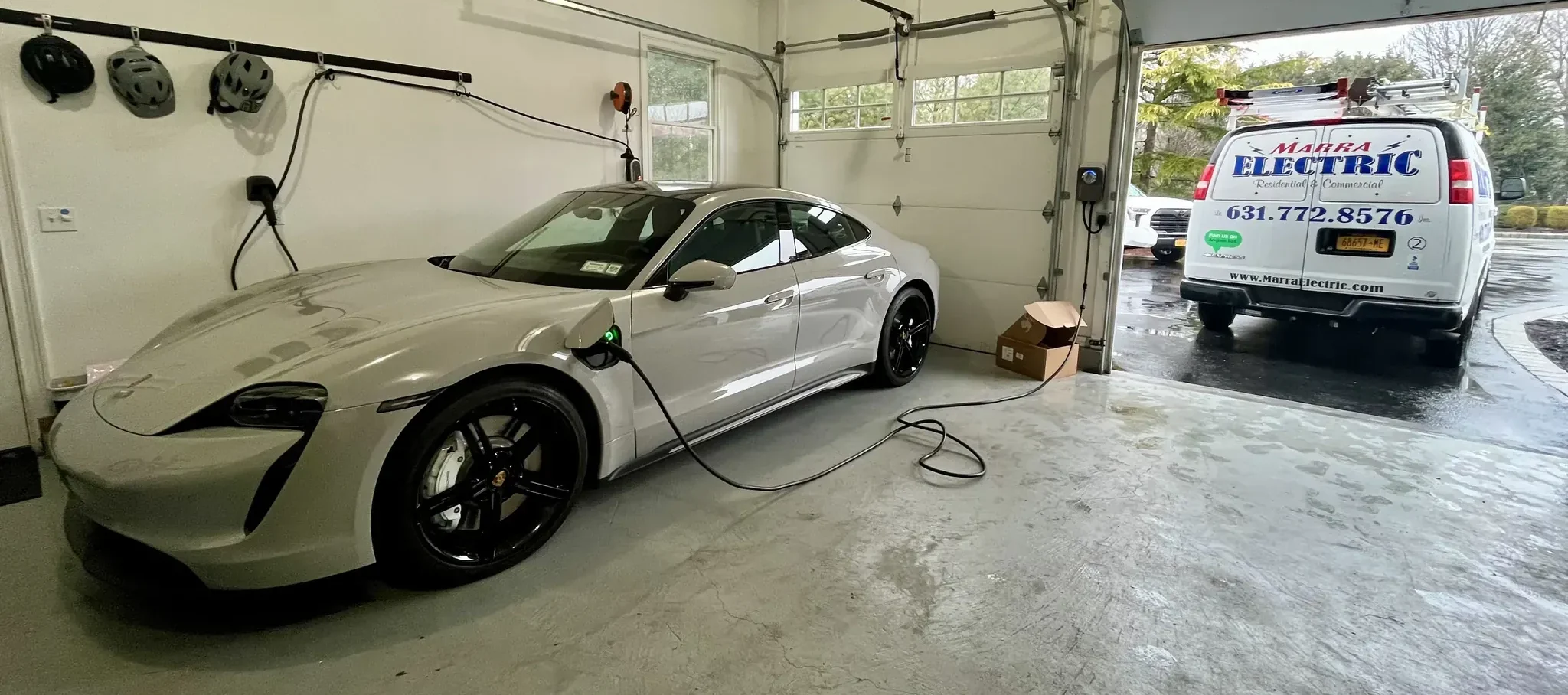
Home EV charger installation in Amityville, NY changes that. Plug in when you get home. Your car charges overnight while you sleep. You leave every morning with a full battery, just like your phone.
Most Suffolk County homes with 200-amp panels have enough capacity for a Level 2 charger. Older homes with 100-amp service usually need an upgrade first. Either way, you need someone who knows how to assess your electrical system properly—because this isn’t about whether you have an outlet in your garage. It’s about whether your panel can handle a continuous 40-60 amp load without overheating your circuits or tripping breakers at 2 AM.
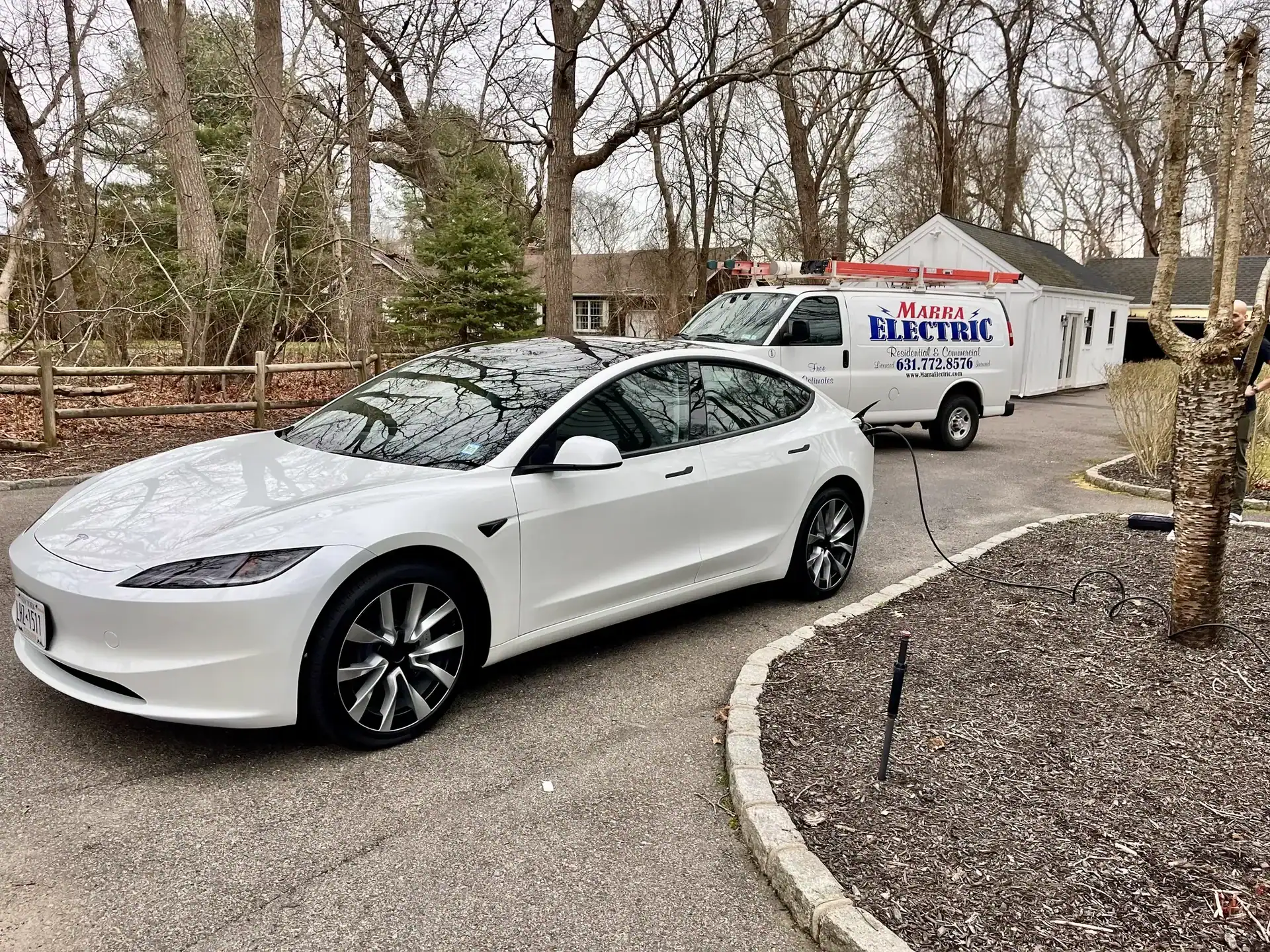
Marra Electric has been handling residential and commercial electrical work across Suffolk County for over 20 years. We’re fully licensed and insured. Our electricians show up in company vehicles, wearing uniforms, with the tools and materials to complete your installation the same day.
We’ve installed EV chargers in homes throughout Amityville, Copiague, Lindenhurst, and surrounding areas. We know Suffolk County electrical codes. We understand local permitting requirements. We maintain relationships with town inspectors, which means your permits move faster and inspections get scheduled without the usual back-and-forth.
You get upfront pricing before we start. No surprise charges. No hidden fees. Just transparent communication about what your home needs and what it’ll cost to do it right.
First, we assess your electrical panel. We’re checking available capacity, looking at your current load, and determining whether you need a panel upgrade before we can safely add a Level 2 EV charger installation in Amityville, NY.
If your panel has capacity, we install a dedicated 240-volt circuit from your panel to your chosen charger location. This includes proper wire sizing, conduit installation, a dedicated breaker, and code-compliant grounding. If you need a panel upgrade, we handle that first—typically upgrading from 100-amp to 200-amp service, which runs between $2,000 and $3,500 depending on your home’s specific requirements.
We mount your charger, make all electrical connections, and test the system. Then we handle permit applications and coordinate required inspections with your local building department. You don’t visit town offices or chase down inspectors.
Most installations complete in 4-6 hours. Panel upgrades add time, but we schedule everything upfront so you know exactly when your charger will be operational.
Ready to get started?
Your electric car charger installation in Amityville, NY includes a complete electrical assessment, load calculation, and honest recommendation about whether your current panel can support the charger. We’re not upselling panel upgrades—we’re telling you what your electrical system actually needs.
We install a dedicated 240-volt circuit with appropriate amperage for your specific charger model. Most Level 2 chargers require 40-50 amps, but some newer models pull 60 amps or more. We size everything correctly the first time.
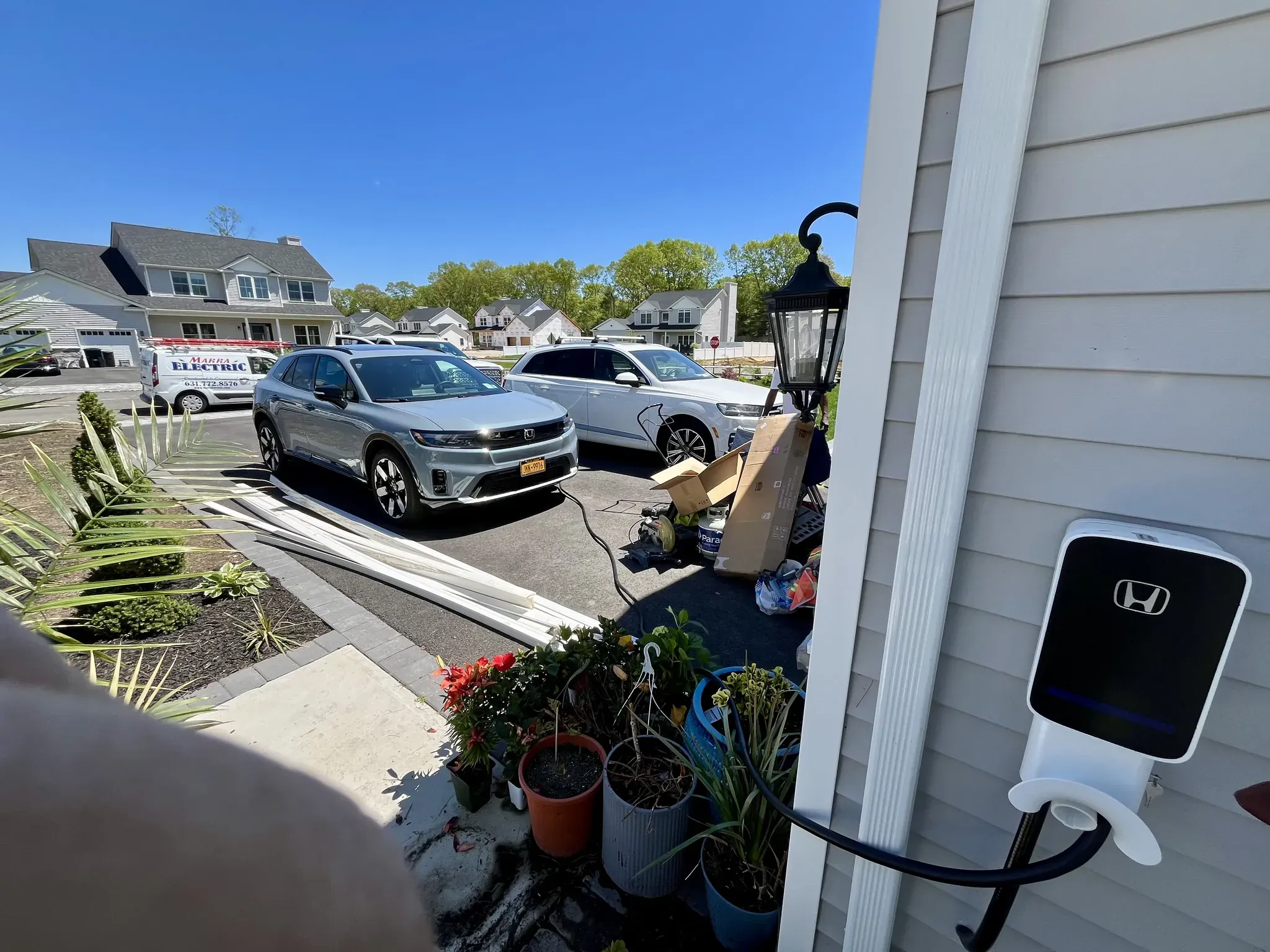
The installation includes all necessary materials: wire, conduit, breaker, mounting hardware, and proper grounding. We handle all permit applications for Suffolk County jurisdictions and coordinate inspections. Your charger gets mounted at the location you choose—usually in your garage or on an exterior wall near where you park.
PSEG Long Island customers can receive a $200 rebate on qualified ENERGY STAR certified Level 2 chargers. Customers in Disadvantaged Communities qualify for additional rebates. There’s also a federal tax credit covering 30% of installation costs, up to $1,000 for residential installations. We provide all documentation you need to claim available incentives.
Most home EV charging station installations in Amityville, NY complete within 4-6 hours if your electrical panel has available capacity and space. That’s the actual installation work—running the dedicated circuit, mounting the charger, making connections, and testing the system.
The timeline extends if you need a panel upgrade first. Upgrading from 100-amp to 200-amp service typically adds another 6-8 hours of work, but you’re upgrading your entire home’s electrical infrastructure in the process, not just adding capacity for your EV charger.
Permitting and inspection scheduling affect your overall timeline more than the physical installation. Suffolk County towns require electrical permits for Level 2 charger installations. We submit permit applications immediately and coordinate inspections, but you’re working within your local building department’s schedule. Most permits get approved within a week. Inspections usually happen within a few days of completion.
It depends on your current panel’s capacity and how much electrical load you’re already using. Most Suffolk County homes built after 2000 have 200-amp panels with enough capacity for a Level 2 EV charger installation in Amityville, NY. Homes built before the 1980s often have 100-amp panels that need upgrading.
But it’s not just about the panel size—it’s about your total electrical load. We run a load calculation that accounts for your home’s square footage, major appliances, HVAC system, and existing electrical usage. If you’re already running close to your panel’s capacity, adding a 40-60 amp continuous load could overload your system.
Panel upgrades aren’t cheap—expect $2,000 to $3,500 for most residential upgrades in Amityville. But you’re not just adding capacity for your EV. You’re upgrading your home’s entire electrical infrastructure, which matters for safety, future electrical projects, and property value. Many homeowners discover during the EV charger installation process that their panel needed upgrading anyway.
Level 1 chargers plug into standard 120-volt outlets and add about 3-5 miles of range per hour of charging. That’s fine if you drive 20 miles a day and can charge for 12 hours overnight. It doesn’t work if you’re commuting from Amityville to Manhattan—that’s 100+ miles round trip, plus evening errands and weekend driving.
Level 2 chargers require a dedicated 240-volt circuit and add 25-30 miles of range per hour. Most electric vehicles fully charge in 4-8 hours overnight. You leave every morning with a full battery regardless of how much you drove the day before.
The electric car charger installation in Amityville, NY that most homeowners need is Level 2. You’re investing in the electrical work once—the dedicated circuit, the permit, the inspection. That upfront cost makes sense when it eliminates range anxiety and gives you the charging speed that matches how you actually use your vehicle. Level 1 charging sounds cheaper until you realize it doesn’t solve the problem you bought an EV to solve.
Basic installations with adequate panel capacity typically run $800-$1,500 for labor and materials. That assumes your panel is in your garage or within 25 feet of where you want the charger mounted. Longer wire runs, exterior conduit work, or complicated routing increases costs.
Panel upgrades add $2,000-$3,500 to your total project cost. You’re upgrading your entire electrical service—new panel, new main breaker, updated grounding, and bringing everything to current code. It’s a significant investment, but it’s infrastructure your home needs regardless of the EV charger.
The charger itself ranges from $400-$1,200 depending on features, brand, and amperage. Tesla Wall Connectors, ChargePoint Home Flex, and Grizzl-E chargers are popular models we install regularly. Some homeowners qualify for PSEG Long Island’s $200 rebate on ENERGY STAR certified chargers, plus the federal tax credit covering 30% of installation costs up to $1,000. Those incentives offset a meaningful portion of your total investment in home EV charging station installation in Amityville, NY.
Yes. Suffolk County towns require electrical permits for Level 2 EV charger installations because you’re adding a dedicated 240-volt circuit to your home’s electrical system. This isn’t like plugging in an appliance—you’re making permanent electrical modifications that need to meet local code and pass inspection.
The permitting process ensures your installation is safe, properly sized, and correctly grounded. Your local building department reviews the permit application, approves the work, and schedules an inspection after installation. The inspector verifies wire sizing, breaker ratings, grounding, and overall code compliance.
We handle the entire permit process for your licensed EV charger electrician installation in Amityville, NY. We submit applications, provide required documentation, and coordinate inspections. You don’t visit town offices or follow up with inspectors. The permit typically costs $50-$150 depending on your municipality, and it’s included in our upfront pricing. Skipping permits isn’t worth the risk—your insurance company won’t cover electrical fires from unpermitted work, and you’ll face issues when you sell your home.
Legally, no—not in New York. Electrical work on 240-volt circuits requires a licensed electrician. Even if you have electrical experience, your local building department won’t issue permits for homeowner-installed EV chargers, and inspectors won’t approve work performed without proper licensing.
There’s a practical reason beyond legal requirements. Level 2 EV charger installation in Amityville, NY involves load calculations, proper wire sizing for continuous duty loads, correct breaker selection, and code-compliant grounding. Get any of those wrong and you’re creating fire hazards, voiding your homeowner’s insurance, and potentially damaging your vehicle’s charging system.
The cost difference between DIY and professional installation isn’t worth the risk. You’re paying for expertise that prevents expensive mistakes—undersized wire that overheats, improper grounding that creates shock hazards, or overloaded panels that fail during charging. You’re also paying for someone who handles permits, coordinates inspections, and stands behind the work with licensing and insurance. When something goes wrong with electrical work, the cost of fixing it correctly exceeds what you saved trying to do it yourself.
Other Services we provide in Amityville