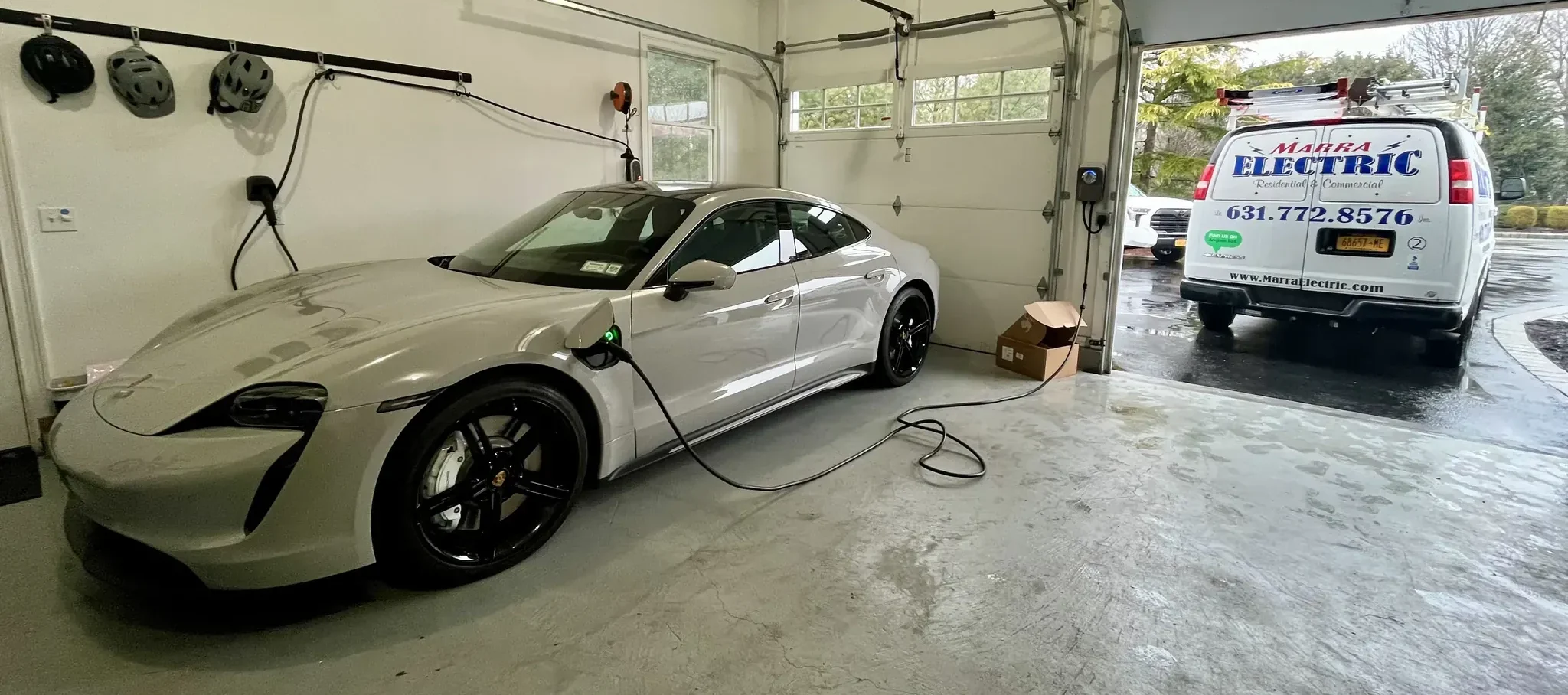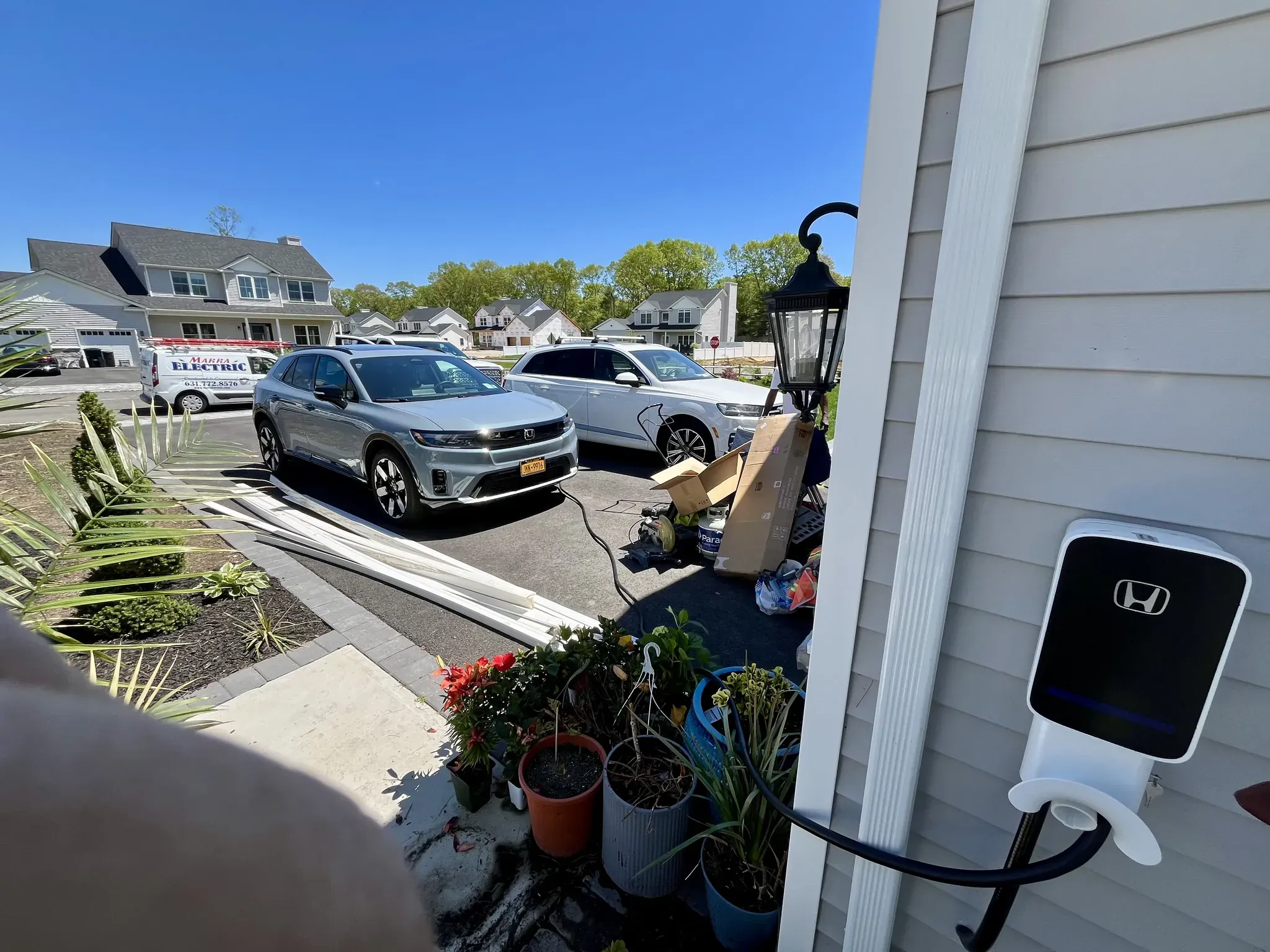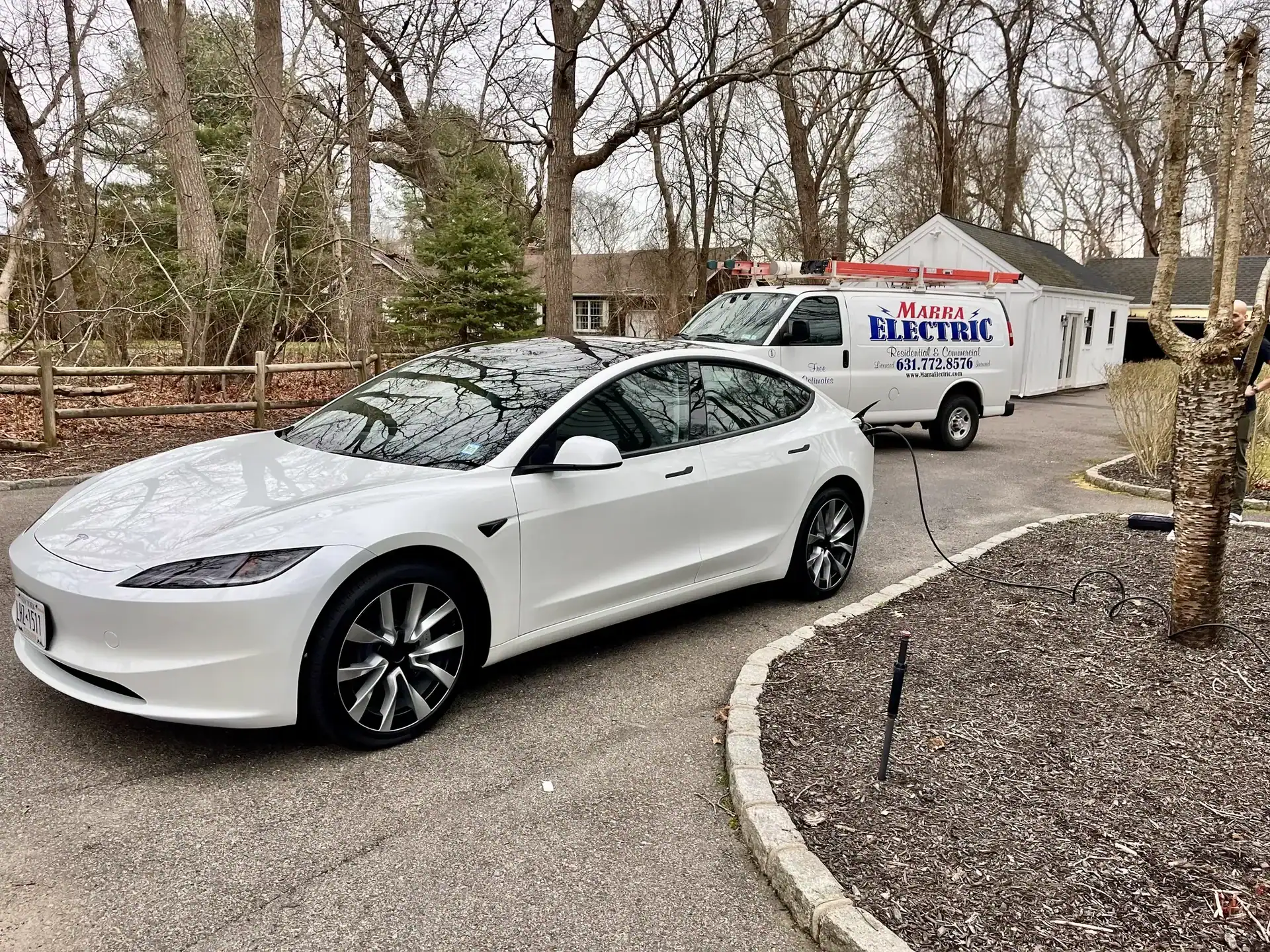
You’re done circling public charging stations or planning your week around where you can plug in. A home EV charging station installation in Pine Aire, NY means your car charges overnight while you sleep, and you leave each morning with a full battery.
Level 2 EV charger installation adds 25 to 40 miles of range per hour—enough to recover a full day’s commute in just a few hours. Compare that to a standard outlet, which barely keeps up if you’re driving daily. You’re not just getting convenience; you’re getting reliability.
Your electrical panel gets evaluated first. Many homes in Pine Aire still run on 100-amp service, which can struggle when you add a 40 or 50-amp EV charger to the load. If an upgrade is needed, it benefits your entire home—not just the garage. More capacity means fewer tripped breakers, safer operation, and room to grow as your household’s electrical demands increase.
We’ve been serving Pine Aire and the surrounding Suffolk County area since 2004. Over 20 years of residential and commercial electrical work means we’ve seen how homes are wired here, what panels need upgrading, and how to navigate local permitting without delays.
You’re working with a fully licensed and insured team that shows up in branded vehicles and uniforms. No guesswork, no shortcuts. Every Tesla charger installation in Pine Aire, NY or any other EV brand gets the same level of attention—proper load calculations, code-compliant wiring, and clean installations that pass inspection the first time.
We’ve earned the Angie’s List Super Service Award seven years running. That doesn’t happen by accident. It happens when you answer calls, show up on time, explain what needs to happen, and stand behind the work with a 100% satisfaction guarantee.
It starts with a free estimate. We’ll look at your electrical panel, measure the distance from the panel to where you want the charger, and calculate your home’s current electrical load. If your panel can handle the additional draw, great. If not, we’ll explain what an upgrade involves and give you transparent pricing before any work begins.
Once you’re ready to move forward, we pull the necessary permits with Suffolk County. Permitting requirements here differ from Nassau County and New York City, and we handle that process so you don’t have to figure it out on your own. The charger gets mounted where you want it—usually in the garage or on an exterior wall near your driveway—and we run a dedicated 240-volt circuit from your panel to the unit.
After installation, the work gets inspected to confirm it meets local code. You’ll receive documentation for your records, which matters for insurance purposes and if you ever sell your home. Then you’re done. Plug in, charge overnight, and stop thinking about where the nearest public charger is.
Ready to get started?
Your home EV charging station installation in Pine Aire, NY includes a full electrical assessment before we touch anything. We measure your existing load, check your panel’s capacity, and determine whether your current setup can support a Level 2 charger. Most EVs pull between 40 and 60 amps continuously, and your circuit breaker and wiring need to be sized at least 125% of that draw to meet code.
If your home still has 100-amp service—common in older Pine Aire properties—we’ll recommend upgrading to 200 amps. That upgrade doesn’t just make room for your EV charger; it improves your home’s entire electrical infrastructure. You’ll have the capacity to add central air, a second refrigerator, or any other high-draw appliance without overloading your system.
We handle the permit application, the installation, and the final inspection. You get a dedicated circuit, a properly mounted charger, and all the documentation you need. No surprise fees, no hidden costs. Just upfront pricing and work that’s done right the first time.
Suffolk County has seen steady growth in EV adoption, and the infrastructure is catching up. PSEG Long Island offers time-of-use rates that let you charge overnight at lower costs, which can save you over $1,200 a year compared to fueling a gas vehicle. Pair that with the federal tax credit covering 30% of installation costs, and the numbers start to make a lot of sense.
Most installations take four to six hours if your electrical panel already has the capacity. That includes mounting the charger, running the dedicated circuit, and connecting everything to your panel. If your home needs a panel upgrade from 100-amp to 200-amp service, add another few hours for that work.
The timeline also depends on permitting. Suffolk County requires permits for EV charger installations, and processing times vary depending on workload at the local building department. We submit the paperwork and keep the process moving, but it’s worth planning for a week or two between scheduling and completion if permits are involved.
Once the work is done and inspected, you’re ready to charge. There’s no break-in period or complicated setup. Plug in your vehicle, and the charger does the rest.
It depends on your current panel size and how much load you’re already using. A Level 2 charger typically requires a 40 or 50-amp dedicated circuit, and your total panel capacity needs to support that on top of everything else running in your home—HVAC, appliances, lighting, and any other high-draw equipment.
We run a load calculation during the estimate to see where you stand. If you’re close to maxing out your current service, an upgrade makes sense. Many homes in Pine Aire were built with 100-amp panels, which were fine decades ago but struggle with modern electrical demands. Upgrading to 200 amps gives you room for the EV charger and anything else you might add down the road.
If your panel is already 200 amps and you’re not running a lot of heavy equipment, you might be fine without an upgrade. We’ll tell you either way and explain what the options are before you make a decision.
Yes. Suffolk County requires permits for electric car charger installation in Pine Aire, NY, and the work needs to be done by a licensed electrician. The permit ensures the installation meets local electrical code, which protects you, your home, and anyone who might buy your property in the future.
We handle the permit application as part of the installation process. You don’t need to visit the building department or figure out what forms to fill out. Once the work is complete, an inspector will verify that everything was installed correctly. You’ll receive documentation showing the installation passed, which is important for insurance and resale purposes.
Skipping the permit might seem like a shortcut, but it creates problems later. Insurance companies can deny claims if unpermitted work causes an issue, and you’ll have trouble selling your home if the installation wasn’t done legally. It’s worth doing it right from the start.
Level 1 charging uses a standard 120-volt outlet—the same kind you plug a lamp into. It’s slow, adding about three to five miles of range per hour. If you’re driving 30 or 40 miles a day, you’d need to plug in for eight to twelve hours just to recover what you used. That works for some people, but it’s not practical if you’re commuting regularly or driving longer distances.
Level 2 charging uses a 240-volt circuit, the same voltage as your dryer or oven. It adds 25 to 40 miles of range per hour, depending on your vehicle and charger. That means you can fully recharge overnight, even after a long day of driving. It’s faster, more reliable, and better suited to daily use.
Most EV owners who try Level 1 charging end up upgrading to Level 2 within a few months. If you’re serious about driving electric, Level 2 is the way to go from the start.
Installation costs depend on three main factors: the distance from your electrical panel to the charger location, whether your panel needs an upgrade, and what type of charger you’re installing. A straightforward installation with a nearby panel and sufficient capacity typically runs less than a full panel upgrade and long wire run.
Panel upgrades from 100-amp to 200-amp service generally cost between $2,000 and $3,500 in Suffolk County, depending on the complexity of the job and what your home requires. If your panel is already sized correctly and the charger is going in the garage near the panel, costs drop significantly.
We provide free estimates with upfront pricing. You’ll know what the job costs before we start, and there are no surprise fees once the work is done. Factor in the federal tax credit, which covers 30% of installation costs, and the long-term savings on fuel—most Pine Aire homeowners save over $1,200 a year by charging at home instead of buying gas—and the investment pays off faster than you’d think.
Yes, especially as EV adoption continues to grow across Long Island. Buyers shopping for homes in Pine Aire increasingly expect charging infrastructure, and a professionally installed Level 2 charger signals that the home is ready for modern transportation. It’s one less thing a buyer has to arrange after moving in.
The installation also demonstrates that your electrical system was evaluated and, if needed, upgraded to handle higher loads. That’s appealing to buyers even if they don’t own an EV yet, because it means the home’s infrastructure is up to date and capable of supporting future needs.
Real estate agents in Suffolk County report that homes with EV chargers tend to move faster, particularly in areas where EV ownership is common. It’s not a massive value boost like a kitchen remodel, but it’s a selling point that differentiates your property and makes it more attractive to a growing segment of buyers.
Other Services we provide in Pine Aire