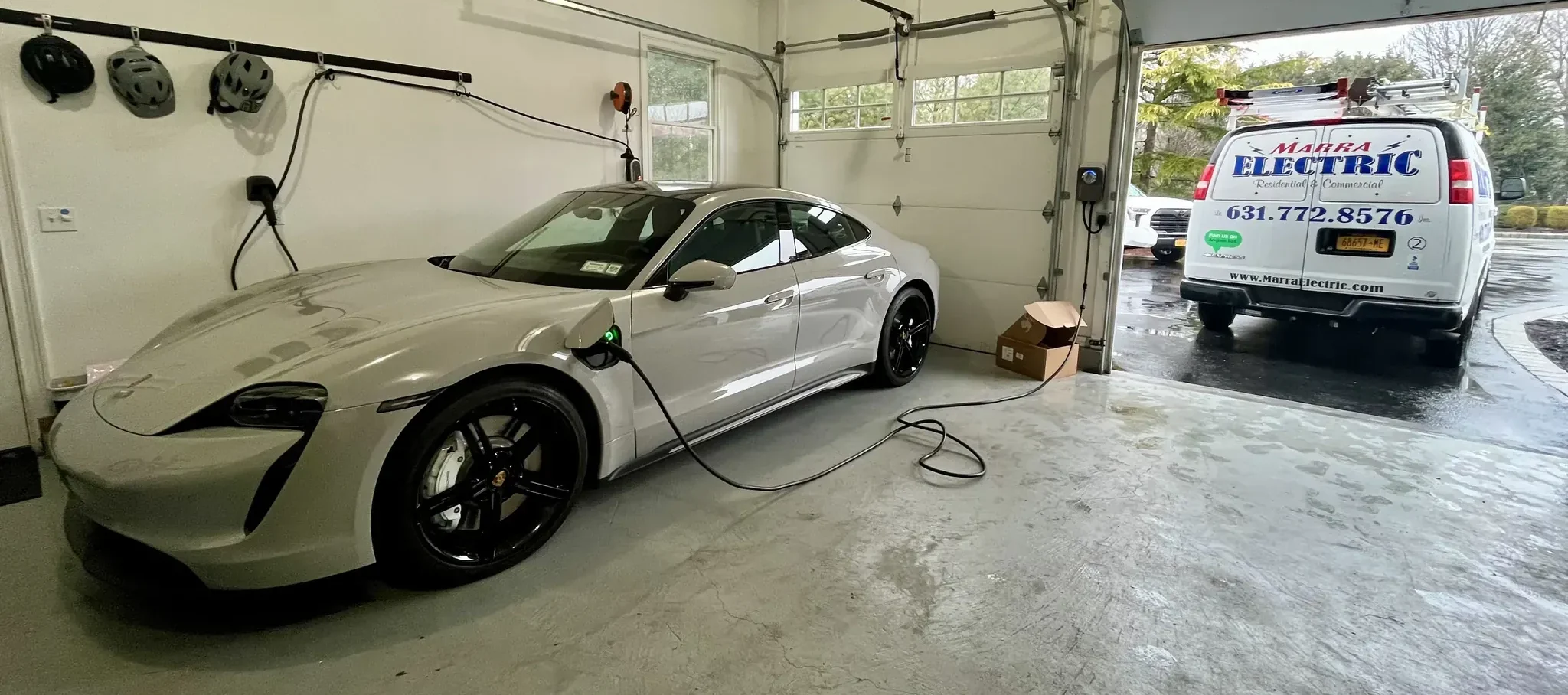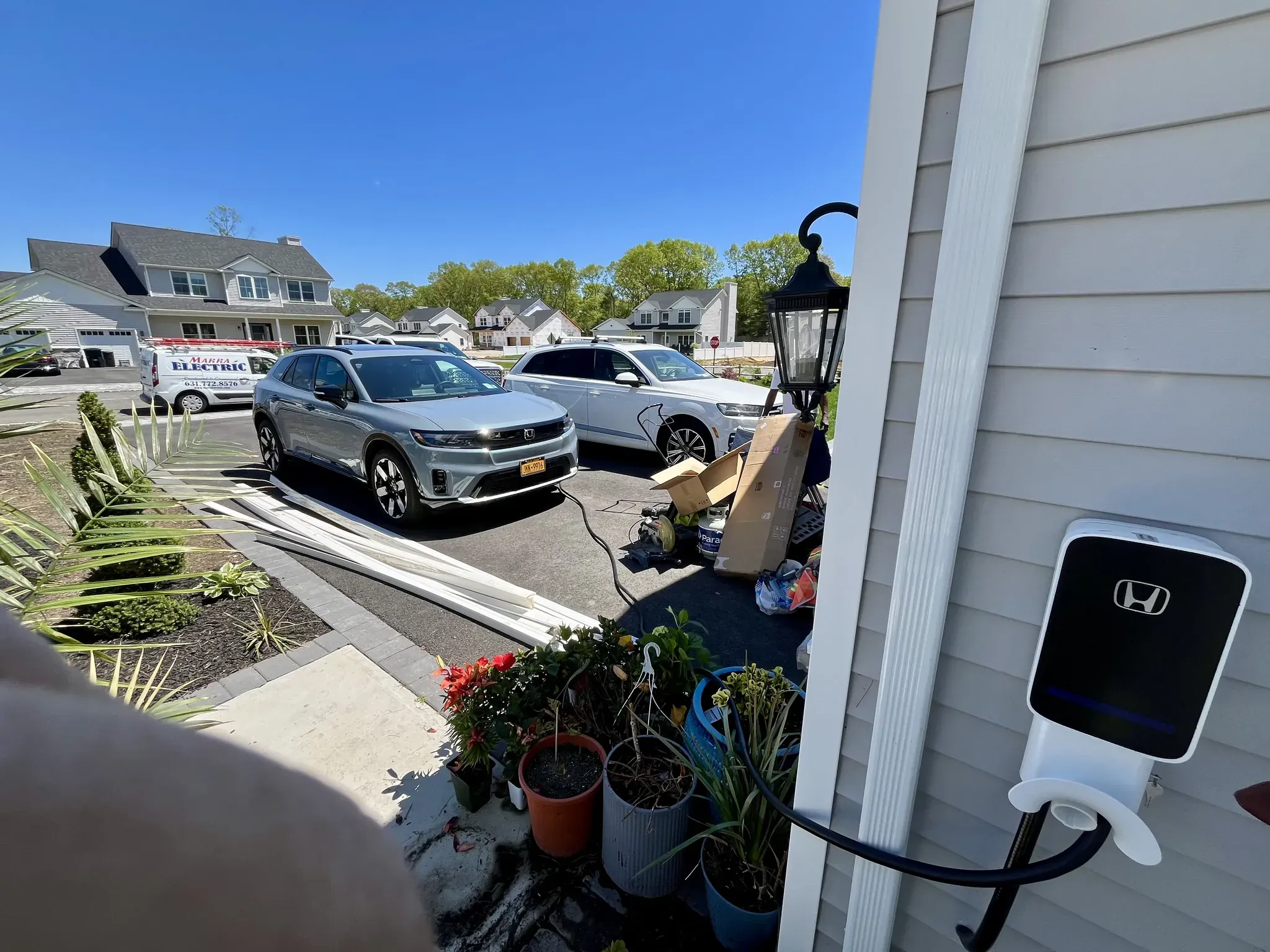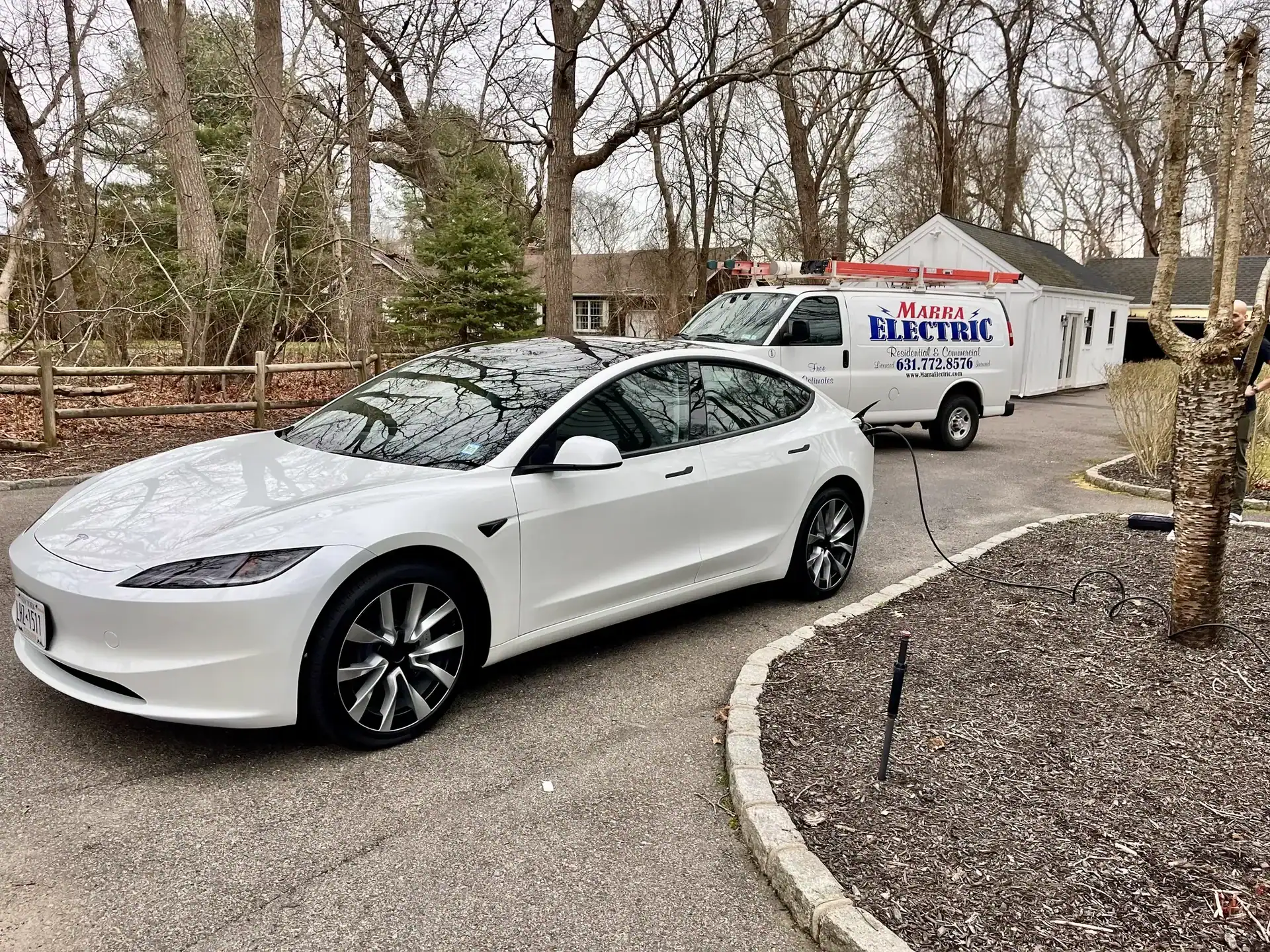
That portable charger that came with your Tesla or electric car? It’s slow. Painfully slow. You’re getting maybe 3-5 miles of range per hour plugged into a standard outlet, which means you’re planning your week around public charging stations or hoping overnight is enough to cover tomorrow’s commute.
A Level 2 EV charger installation in Saint James, NY changes that. You’ll add 25-40 miles of range per hour, which means a full charge while you sleep. No more apps tracking station availability. No more sitting in parking lots. Just plug in when you get home and forget about it.
And if you’re on PSEG Long Island’s Time-of-Day rate, you’re saving about 40% on electricity costs by charging overnight during off-peak hours. That’s roughly $1,200-$1,800 back in your pocket every year compared to what you’d spend on gas. The charger pays for itself, and your mornings get a lot simpler.
We’ve been handling residential electrical work across Saint James and Suffolk County for over 20 years. We’re fully licensed, insured, and we’ve installed EV chargers in homes just like yours—some with 100-amp panels that needed upgrades, others with detached garages that required trenching and conduit work.
We’re also Tesla-certified, which means we know the specific requirements for Wall Connectors and other EV charging systems. But more than that, we know how to pull permits in Saint James, pass inspections on the first try, and give you an upfront price before any work starts. No surprises. No upselling once we’re halfway through the job.
If your panel can handle the load, great. If it can’t, we’ll tell you exactly what needs to happen and what it’ll cost. That’s how we’ve earned the Angie’s List Super Service Award seven years running.
First, we come out for a free estimate. We’ll look at your electrical panel, check the amperage, measure the distance from the panel to where you want the charger, and talk through whether you need any upgrades. If your home was built before 1990, there’s a decent chance you’re working with a 100-amp panel, which might need an upgrade to safely handle an EV charger plus your existing load.
Once you approve the estimate, we handle the permit. Nearly every Level 2 charger installation in Suffolk County requires one, and we pull it so you don’t have to deal with the town. Then we schedule the install. Depending on the setup, that’s usually a half-day to full-day job. We’ll mount the charger, run the wiring, connect everything to a dedicated circuit, and make sure it’s code-compliant.
After the install, the town inspector comes out to sign off. We coordinate that. Once it passes, you’re done. Plug in your car, set it to charge overnight, and you’re pulling a full battery by morning. If anything comes up down the road, we’re available 24/7 for service calls.
Ready to get started?
A proper electric car charger installation in Saint James, NY isn’t just mounting a box on the wall. It’s running a dedicated 240-volt circuit from your panel, installing a breaker that can handle the load, and making sure the whole system is grounded and code-compliant. If your charger is going in a garage, we’re running conduit. If it’s outside or in a detached structure, we’re trenching and burying the line.
We also handle the stuff most people don’t think about until it becomes a problem. GFCI protection. Proper wire gauge for the distance. Load calculations to make sure your panel isn’t maxed out. And if you’re in one of the older neighborhoods in Saint James where homes are still running on 100-amp service, we’ll let you know if an upgrade is necessary before your charger ever gets installed.
You’ll also want to take advantage of the rebates. PSEG Long Island offers up to $300 for qualified Level 2 chargers, and there’s a federal tax credit covering 30% of installation costs. We’ll point you toward those programs, but the real savings come from charging at home instead of paying premium rates at public stations. That alone saves most Saint James EV owners over $100 a month.
Most Level 2 EV charger installations in Saint James run between $1,000 and $2,500, depending on your electrical setup and how far the charger is from your panel. If your panel is in the basement and your charger is going in an attached garage 20 feet away, you’re on the lower end. If we’re running a line to a detached garage 60 feet from the house and trenching through your driveway, costs go up.
Panel upgrades add to that total. If you’re still on a 100-amp service and your home’s electrical load is already pushing capacity, you’ll need to upgrade to 200 amps before adding an EV charger. That’s an additional cost, but it’s also a necessary one if you want a safe, code-compliant install that passes inspection.
We give you an upfront price after the estimate. No hidden fees, no surprise charges once we start the work. You’ll know exactly what you’re paying before we pull the permit.
Yes. Nearly every Level 2 charger install in Suffolk County requires an electrical permit, and Saint James is no exception. The permit isn’t red tape—it’s a safety checkpoint that ensures your installation meets National Electrical Code standards and won’t create a fire hazard or overload your system.
We pull the permit as part of the job. You don’t have to go to the town building department or deal with paperwork. Once the install is done, the town sends an inspector out to verify everything is up to code. We coordinate that inspection and make sure the work passes the first time.
Skipping the permit might seem like a shortcut, but it’s a problem if you ever sell your home or file an insurance claim. Unpermitted electrical work can void warranties, fail home inspections, and cost you far more to fix later than just doing it right the first time.
It depends on your panel’s capacity and your home’s current electrical load. Most EV chargers pull between 30 and 50 amps, which is a significant draw. If you’ve got a 200-amp panel with room to spare, you’re probably fine. If you’re on a 100-amp panel and you’re already running central air, an electric dryer, and a bunch of other appliances, you might be maxed out.
We do a load calculation during the estimate. That tells us whether your panel can safely handle the additional circuit or if you need an upgrade. A lot of homes in Saint James were built in the ’70s and ’80s, and many are still running original 100-amp panels. Those panels weren’t designed for modern electrical demands, let alone EV charging.
If an upgrade is necessary, we’ll explain why and give you a clear price. Panel upgrades aren’t cheap, but they’re a one-time investment that also increases your home’s value and makes future electrical work easier.
Most installs take between four and eight hours, depending on the complexity. If your panel is close to the install location and you don’t need any upgrades, we can usually knock it out in half a day. If we’re running a long conduit run, trenching through concrete, or upgrading your panel first, it might take a full day or span two visits.
The permit and inspection add time to the overall timeline, but not to the actual work. We pull the permit before we start, do the install, and then schedule the inspection. Once the inspector signs off, you’re good to go. The whole process from estimate to final approval usually takes one to two weeks, depending on the town’s inspection schedule.
We’ll give you a timeline during the estimate so you know what to expect. If you’ve got a specific deadline—like a new EV being delivered—we’ll do our best to work around it.
Level 1 charging uses a standard 120-volt outlet—the same outlet you’d plug a lamp into. It’s slow. You’re looking at about 3-5 miles of range per hour, which means it takes 24+ hours to fully charge most EVs. That’s fine if you barely drive and can leave your car plugged in for days, but it’s not practical for most people.
Level 2 charging uses a 240-volt circuit, the same kind that powers your dryer or oven. It charges 25-40 miles of range per hour, depending on your vehicle and charger model. That means a full charge overnight, even if you’re starting from near-empty. It’s faster, more convenient, and it’s what most EV owners upgrade to once they realize Level 1 isn’t cutting it.
The Tesla charger installation in Saint James, NY that we do most often is Level 2. It’s the sweet spot between speed and cost, and it’s what you need if you’re using your EV as a daily driver.
Yes. PSEG Long Island offers rebates up to $300 for qualified Energy Star-certified Level 2 chargers. If you’re in a designated disadvantaged community, that rebate can go higher. You’ll need to buy an eligible charger and submit proof of purchase and installation to claim it.
There’s also a federal tax credit that covers 30% of your installation costs, including labor and materials. That credit applies to home EV charging station installation, so if your total project costs $2,000, you could get $600 back at tax time. Combined with the PSEG rebate, that takes a decent chunk out of your upfront cost.
We’ll point you toward the rebate programs and make sure your install qualifies, but you’ll need to handle the paperwork on your end. The savings are real, though, and when you factor in what you’ll save on gas every year, the charger basically pays for itself within two to three years.
Other Services we provide in Saint James