EV Charger Installation in West Hampton Dunes, NY

Charge at Home, Skip the Public Station Wait

Wake up to a fully charged car every morning with a Level 2 EV charger installation that actually fits your home’s electrical system.
[Add Trustindex Button Here]
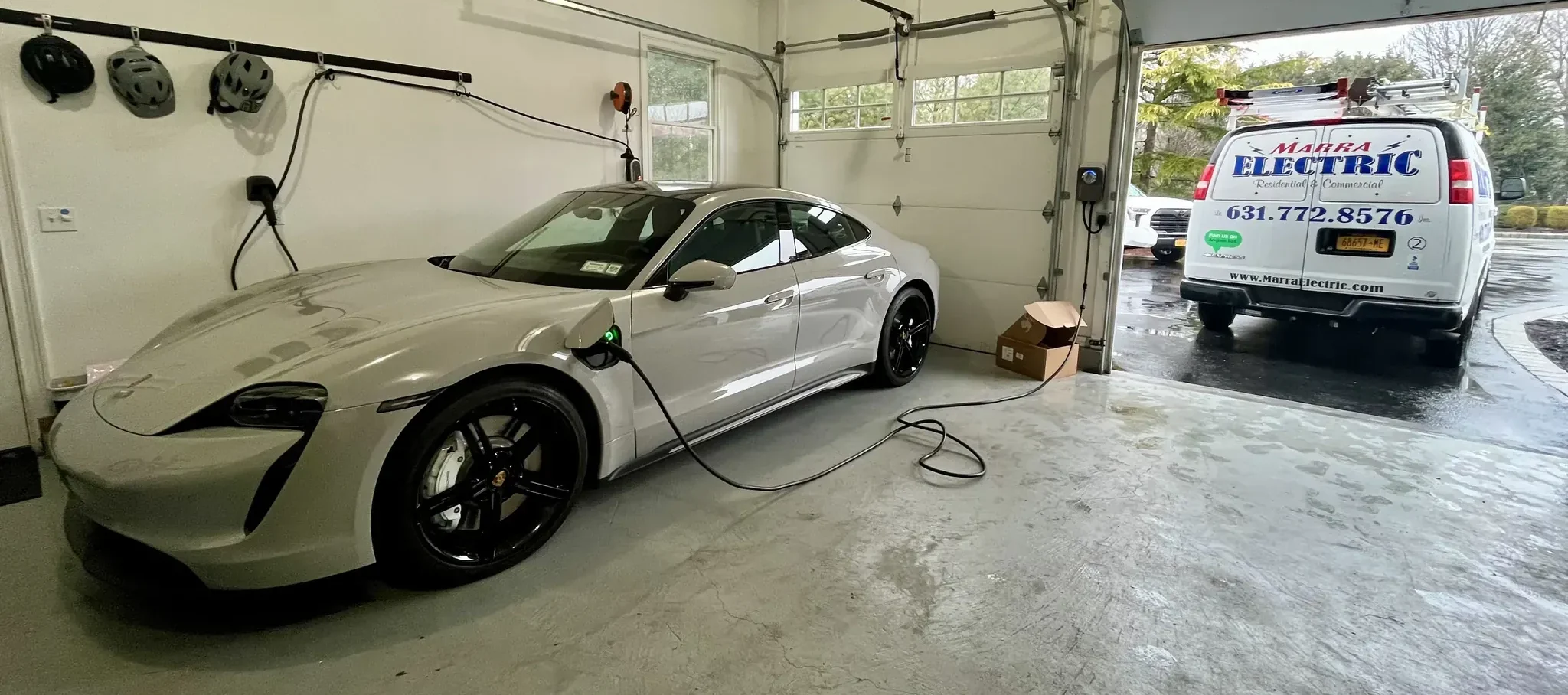
A white electric car charges in a garage, plugged into a wall outlet. Nearby, a cardboard box is on the floor. Outside, a Maria Electric commercial electrician Suffolk County service van is parked in the driveway on a rainy day.
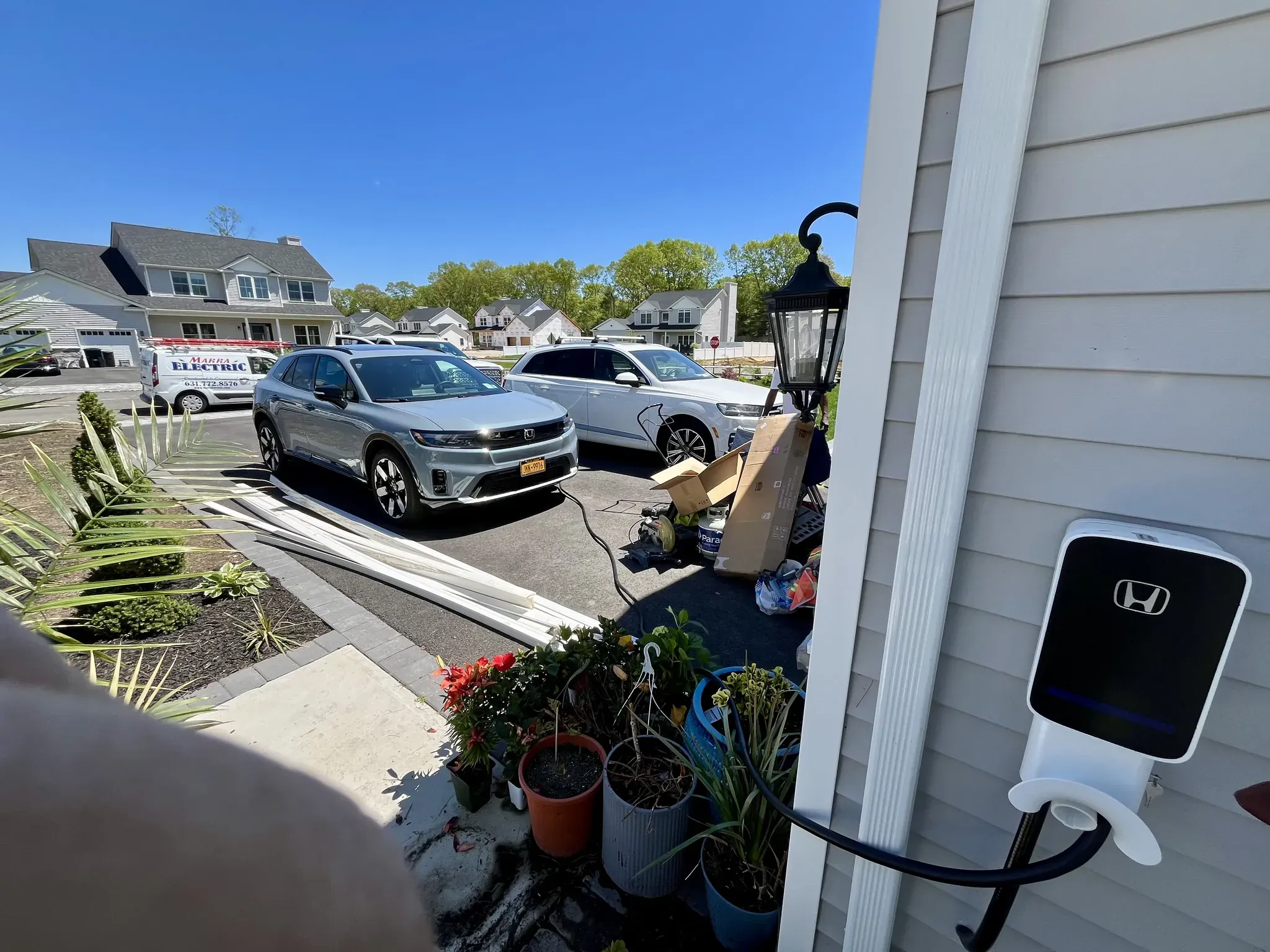
Two silver Honda electric vehicles are parked in a NY suburban driveway near a house. A Honda EV charger, expertly installed by a residential electrician Suffolk County, is mounted on the garage wall. It is a sunny day with plants and boxes nearby.

Home EV Charging Station Installation Benefits

Stop Losing Time and Money on Public Chargers

Public charging stations eat up your schedule and your wallet. Most West Hampton Dunes homeowners who install a Level 2 home charging station save around 50% on fueling costs compared to using public stations regularly.

Charging overnight during off-peak hours means you’re paying the lowest possible rate. In Suffolk County, time-of-use rates between midnight and 6 a.m. can cut your charging costs by hundreds per year.

A Level 2 charger delivers 20 to 40 miles of range per hour. That’s seven to ten times faster than a standard 120-volt outlet, which only gives you about 3 to 5 miles per hour. If you drive 40 miles a day, you’re looking at a full charge in just a couple hours instead of waiting all night on a regular plug.

Your home’s value goes up too. Buyers in high-income areas expect EV infrastructure now. A professionally installed charging station isn’t just convenient for you today—it’s a selling point when you’re ready to move.

Licensed EV Charger Electrician in West Hampton Dunes

Two Decades Serving Suffolk County Homeowners

We’ve been handling residential electrical work across Suffolk County since 2004. That’s over 20 years of panel upgrades, generator installs, and now electric car charger installation in West Hampton Dunes, NY and surrounding communities.

We’re fully licensed and insured. Our team shows up in company vehicles, in uniform, and with upfront pricing before any work starts. No surprise bills when the job’s done.

West Hampton Dunes homeowners expect quality work and straight answers. With seven consecutive Angie’s List Super Service Awards and a 5-out-of-5 rating, we’ve built our reputation on doing exactly what we say we’ll do. If something goes wrong, we come back and fix it.

A black electric car charges in a driveway, the cable plugged in. Two white Mario Electric vans—experts as a residential electrician Suffolk County—are parked on the street before suburban houses with autumn trees.

Tesla Charger Installation Process in West Hampton Dunes

Here's What Happens from Estimate to Activation

First, we schedule a free on-site estimate. We’ll look at your electrical panel, measure the distance from the panel to where you want the charger, and check if your current setup can handle the load. Most Level 2 chargers need a 240-volt circuit with 40 to 60 amps. If your panel’s maxed out, we’ll tell you upfront what’s required to upgrade it.

Once you approve the price, we pull the necessary permits. Suffolk County requires permits for EVSE installation, and we handle that paperwork. Then we schedule the install around your availability.

On install day, we run the wiring from your panel to the charger location, mount the unit, and connect everything according to code. We test the system to make sure it’s delivering the right voltage and communicating with your vehicle. Most installations take four to six hours, depending on the complexity.

After the work’s done, we walk you through how to use the charger and answer any questions. Then we clean up, and you’re ready to plug in that night.

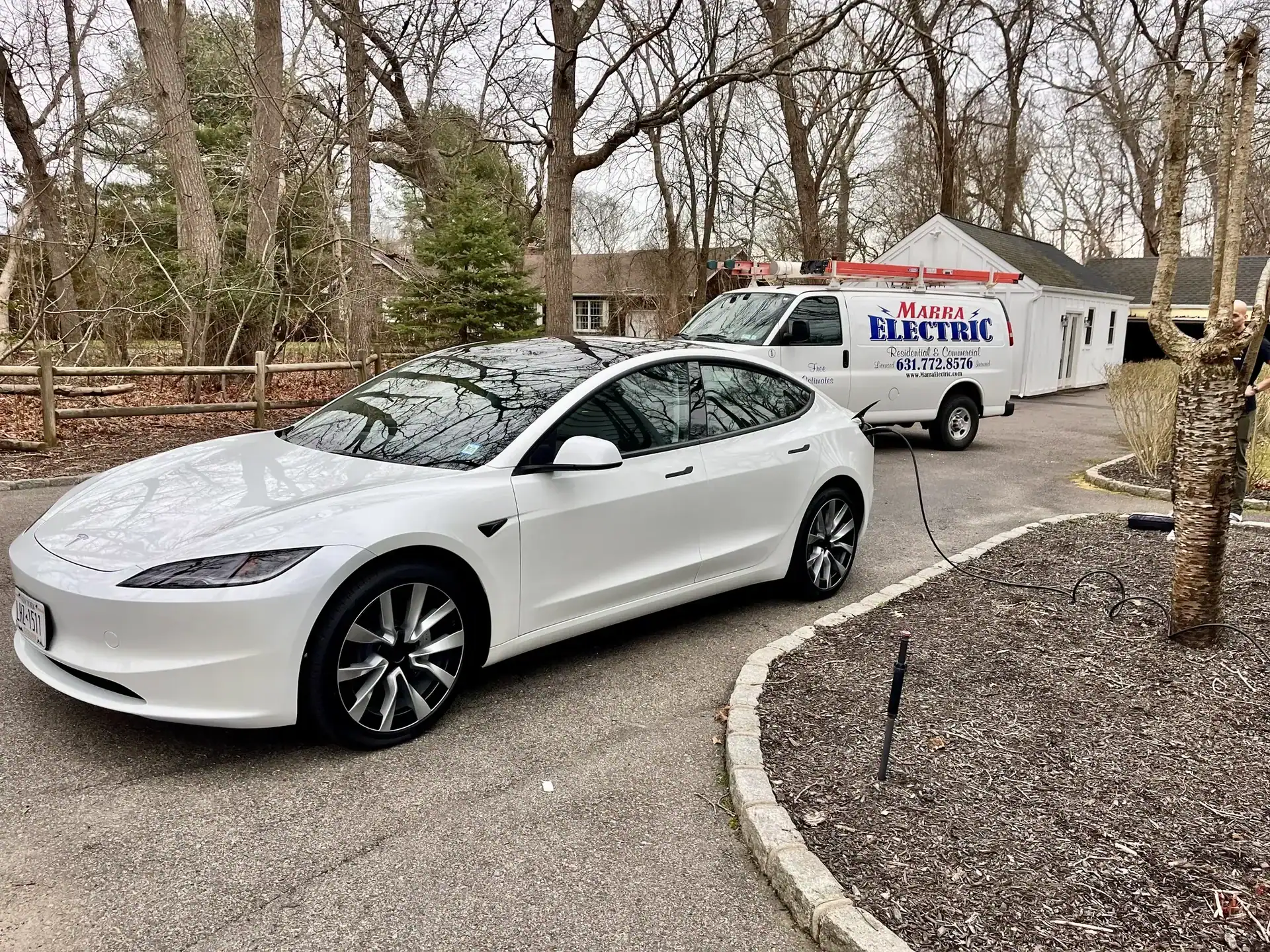
A white electric car is parked in a driveway, plugged in for charging. Nearby, a van labeled “Marra Electric,” a trusted residential electrician Suffolk County NY, is parked near a house surrounded by leafless trees and landscaping.

Explore More Services

About Marra Electric

Level 2 EV Charger Installation in West Hampton Dunes

What's Included in Your Installation

Every electric car charger installation in West Hampton Dunes, NY includes a full electrical assessment, permit handling, circuit installation, charger mounting, and final testing. We also provide a detailed walkthrough so you understand how to operate your new system.

If your panel needs an upgrade to support the charger, we’ll give you a separate line-item price for that work. Many homes in West Hampton Dunes were built before EVs became common, so panel upgrades aren’t unusual. We’re upfront about what’s needed and why.

We install all major brands: Tesla Wall Connectors, ChargePoint Home Flex, JuiceBox, Grizzl-E, and others. If you already bought a unit, we’ll install it. If you’re not sure which one to get, we’ll recommend options based on your vehicle and budget.

You’re also eligible for a federal tax credit covering 30% of the installation cost, up to $1,000. We’ll provide documentation for your tax filing. New York State has additional incentive programs that change periodically, and we’ll point you toward current offerings when we meet.

West Hampton Dunes has a median home value over $2 million, and most homeowners here drive premium EVs. A professionally installed home EV charging station isn’t just about convenience—it’s about protecting your investment and making sure your electrical system can handle the load safely for years.

A white electric car charges in a driveway from a wall-mounted charger, installed by a residential electrician Suffolk County, NY. Nearby are another car and a Manna Electric van. The sunny scene features trees and a house in the background.

How long does a home EV charging station installation take in West Hampton Dunes?

Most installations take between four and six hours. That includes running the wiring from your electrical panel to the charger location, mounting the unit, making all the connections, and testing everything to make sure it’s working correctly.

If your electrical panel needs an upgrade first, that adds time. Panel upgrades usually take another three to five hours, depending on the scope. We’ll do both in the same visit if possible, or we can split it into two appointments if that works better for your schedule.

Distance matters too. If your panel is in the basement and you want the charger installed in a detached garage 100 feet away, that’s more labor and materials than mounting it on the wall right next to the panel. We account for all of that in the estimate so there’s no confusion later.

It depends on your current panel’s capacity and what’s already running on it. A Level 2 charger typically needs a dedicated 240-volt circuit with 40 to 60 amps. If your panel is already near its limit—say you’ve got central air, a pool heater, and other high-draw appliances—you might not have enough capacity left.

During the estimate, we’ll check your panel’s total amperage and see how much is already allocated. If there’s room, we add the circuit. If not, we’ll recommend either a panel upgrade or a load-sharing device that manages power between your charger and other systems.

Many homes in West Hampton Dunes were built decades ago with 100-amp or 150-amp panels. Modern homes with EVs usually need 200 amps. Upgrading isn’t a bad thing—it gives you capacity for future needs and makes your home safer overall. We’ll explain the cost and timeline before you decide anything.

Yes. Tesla Wall Connectors work with any EV if you use the right adapter. Tesla vehicles use the NACS connector, but most other EVs use the J1772 standard. Tesla sells a J1772 adapter, and many third-party options exist too.

That said, if you don’t drive a Tesla, you might prefer a universal charger like ChargePoint or JuiceBox. These come with a J1772 connector built in, so there’s no adapter needed. They also offer app-based controls, scheduling, and energy tracking.

We install whatever unit makes sense for your situation. If you’ve already bought a Tesla Wall Connector and drive a Rivian, we’ll make it work. If you’re still deciding, we’ll walk through the pros and cons of each option based on your vehicle, your budget, and how you plan to use it. There’s no one-size-fits-all answer, and we’re not tied to any specific brand.

Installation costs vary based on distance from your panel, whether you need an upgrade, and which charger you’re installing. A straightforward install with a short wire run and available panel capacity typically ranges from $800 to $1,500. If you need a panel upgrade, add another $1,500 to $3,000 depending on the scope.

We give you an upfront price after the free estimate. That price includes labor, materials, permits, and testing. No surprise charges when the job’s done.

The federal tax credit covers 30% of the installation cost, up to $1,000. So if your total install is $2,000, you’re getting $600 back at tax time. That brings your net cost down significantly. We provide all the documentation you need to claim it. Some homeowners also qualify for utility rebates or state incentives, and we’ll point you toward those programs during the estimate.

Yes, but it’s still cheaper than gas or public charging. How much your bill goes up depends on how much you drive and when you charge. If you drive 1,000 miles a month and your EV gets 3 miles per kWh, that’s about 333 kWh. At Suffolk County’s average rate of around $0.20 per kWh, that’s $67 a month.

Charging during off-peak hours cuts that cost. Many utilities offer time-of-use rates where electricity between midnight and 6 a.m. costs significantly less. If you’re paying $0.12 per kWh overnight instead of $0.20, that same 333 kWh costs $40 instead of $67.

Compare that to fueling a gas car that gets 25 mpg. At $3.50 per gallon, 1,000 miles costs $140. So even at the higher electric rate, you’re saving $73 a month. With time-of-use rates, you’re saving $100 a month. Over a year, that’s $1,200 in your pocket. The charger pays for itself pretty quickly.

Yes. Suffolk County requires permits for electric car charger installation, and we handle the entire process. That includes submitting the application, providing the necessary documentation, and scheduling the inspection.

Permit costs are usually between $50 and $150, depending on the scope of work. If we’re doing a panel upgrade along with the charger install, the permit might cost a bit more. We include permit fees in the upfront price so you know the total cost before we start.

The inspection happens after the install is complete. The county inspector checks our work to make sure everything meets code. We’ve been doing this for over 20 years, so inspections are routine. If the inspector finds anything that needs adjustment, we fix it immediately at no extra cost. Once the inspection passes, you’re fully legal and ready to charge.

Other Services we provide in West Hampton Dunes