You’ve probably noticed the lights flickering when the AC kicks on. Or maybe your breaker trips every time you run the microwave and coffee maker at the same time. These aren’t just annoyances—they’re your electrical system telling you it can’t keep up.
Most homes in North Bay Shore were built before 1980. That means the electrical panel was designed for half the power you’re using today. No smartphones charging overnight, no home offices, no central air running all summer. Just basic lighting and a few appliances.
When you address these issues early, you’re looking at a $150-300 service call. Wait until something fails at midnight or starts smoking, and you’re into $800+ emergency territory. The difference isn’t the complexity of the fix—it’s the timing and the damage that happens while you wait.
A licensed electrician in North Bay Shore can identify what’s actually wrong, explain why it’s happening, and give you a price before any work starts. No surprises. No upselling. Just a clear path from “this keeps happening” to “this is handled.”
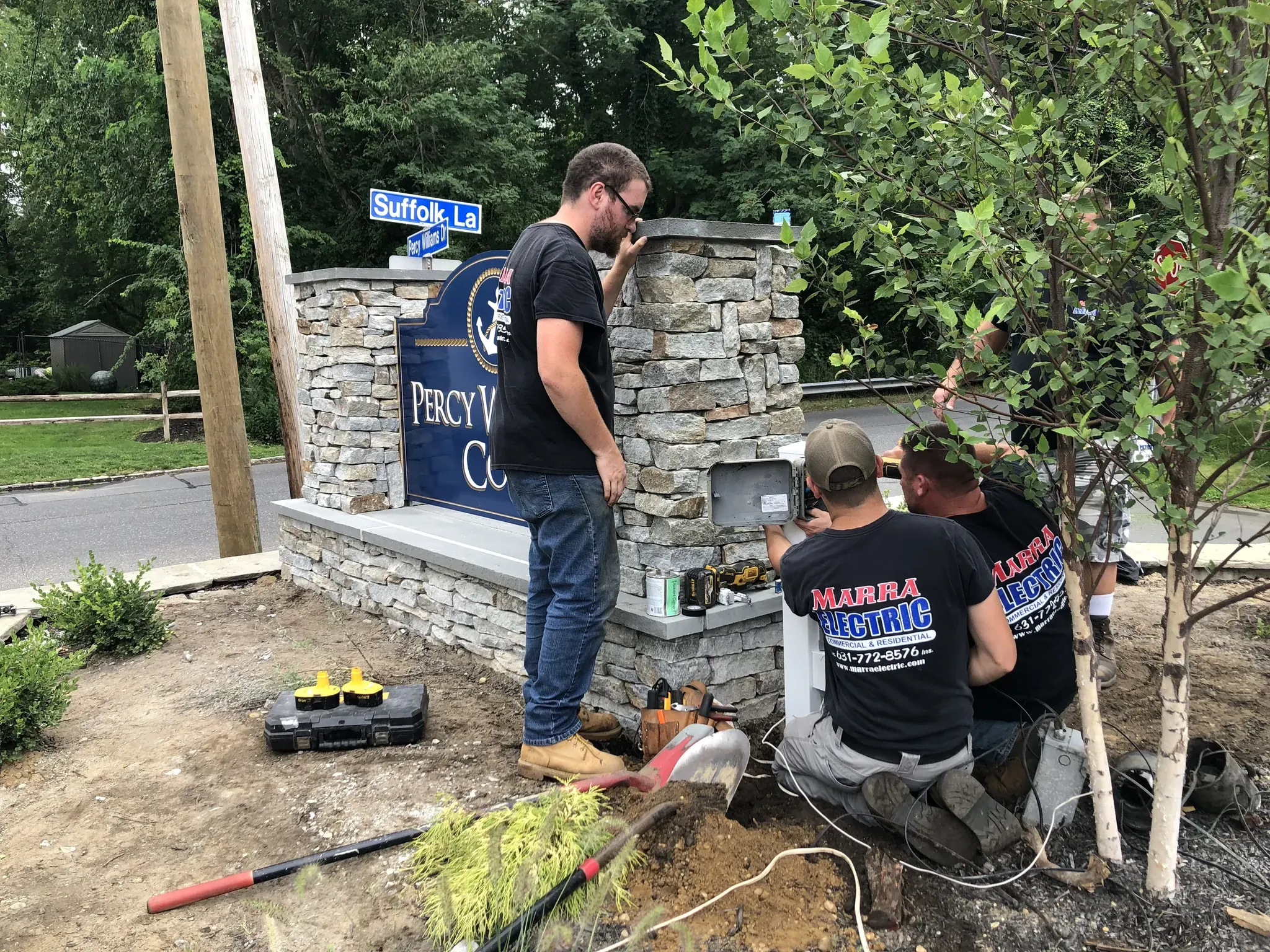
We’ve been serving Suffolk County for over 20 years. We’re fully licensed and insured, and we show up in marked vehicles with uniformed technicians because professionalism isn’t optional when you’re working inside someone’s home or business.
You’ll get upfront pricing before we start. You’ll get a free estimate on the work you’re asking about. And if something doesn’t meet your expectations, we’ll make it right—that’s the 100% satisfaction guarantee we’ve backed since day one.
North Bay Shore homeowners deal with aging infrastructure, coastal humidity that accelerates wear on electrical components, and power grid fluctuations that come with Long Island’s weather swings. We’ve seen it all, and we know how to fix it without the runaround.
First, you’ll talk to someone who actually understands electrical work—not a call center. We’ll ask what’s going on, when it started, and whether it’s an emergency or something that can be scheduled.
If it’s urgent, we offer 24/7 emergency service. If it’s not, we’ll set a time that works for you. When we arrive, we’ll assess the issue, explain what we found in plain language, and give you a price to fix it. You approve the work before we touch anything.
Once you’re good with the plan, we get to work. We don’t cut corners, and we don’t leave a mess. Everything gets done to code, tested, and cleaned up. Before we leave, we’ll walk you through what we did and answer any questions you have.
You’re not signing off on anything until you’re satisfied. That’s how electrical troubleshooting and repairs should work—transparent from the first call to the final invoice.
Ready to get started?
Whether you need a panel upgrade, generator installation, EV charger setup, or an electrical inspection for your home, the process stays the same: honest assessment, clear pricing, quality work.
Panel upgrades are common in North Bay Shore because older 60-100 amp panels can’t handle modern electrical loads. If your home was built before 1990, there’s a good chance your system is undersized. Upgrading to 150-200 amps gives you the capacity for everything from central air to electric vehicle charging without constantly resetting breakers.
Generator installations make sense here. Suffolk County sees storms, outages, and grid issues that leave homes without power for hours or even days. A backup generator keeps your refrigerator running, your sump pump working, and your family comfortable when the lights go out.
EV charger installation is another growing request. Charging at home costs about $12-15 per full charge compared to $30-50 at commercial stations. With Suffolk County’s electricity rate sitting around 27 cents per kWh, a home charging setup pays for itself faster than most people expect. We’ll handle the electrical installation, permitting, and inspection so it’s done safely and up to code.
If your breakers trip regularly, your lights dim when you turn on appliances, or you’re still running a 60-100 amp panel in a home built before 1990, you likely need an upgrade. Modern homes need 150-200 amps to safely handle the electrical load from air conditioning, kitchen appliances, home offices, and EV chargers.
Another red flag: Federal Pacific or Zinsco panels installed in the 1960s through 1980s. These brands have known safety issues, and many insurance companies won’t cover homes that still have them. We can inspect your panel and tell you whether it’s undersized, outdated, or dangerous.
The upgrade itself involves installing a new panel with modern circuit breakers, updating the service entrance if needed, and making sure everything meets current electrical code. Most residential panel upgrades in North Bay Shore take one day, and you’ll notice the difference immediately—no more tripped breakers every time you run two appliances at once.
Flickering lights usually mean your electrical system is struggling to handle the load. When a high-draw appliance like your AC, refrigerator, or microwave kicks on, it pulls a surge of power. If your panel or wiring can’t deliver that power smoothly, the lights dim or flicker as the system compensates.
This is especially common in older North Bay Shore homes where the wiring and panel were designed for much lower power demands. It’s not just annoying—it’s a sign that your system is overworked. Left unchecked, this can lead to overheating, damaged wiring, or even electrical fires.
The fix depends on what’s causing it. Sometimes it’s a loose connection that needs tightening. Other times it’s an undersized circuit that needs to be upgraded or a panel that can’t distribute power efficiently. We’ll test your system, identify the weak point, and recommend a solution that actually solves the problem instead of masking it.
If you want to protect your electronics from power surges caused by lightning, grid fluctuations, and sudden weather changes, yes. Nassau and Suffolk County see more lightning activity and coastal weather swings than many areas, and those surges can fry your TV, computer, HVAC system, and appliances in seconds.
A whole-home surge protector installs at your electrical panel and stops surges before they reach your devices. It’s different from those power strips you plug into the wall—those only protect what’s plugged into them, and they wear out over time. A whole-home system protects everything wired into your house.
The cost is a few hundred dollars for the device and installation, which is a lot less than replacing a $2,000 refrigerator or a $1,500 HVAC control board after a storm. It’s one of those upgrades that doesn’t seem urgent until you need it, and by then it’s too late.
Most EV charger installations take four to eight hours depending on how far your electrical panel is from where you want the charger installed. If your panel is in the garage and you’re mounting the charger on the same wall, it’s straightforward. If the charger needs to go outside or far from the panel, we’ll need to run new wiring, which adds time.
We’ll also check whether your current panel has the capacity to handle the charger. Level 2 chargers—the kind most people install at home—draw 30-50 amps. If your panel is already maxed out, you might need an upgrade before we can safely add the charger. That’s not always the case, but it’s worth checking upfront.
Once the charger is installed, we’ll pull permits, schedule the inspection, and make sure everything is code-compliant. You’ll be able to charge your vehicle overnight for a fraction of what you’d pay at a commercial charging station, and the whole setup typically pays for itself within a couple of years.
First, figure out what’s on that circuit. If the breaker trips every time you use a specific appliance or combination of devices, you’re probably overloading the circuit. The breaker is doing its job—it’s shutting off power before the wiring overheats.
Try unplugging or turning off some devices on that circuit and resetting the breaker. If it holds, you know it’s a load issue. If it trips again immediately, even with nothing running, you’ve got a bigger problem—possibly a short circuit, damaged wiring, or a failing breaker.
Don’t keep resetting a breaker that won’t stay on. That’s a fire hazard. Call us to troubleshoot the issue. We’ll test the circuit, check for damaged wiring, and determine whether you need a repair, a dedicated circuit for high-draw appliances, or a panel upgrade to handle your home’s electrical demand safely.
It depends on what you need done. A service call to diagnose an issue typically runs $150-300. Simple repairs like replacing an outlet or fixing a loose connection might add another $100-200. Panel upgrades usually fall between $1,500 and $3,500 depending on the amperage and complexity.
Generator installations range from $3,000 for a basic standby unit to $10,000+ for whole-home systems with automatic transfer switches. EV charger installations generally cost $800-2,000 depending on the distance from your panel and whether any upgrades are needed.
Here’s the thing: you’ll know the exact price before we start. We give you upfront pricing after we assess the job, and that’s the number you’ll pay—no surprise charges, no hidden fees. If the scope changes or we find something unexpected, we’ll explain what it is and what it costs before moving forward. You’re in control of what gets done and what it costs.
Other Services we provide in North Bay Shore