EV Charger Installation in Laurel, NY

Charge at Home Without the Guesswork or Risk

We’re licensed electricians who handle your entire EV charger installation in Laurel, NY—from electrical assessment and permits to final inspection—so you wake up to a full battery every morning.
[Add Trustindex Button Here]
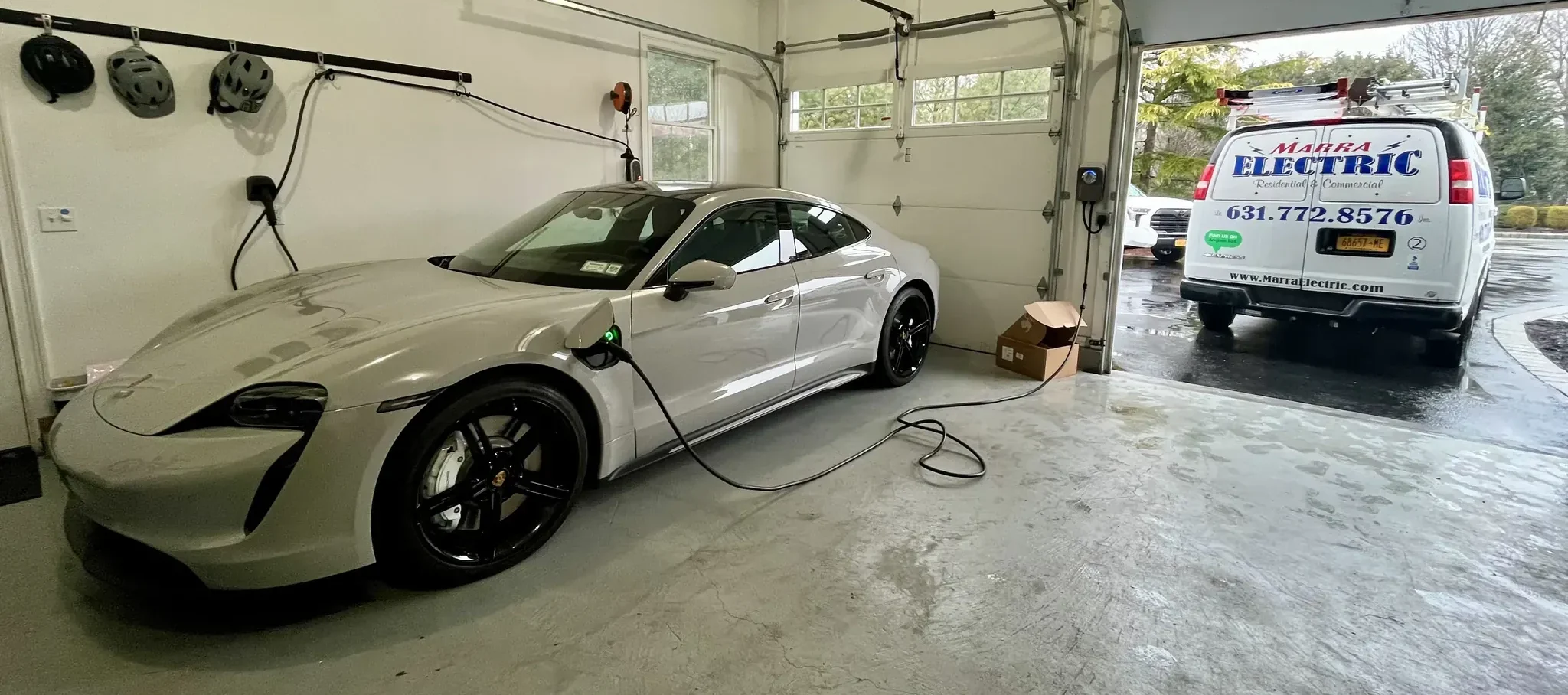
A white electric car charges in a garage, plugged into a wall outlet. Nearby, a cardboard box is on the floor. Outside, a Maria Electric commercial electrician Suffolk County service van is parked in the driveway on a rainy day.
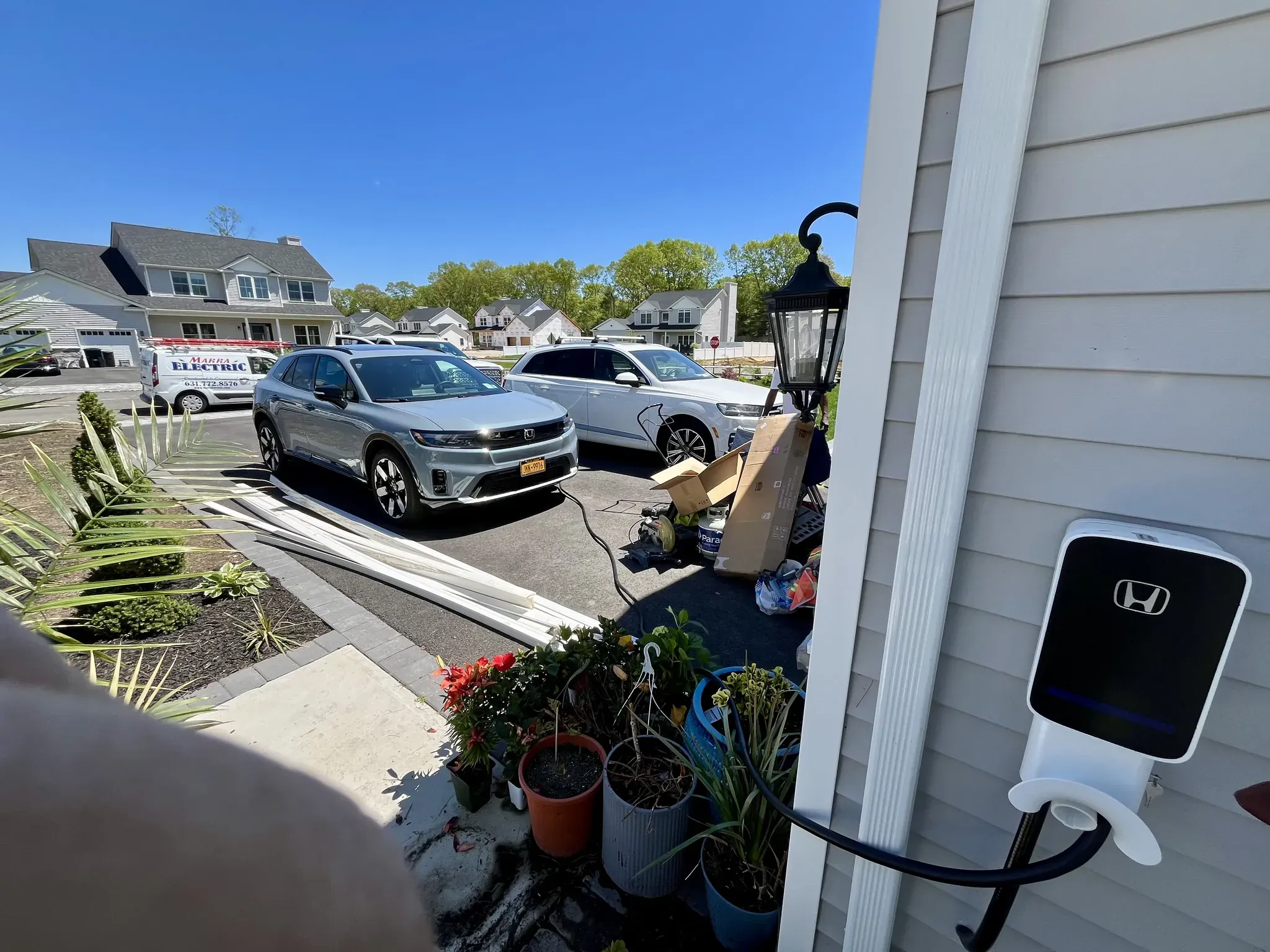
Two silver Honda electric vehicles are parked in a NY suburban driveway near a house. A Honda EV charger, expertly installed by a residential electrician Suffolk County, is mounted on the garage wall. It is a sunny day with plants and boxes nearby.

Licensed EV Charger Electrician Suffolk County

Stop Planning Your Life Around Public Chargers

You bought an electric vehicle expecting convenience. Instead, you’re mapping out charging stations before every trip and hoping the one near your office isn’t occupied when you pull in.

That portable Level 1 charger that came with your car? It adds maybe 4-5 miles of range per hour. If you’re commuting from Laurel to anywhere in Nassau County or beyond, that’s not keeping pace with your actual driving.

A Level 2 home EV charging station installation changes that completely. You plug in when you get home. Your car charges overnight on 240-volt power, the same circuit your dryer uses. By morning, you’ve got 25-40 miles of range added per hour—enough to fully charge most EVs in 4-8 hours.

No more detours. No more waiting at public stations. No more range anxiety on your way to the Hamptons or back from the city. Just plug in, go inside, and your car handles the rest while you sleep.

Tesla Charger Installation Laurel Experts

We've Been Wiring Suffolk County Since 2004

We’ve handled electrical projects across Suffolk County for over 20 years. We’re not a national franchise that subcontracts your job to whoever’s available. We’re the licensed electricians who show up, assess your panel, pull the permits, and install your charger correctly the first time.

We’re Tesla-certified, which means we know the specific requirements for Tesla Wall Connectors and every other major EV charger brand. We’ve seen every type of electrical panel in Laurel—from older homes that need upgrades to newer builds with capacity to spare.

You’ll get upfront pricing before we start, no surprise bills after, and a team that’s been recognized with the Angie’s List Super Service Award seven years running. That doesn’t happen by cutting corners.

A black electric car charges in a driveway, the cable plugged in. Two white Mario Electric vans—experts as a residential electrician Suffolk County—are parked on the street before suburban houses with autumn trees.

Home EV Charging Station Installation Process

Here's Exactly What Happens During Your Installation

First, we assess your electrical panel. Most Suffolk County homes built before 1990 weren’t designed for the 40-60 amp load an EV charger requires. We’ll tell you right away if your current setup can handle it or if you need a panel upgrade. No guessing.

Next, we handle the permit. Almost every Level 2 EV charger installation in Laurel requires an electrical permit from your local building department. We pull it, schedule the inspection, and make sure everything meets code. You don’t have to call anyone or stand in line at town hall.

Then we install the charger. We run a dedicated 240-volt circuit from your panel to wherever you park—garage, driveway, carport. We mount the charging unit, connect the wiring, test the system, and walk you through how it works.

Finally, the town inspector signs off. Once that happens, you’re done. You’ve got a fully permitted, code-compliant charging station that’ll add thousands of dollars to your home’s value and save you 15 to 30 grand in fuel costs over the next decade.

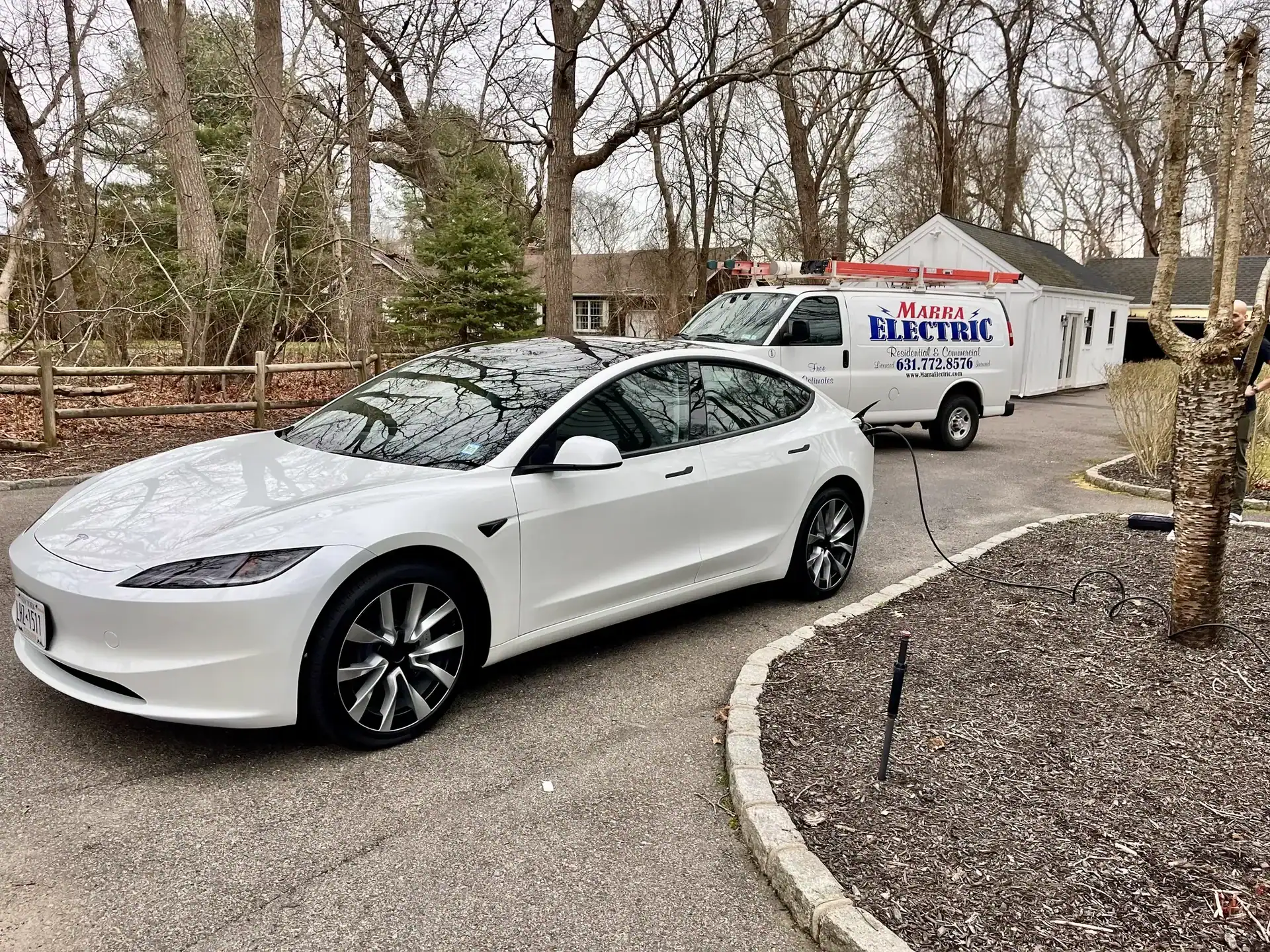
A white electric car is parked in a driveway, plugged in for charging. Nearby, a van labeled “Marra Electric,” a trusted residential electrician Suffolk County NY, is parked near a house surrounded by leafless trees and landscaping.

Explore More Services

About Marra Electric

Level 2 EV Charger Installation Laurel NY

What You Actually Get With This Installation

You get a complete electrical assessment before we touch anything. We check your panel’s capacity, measure the distance to your parking area, and calculate the load to make sure your home can safely support the charger. If you need an upgrade, we’ll tell you exactly what that involves and what it costs.

You get all permits pulled and all inspections scheduled. We deal with the town, not you. Suffolk County has specific codes for EVSE installation, and we know them.

You get a dedicated 240-volt circuit installed to code. That means proper wire gauge, correct breaker size, weatherproof conduit if it’s an outdoor run, and a secure mount for the charging unit. We don’t use shortcuts.

And here’s something worth knowing: Long Island leads New York State in EV adoption, with over 87,000 registered electric vehicles in Nassau and Suffolk counties as of 2025. That number jumped 23% in the last year alone. Governor Hochul has committed to requiring all new passenger vehicles sold in New York to be zero-emission by 2035. If you’re in Laurel and you don’t have a charger yet, you’re going to need one sooner than you think. Homes with Level 2 chargers installed are already selling faster and for 2-3% more in EV-dense areas. You’re not early—you’re right on time.

A white electric car charges in a driveway from a wall-mounted charger, installed by a residential electrician Suffolk County, NY. Nearby are another car and a Manna Electric van. The sunny scene features trees and a house in the background.

Do I need to upgrade my electrical panel for an EV charger installation in Laurel?

It depends on your panel’s current capacity and age. Most electric vehicles need a dedicated 240-volt circuit that draws 40-60 amps. If your panel is already maxed out or you’ve got an older 100-amp service, you’ll likely need an upgrade to safely handle that load.

Homes in Laurel built before 1990 often have electrical systems designed for much lower demand. Back then, nobody was planning for central air, multiple computers, smart home devices, and an EV charger all running at once. We’ll assess your panel during the estimate and tell you exactly what you need.

If an upgrade is necessary, it’s not just about the charger. You’re also future-proofing your home’s electrical system for everything else you’ll plug in over the next 20 years. And if you’re planning to sell eventually, a modern 200-amp panel is something buyers expect.

Most installations take 4-6 hours if your panel has capacity and the charger is going in a garage close to your electrical panel. If we’re running a longer conduit to a driveway or carport, add a few more hours.

If you need a panel upgrade first, that’s a separate job that usually takes a full day. Then we come back and install the charger once the new panel is in and inspected.

Permitting adds time to the overall timeline, but not to the work itself. We pull the permit as soon as you approve the estimate. Depending on your town’s schedule, the inspection might happen the same day we finish or a few days later. Either way, you’ll know the timeline upfront, and we’ll keep you updated if anything changes.

For a straightforward Level 2 charger installation with no panel upgrade needed, most homeowners in Suffolk County pay between $800 and $2,000. That includes the labor, materials, permit, and inspection. The range depends on how far we’re running the circuit and whether it’s an indoor or outdoor install.

If you need a panel upgrade, add another $1,500 to $3,000 depending on the size of the new panel and how much work is involved. We’ll give you an exact price during the estimate—no ranges, no “it depends” pricing after we start.

And here’s something that offsets the cost: you can claim a 30% federal tax credit on the installation. If your total bill is $2,000, that’s $600 back. Plus, you’ll save $2-4 per charge compared to $40-80 for a tank of gas. Over five years, that’s $15,000 to $30,000 in your pocket instead of at a gas pump.

You need a licensed electrician, and here’s why: a Level 2 charger isn’t a plug-in appliance. It requires a dedicated 240-volt circuit, proper wire sizing, a correctly rated breaker, and installation that meets National Electrical Code standards and local Suffolk County requirements.

If the wiring is wrong, you risk overheating, electrical fires, or a tripped breaker every time you try to charge. If the installation doesn’t pass inspection, your insurance might not cover damage if something goes wrong. And if you’re planning to sell your home, an unpermitted charger install will come up during the buyer’s inspection and kill your deal or cost you money to fix.

Most towns in Suffolk County require a permit for any new 240-volt circuit. That permit requires a licensed electrician to pull it and a town inspector to sign off. There’s no DIY shortcut that’s legal or safe. We’ve been called in to fix plenty of bad installs—it’s always more expensive the second time around.

Almost every EV sold in North America uses the same J1772 plug standard for Level 2 charging. That includes Chevy, Ford, Nissan, Hyundai, Kia, BMW, Audi, Volkswagen, and most others. If you buy a charger with a J1772 connector, it’ll work with any of those vehicles.

Tesla uses a proprietary connector, but they include an adapter with every car that lets you use any J1772 charger. Or you can install a Tesla Wall Connector, which works with all Tesla models. If you’ve got a Tesla and you might buy a different EV later, a J1772 charger gives you more flexibility.

We’re Tesla-certified, so we can install Wall Connectors or any other brand you prefer. If you’re not sure which charger to buy, we’ll walk you through the options during your estimate. The installation process is nearly identical regardless of brand—the difference is in features like app connectivity, scheduling, and power output.

Yes, you need a permit. Any new 240-volt circuit in Suffolk County requires an electrical permit and inspection to make sure the work meets code. It’s not optional, and it’s not just bureaucracy—it’s how the town ensures your installation is safe and won’t cause problems down the line.

We handle the entire permit process. We pull it, schedule the inspection, and make sure everything passes. You don’t have to call the building department, wait in line, or figure out what paperwork they need. That’s part of what you’re paying us for.

Once the inspection is done and signed off, you’ll have documentation that the work was completed legally. That matters if you ever sell your home, file an insurance claim, or need to prove the charger was installed correctly. Skipping the permit might save you a couple hundred bucks now, but it’ll cost you thousands later when it becomes a problem.

Other Services we provide in Laurel