
Summary:
You’re planning a renovation — maybe a kitchen remodel, a finished basement, or an addition — and somewhere in the process, someone tells you the electrical needs attention. Maybe your panel is too old to handle the new load. Maybe you need new circuits before the walls close. You may also need smoke and carbon monoxide detector installation to keep your renovated space safe and up to code.
It doesn’t have to be. Knowing what to look for — and what to ask — takes most of the risk out of the decision. Let’s start with the most important piece: licensing.
What Licensing and Insurance Mean for Suffolk County Homeowners
New York doesn’t issue a single statewide electrician license. Licensing is handled at the local level, which means a contractor licensed in Nassau County isn’t automatically licensed to work in Suffolk County. We manage our licensing through Suffolk County Consumer Affairs — and if you want to verify that the electrician you’re hiring is legitimate, that’s the office to call: 631-853-4600.
What you’re looking for specifically is a Master Electrician license. That’s the credential required to pull permits for electrical work in Suffolk County. A journeyman can perform the work, but a licensed master electrician has to be responsible for the permit and the inspection. If a contractor can’t tell you their Suffolk County license number, that’s your answer.
Insurance is equally non-negotiable. Any legitimate electrical contractor carries general liability insurance and workers’ compensation. Without both, you as the homeowner can be held financially responsible for injuries or property damage that happen on your property. Hiring an uninsured contractor can also void your homeowner’s insurance policy for any claims tied to that work.
Do I Need a Permit for Electrical Work in Suffolk County?
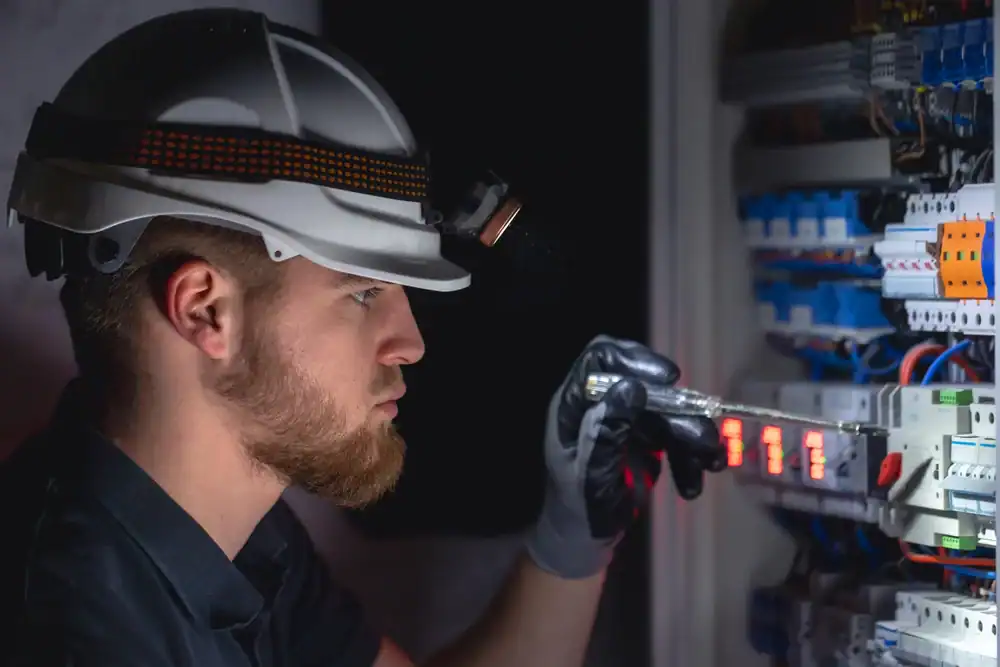
The short answer is yes — for almost anything beyond swapping out a light fixture. Panel upgrades, new circuits, rewiring, EV charger installations, generator installs — all of it requires a permit and a subsequent inspection in Suffolk County. And because Suffolk County is made up of multiple towns, the permit gets pulled through whichever town building department governs your property. That means the Town of Islip, the Town of Huntington, the Town of Brookhaven, the Town of Smithtown, the Town of Babylon, and others each have their own process.
We handle all of that for you. We know which town covers your address, we pull the permit before work begins, and we schedule the inspection when the job is done. You shouldn’t have to navigate that process yourself.
Here’s why this matters more than people realize: unpermitted electrical work creates serious problems down the road. If you sell your home, a buyer’s inspection will flag it. If something goes wrong and you file an insurance claim, the insurer can deny it if the work wasn’t permitted. And if the work was done incorrectly — which is more likely without an inspection to catch it — you’re left with a safety issue and no recourse. Permits aren’t bureaucratic overhead. They’re the mechanism that ensures the work protecting your home was actually done right.
Some homeowners worry that pulling a permit will trigger scrutiny of other things in their house. That’s understandable, but it’s not how the process works. An electrical inspection is scoped to the work being permitted — it’s not an open invitation to audit your entire home. The far greater risk is skipping the permit and inheriting the consequences later.
One more thing worth knowing: Master Electricians in Suffolk County are required to complete continuing education every two years to maintain their license. That requirement exists because the National Electrical Code gets updated regularly, and the standards for things like GFCI and AFCI protection, panel capacity, and circuit requirements change over time. When you hire a licensed master electrician, you’re hiring someone who is required by law to stay current.
How to Verify an Electrician's License Before You Hire Them
Asking for a license number is the right instinct. Actually verifying it takes about two minutes and is worth every second. You can confirm a contractor’s Suffolk County electrical license directly through Suffolk County Consumer Affairs. If the license is valid, current, and held in the name of the business or individual you’re hiring, you’re in good shape. If they hesitate to give you the number, or if it doesn’t check out, move on.
Beyond the license, there are a few other things worth confirming before you sign anything. Ask whether they carry both general liability and workers’ compensation insurance, and ask for a certificate of insurance — a legitimate contractor will have one ready. Ask who will be on-site doing the work and whether the licensed master electrician will be involved in the job, not just on paper. And ask whether the estimate you’re receiving is the final price, or whether additional costs can be added once work begins.
That last question matters more than most people expect. Open-ended hourly billing with no cap is common in the trades, and it’s one of the biggest sources of post-job frustration. A contractor who gives you a written, upfront price before touching anything is telling you something important about how they operate. It means they’ve assessed the job thoroughly, they stand behind their estimate, and they’re not planning to find surprises once the walls are open.
Third-party signals are worth checking too. A contractor with hundreds of verified Google reviews, an A+ rating from the BBB, and a track record of industry awards isn’t just good at marketing — they’ve built a reputation that’s hard to fake at scale. Seven consecutive years of the Angie’s List Super Service Award means that year after year, real customers on a verified platform rated that contractor among the best. That kind of consistency tells you more than any single review.
Planning the Electrical Side of Your Home Renovation in Suffolk County
Most renovation projects in Suffolk County touch the electrical system whether the homeowner planned for it or not. The median home in Suffolk County was built around 1970, which means it was wired for a load that bears almost no resemblance to what a modern household actually draws. A 60-amp or 100-amp panel — common in homes from that era — simply can’t support central air conditioning, an electric range, an EV charger, and a renovated kitchen running simultaneously.
Knowing this going in saves a lot of mid-project surprises. The time to evaluate your panel, your service capacity, and your existing wiring is before the renovation starts — not after the drywall is up.

When Does a Home Renovation Require an Electrical Panel Upgrade?
Not every renovation triggers a panel upgrade, but a lot of them do — and it’s worth understanding why before you get a quote that includes one. Your panel is the hub that distributes power throughout your home. Every circuit runs through it, and every circuit has a capacity limit. When you add a new kitchen with high-draw appliances, finish a basement with additional lighting and outlets, or install an EV charger in the garage, you’re adding load that your existing panel may not be able to safely handle.
The most common scenario in Suffolk County involves homes that still have a 60-amp or 100-amp service. Those panels were installed when a home’s total electrical load was a fraction of what it is today. Adding a 240V EV charger alone typically requires a dedicated 50-amp circuit — which may represent half of an older panel’s total capacity. Add a central air conditioner, a modern refrigerator, and a dishwasher, and you’re past what that system was designed to carry.
Federal Pacific Electric “Stab-Lok” panels are particularly common in mid-century Long Island homes and carry a well-documented history of breaker failure and fire risk. If your home was built between roughly 1950 and 1990 and you’ve never had the panel evaluated, it’s worth having a licensed electrician take a look before you add any load to it. The same applies to Zinsco panels, which appear in some Suffolk County homes from the same era.
Upgrading to a 200-amp panel in Suffolk County typically costs between $1,100 and $4,000 depending on the size of the home and what additional work is required. That range accounts for the permit, the inspection, and the PSEG Long Island coordination required for a meter pull and reconnection — something a local contractor handles as a matter of course, but that an out-of-area contractor may not know how to navigate efficiently.
The right time to find out whether your panel needs an upgrade is at the estimate stage, before work begins. A thorough electrical contractor will assess your current service capacity as part of scoping any renovation project and tell you honestly what the panel can and can’t support.
What Electrical Work Is Typically Required During a Kitchen or Bathroom Renovation?
Kitchen and bathroom renovations are the most common projects that bring electrical work to the surface in Suffolk County homes — and they’re also the projects most likely to reveal that the existing wiring isn’t up to current code.
In a kitchen renovation, you’re almost always adding circuits. Modern kitchens require dedicated circuits for the refrigerator, dishwasher, and microwave, plus a minimum of two 20-amp small appliance circuits for the countertop outlets. If you’re upgrading to an electric range or adding under-cabinet lighting, those need their own circuits too. The National Electrical Code also requires GFCI protection on all kitchen outlets near water sources — which means if your kitchen was wired in 1968, a renovation is the moment to bring it up to current standards.
Bathrooms follow a similar pattern. Every bathroom outlet must be GFCI-protected, exhaust fans need dedicated wiring, and if you’re adding heated floors or a spa-style shower system, those require their own circuits as well. In older Suffolk County homes, it’s not unusual to find a bathroom with a single outlet on a shared circuit — something that doesn’t meet current code and can’t support a modern bathroom’s load.
The sequencing matters too. Electrical rough-in work — running wire through open walls and ceilings, installing boxes, and connecting circuits at the panel — has to happen before insulation and drywall go in. If you call an electrician after the walls are closed, you’re looking at significantly more work and cost to access what needs to be accessed. The right time to bring an electrician into a renovation conversation is at the planning stage, not as an afterthought.
For homeowners in Commack, Bay Shore, Smithtown, Huntington, Ronkonkoma, and the dozens of other Suffolk County communities where mid-century homes are the norm, this planning step often surfaces the panel question as well. A kitchen renovation that adds four new circuits to a 100-amp panel that’s already running near capacity isn’t just an electrical project — it’s a panel upgrade project. Knowing that before the cabinets are ordered saves time, money, and a lot of frustration.
How to Find the Right Licensed Electrician for Your Suffolk County Renovation
The decision comes down to a few things: verified licensing through Suffolk County Consumer Affairs, proof of insurance, a written upfront price before work begins, and a track record that holds up under scrutiny. A contractor who’s been serving Suffolk County for 20 years, has earned third-party recognition for seven consecutive years, and has hundreds of verified reviews from real homeowners in your area isn’t a gamble — they’re a known quantity.
Your home is worth doing this right. The electrical system behind your walls affects everything from daily safety to insurance coverage to what happens when you eventually sell. Cutting corners on who you hire — or skipping permits to save a few hundred dollars — creates problems that tend to surface at the worst possible time.
If you’re planning a renovation and want to understand exactly what the electrical scope looks like before you commit to anything, we offer free estimates with no obligation. Call, and you’ll get a straight answer about what your home needs, what it costs, and what the process looks like from start to finish.