Summary:
Something shifted in Suffolk County over the last couple of years. EVs that used to be a novelty in neighborhood driveways are now everywhere — in Huntington, Smithtown, Islip, and just about every town in between. And as more people make the switch, the conversation has moved past “should I get an electric car?” to “how do I actually charge it at home without losing my mind?”
If you’re already driving an EV or seriously considering one, this page is for you. We’ll walk through what home EV charger installation actually involves, what it costs here in Suffolk County, and why 2026 specifically is a good year to stop waiting.
Why EV Adoption Is Accelerating on Long Island Right Now
More than 17 million electric vehicles were sold globally in 2024 — about one in five new cars purchased worldwide. Nassau and Suffolk Counties together have over 35,500 registered EVs, and that number keeps climbing. New York State has already committed to requiring all new passenger vehicles to be zero-emission by 2035, so this isn’t a passing trend. It’s the direction the market is heading, and a lot of Suffolk County homeowners are getting ahead of it.
The practical reality for Long Island drivers is that EVs make a lot of sense here. Most households own at least one car, commutes are real — often 30 to 60 miles a day — and there’s no subway to fall back on. That makes reliable home charging less of a luxury and more of a daily necessity.

Why Level 1 Charging Stops Working for Most Suffolk County Drivers
When you bring home a new EV, it comes with a standard 120-volt cord that plugs into any regular outlet. That’s Level 1 charging, and it adds about three to five miles of range per hour. For a lot of people, that sounds fine — until they actually start driving the car.
If your daily commute is 40 miles, you need roughly eight to twelve hours of Level 1 charging just to replace what you used that day. Factor in a longer drive, a cold Long Island winter that can reduce battery range by 20 to 40 percent, or a day where you forgot to plug in, and you’re starting your morning with a half-charged car and a tight schedule. It’s a manageable inconvenience at first. Most people stop tolerating it pretty quickly.
Research from FLO found that 60 percent of EV owners who initially thought Level 1 would be sufficient are now actively looking to upgrade. The ones who’ve already made the switch to Level 2 home charging tend to describe it the same way: they plug in when they get home, and the car is full by morning. Every morning. It stops being something they think about.
A Level 2 charger runs on a dedicated 240-volt circuit — the same type of connection as a dryer or oven — and delivers 25 to 45 miles of range per hour. For a Suffolk County commuter, that means a full charge overnight with hours to spare. It’s a different experience entirely, and once you have it, going back to a standard outlet feels like going back to dial-up internet.
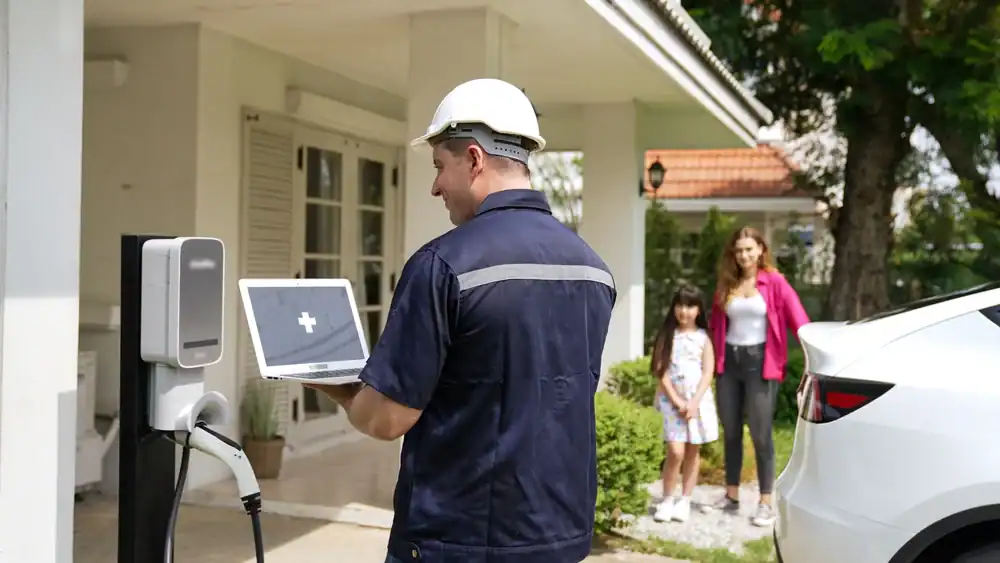
The installation itself is straightforward for most homes. A licensed electrician installs a dedicated circuit from your electrical panel to the charger location — typically a garage or exterior wall — mounts the charging unit, and tests everything before leaving. Most jobs take two to four hours from start to finish.
Does Your Suffolk County Home Need a Panel Upgrade First?
This is the question that stops a lot of homeowners before they even get a quote. They assume their house is too old, the panel is too small, and the whole project is going to spiral into a five-figure electrical overhaul. In most cases, that’s not what happens.
About 80 percent of homes with 200-amp electrical service can support a Level 2 EV charger without any panel upgrade at all. The electrician runs a load calculation — a standard assessment required by the National Electrical Code — to determine whether your existing panel has the capacity. If it does, you’re adding a circuit and a charger. If it doesn’t, you’re looking at a panel upgrade before installation can proceed.
Here in Suffolk County, that matters more than it might in a newer suburb. Roughly 67 percent of homes in the county were built before 1980, when electrical systems were designed for a fraction of the load that modern households put on them. That doesn’t automatically mean you need an upgrade, but it does mean the assessment is worth doing before you assume anything either way.
Panel upgrades in Suffolk County come with one logistical step that homeowners sometimes don’t expect: the work requires coordination with PSEG Long Island for a temporary power disconnection, which typically runs four to six hours. It’s not a major disruption, but it’s something to plan around. A contractor who’s been working in Suffolk County for years knows this process and handles it as a matter of course.
For context on cost: a standard Level 2 charger installation in Suffolk County typically runs between $1,200 and $3,000 before incentives, depending on the complexity of the wiring run and whether any additional work is needed. If a panel upgrade is required, that adds roughly $2,000 to $3,500, including permits and the PSEG coordination. Those are real numbers, not ballpark guesses — and they’re also before you account for the incentives currently available, which bring the net cost down meaningfully.
What EV Charger Installation Actually Costs in Suffolk County in 2026
The cost question is the one we hear most, and the honest answer is that it depends on your home’s setup. But “it depends” isn’t useful without a range, so here’s what we actually see on jobs across Suffolk County.
A typical Level 2 EV charger installation — dedicated circuit, breaker, wiring, mounting, and permit — runs between $1,200 and $3,000 for most single-family homes. Simpler installs where the panel is close to the garage come in at the lower end. Longer wiring runs, outdoor weatherproofing for a coastal location, or any additional electrical work push it higher. Permit fees through your local town building department generally add $150 to $350 on top of that.

The 2026 Incentives That Make This the Right Time to Install
If you’ve been putting this off, the financial case for acting in 2026 is genuinely stronger than it’s been before — and it won’t stay this way indefinitely.
The federal 30C Alternative Fuel Infrastructure Tax Credit currently covers 30 percent of your EV charger installation costs, up to $1,000. That’s a dollar-for-dollar reduction in what you owe at tax time, not just a deduction. It applies to residential installations, and it expires in June 2026. Homeowners who install before that deadline get the credit. Homeowners who wait past it don’t.
On top of that, PSEG Long Island — the utility serving Suffolk County — offers a $200 rebate on qualified Level 2 charger hardware. That’s money back on the equipment itself, separate from the federal credit. PSEG also offers time-of-use rate plans that make overnight electricity significantly cheaper than daytime rates, which is exactly when most EV owners charge. Run the numbers and home charging costs roughly $0.05 per mile. Public charging stations run $0.12 to $0.15 per mile. For a driver covering 13,500 miles a year, that’s a difference of roughly $900 or more annually — every year.
There’s also a home value angle that doesn’t get talked about enough. A 2023 Zillow analysis found that homes with EV charging infrastructure sold for about 3.1 percent more than comparable homes without it. The National Association of Realtors reported in 2024 that 79 percent of their members see EV charging as an increasingly important factor for buyers who drive EVs. If you’re planning to sell at any point in the next decade, a home charging station isn’t just a convenience — it’s a selling point.
Stack the federal tax credit, the PSEG rebate, the annual fuel savings, and the home value impact together, and the installation pays for itself faster than most people expect.
What to Look for in a Licensed EV Charger Installer in Suffolk County
EV charger installation isn’t a job for a handyman or a general contractor who’s done a few of these. It requires a licensed electrician who understands NEC Article 625 — the specific section of the National Electrical Code that governs EV charging systems — and who knows how to navigate the permit process in your town.
In Suffolk County, permits go through your local town’s building department, not a county-wide office. Babylon, Brookhaven, Huntington, Islip, Smithtown — they each have their own processes, their own timelines, and their own inspectors. An electrician who’s been working across Suffolk County for years knows these departments. One who’s new to the area is learning on your job.
A few things worth asking any electrician before you hire them: Do they pull the permit, or do they leave that to you? Do they handle the PSEG coordination if a panel upgrade is needed? Do they provide a written quote before any work starts, or a verbal estimate that can shift once the job is underway? These aren’t gotcha questions — they’re the difference between a smooth installation and a frustrating one.
The 2026 update to the National Electrical Code also added language requiring permanently installed EV charging equipment to be installed by qualified, licensed persons. In New York, skipping the permit process doesn’t just risk a failed inspection — it can void your homeowner’s insurance coverage entirely. That’s the kind of thing that comes up when something goes wrong and the insurance company asks whether the work was permitted and inspected.
What good installation looks like in practice: a load calculation before the quote, a written price reviewed with you before work begins, a dedicated 240-volt circuit sized correctly for your charger, GFCI protection on the circuit, weatherproof mounting if the charger is going outside — Long Island’s salt air and humidity are real factors — and a final inspection by your town’s building department before the job is closed out. That’s the standard. It’s what a licensed, experienced electrician does without being asked.
Ready to Install an EV Charger at Your Suffolk County Home?
The shift toward electric vehicles on Long Island isn’t slowing down. More Suffolk County homeowners are making the move every month, and the ones who’ve set up Level 2 home charging aren’t looking back. The convenience is real, the savings add up quickly, and the window on the current federal tax credit is closing.
If you’re not sure where your home stands — whether your panel can handle it, what the job would cost, or how the permit process works in your town — the best first step is a free estimate from someone who actually knows this market. You shouldn’t have to commit to anything before you understand exactly what’s involved.
We’ve been doing this work in Suffolk County since 2004. We handle the assessment, the permit, the installation, and the PSEG coordination — and we give you a written quote before a single wire is touched. If you’re ready to stop guessing and start charging, reach out to us and we’ll take it from there.