Summary:
You bought the smart switches, or you’re about to. Maybe an EV is on the way, and a generator moved up your list after the last storm knocked out your power. Each project sounds simple on its own. Then someone mentions your panel, and suddenly it’s a bigger conversation.
If you own an older home anywhere in Suffolk County, that conversation is worth having early. Everything you add draws from the same electrical system, and a large share of Suffolk homes were built before 1980. Here’s how to see the whole picture first, before you spend money on pieces that might not fit together.
Understanding Your Home's Electrical System And Its Limits
Your electrical system is everything between the utility line and the outlet on your wall. That means the service coming in from PSEG, the meter, the panel, the breakers, the wiring behind your drywall, and every switch and receptacle on it. The panel decides how much of it you can run at once.
In our experience, panels rated between 60 and 100 amps are the ones that usually need attention. Most modern homes want 150 to 200 amps to cover central air, electric appliances, an EV charger, and all the electronics. Suffolk County homes built before 1990 often have undersized panels. That isn’t a flaw in your house. It was simply built for a different era of electricity use.
If your home is over 40 years old and nothing has been updated, start with a licensed electrical inspection. It’s the cheapest way to learn what you’re really working with.

Do Smart Switches Work In Older Suffolk County Houses?
Sometimes, and sometimes only with extra work. Smart switches are one of the projects people ask us about most, and one of the most misunderstood. The box says it installs in minutes. In a house built decades ago, that’s often optimistic.
Here’s the snag. Many smart switches need a neutral wire at the switch box to power themselves, and older Suffolk County wiring frequently doesn’t have one there. The switch flickers, buzzes, or never connects at all. Depending on the house, the fix might be a special no-neutral switch, or it might mean running new wire. We check your boxes first, so you don’t buy a dozen switches that won’t work.
Outdoor lighting has its own rules. Plenty of Suffolk properties have room for motion-activated, timed, or landscape lighting, and that kind of setup needs weatherproof wiring and dedicated circuits built to code. Tacking it onto whatever circuit happens to be nearby is how you end up with tripped breakers and dim fixtures.
Then there’s the bigger question. Every new circuit draws from the same panel. If you have a 100-amp panel that’s already close to full, adding circuits for a kitchen remodel or new lighting can quietly turn a renovation into a panel upgrade project. It’s far better to learn that at the planning stage than when the ceiling is already open. For recessed lighting, we make as few ceiling cuts as possible, something customers have pointed out in their reviews, and planning the circuits first makes that kind of clean install possible.
Do I Need A 200-Amp Panel For An EV Charger In Suffolk County?
Not always, but you shouldn’t guess. A Level 2 home charger needs its own dedicated circuit, and that circuit has to fit within what your panel can supply alongside everything else in the house. On a 200-amp service that’s often straightforward. On a 100-amp panel that’s already running central air and an electric dryer, it can be a different story.
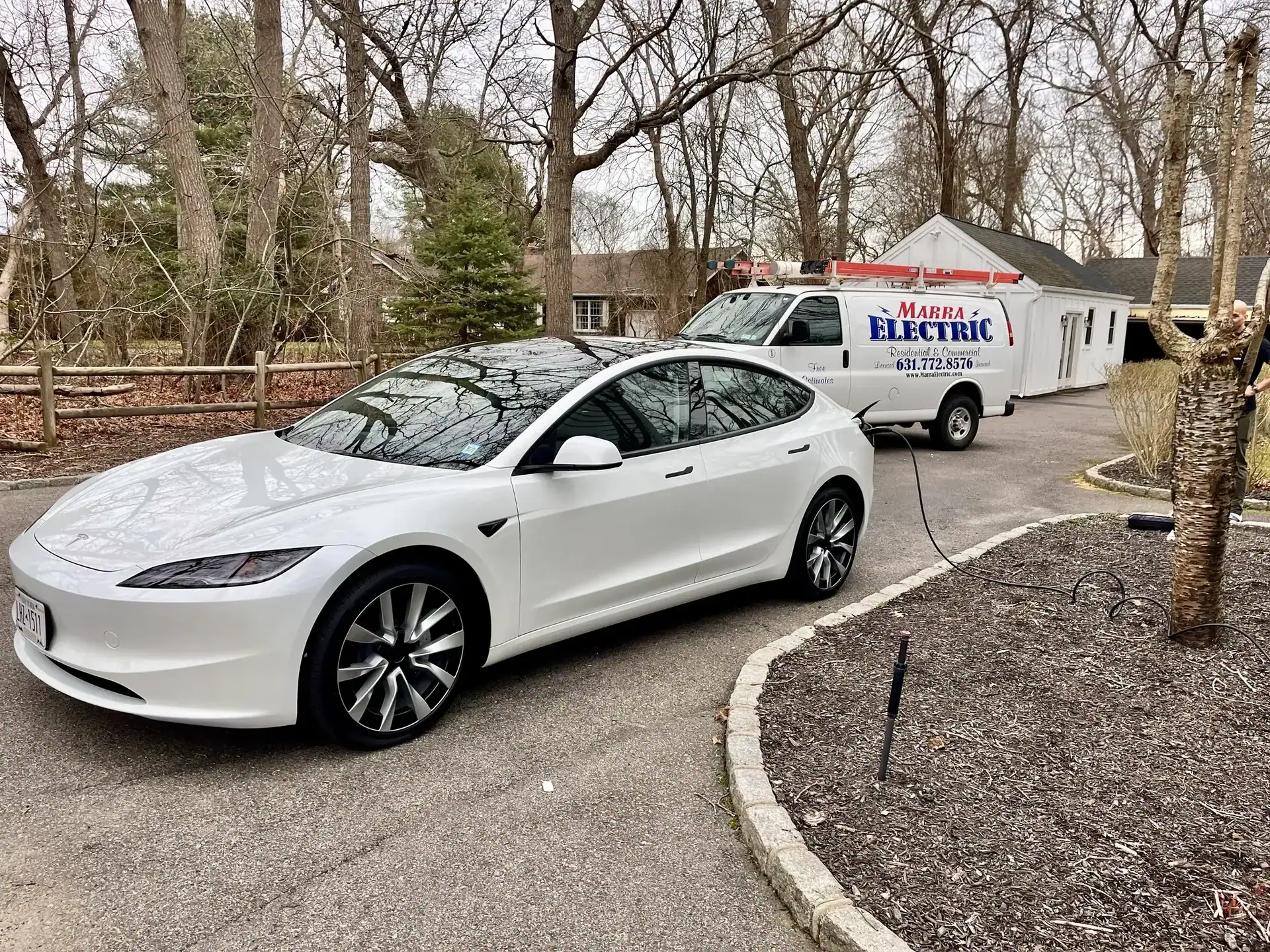
That’s why our EV charger installation starts with the panel, not the charger. We check capacity, pull the permit, and handle the Level 2 setup as one job. We’re a Tesla and ChargePoint certified installer, so either brand is familiar territory.
Generators follow the same logic. After a summer storm or a winter blizzard takes out power, plenty of Suffolk County homeowners start shopping for a Generac or Kohler unit, and we install both. If you already own a portable generator, a manual transfer switch lets you power chosen circuits safely. One of our customers ended up with a 10-circuit emergency backup running off the generator he already owned. Either way, the generator has to be sized against that same panel.
Now the part everyone wants to ask about: cost. Panel upgrades across Suffolk County are commonly quoted somewhere between $2,000 and $5,000, depending on the home’s wiring, its service, and how much has to change. We won’t hand you a number without looking at your panel. Our estimates are free, and once you have ours, the price is the price.
Hiring An Electrical Contractor In Suffolk County: Permits, Licenses, And What Happens Behind The Scenes
Here’s something that surprises people: New York doesn’t have a statewide electrician’s license. Licensing is local, so an electrician licensed in Nassau County isn’t automatically licensed in Suffolk County. Here, the county’s Department of Labor, Licensing and Consumer Affairs handles it, and the master electrician license is the one that allows someone to pull permits.
That matters more than it sounds. Panel work involves the town, the utility, and an inspector, and the person responsible for all of it has to hold the right license. A lot of what separates a smooth upgrade from a stalled one happens in that paperwork, long before anyone touches your breaker box.

Do You Need A Permit For A Panel Upgrade Or EV Charger In Suffolk County?
Yes, for nearly anything beyond a like-for-like swap. Panel upgrades, new circuits, generator installs, EV chargers, major rewiring, pool and spa circuits, and service entrance changes all need one. Swapping a fixture, a receptacle, or a switch for the same thing usually doesn’t.
The permit goes through the building department of the town where your house sits, whether that’s Islip, Babylon, Huntington, Riverhead, or elsewhere in Suffolk County, and a licensed master electrician has to pull it. For a panel upgrade, the sequence runs like this: permit, PSEG disconnects your service, the work gets done, an inspector confirms it meets the National Electrical Code, and only after the inspection passes does PSEG reconnect your power. Skip the inspection and you could be sitting in the dark.
We schedule the PSEG disconnect and the inspector sign-off ourselves, so you’re not playing phone tag between a utility and a town office.
This is also where a cheap quote sometimes turns out to be cheap for a reason. A cash-only or no-permit deal can look like a bargain next to a quote that includes the permit, but unpermitted work creates problems down the road, and it doesn’t answer the capacity question either. An electrical inspection does. It also tells you whether an aging panel, a fuse box, or a Federal Pacific or Zinsco unit should come out before you add anything new.
How Do You Verify An Electrician's License In Suffolk County?
Call Suffolk County’s Department of Labor, Licensing and Consumer Affairs at 631-853-4600 and ask. It takes a few minutes, and you should do it with any contractor, including us. We’d rather you check than take our word for it.
While you have a license number in hand, ask for proof of liability and workers’ comp insurance too. Then ask the questions people tend to forget. Is the estimate itemized and in writing? Who pulls the permit? If something unexpected turns up behind a wall, who decides on the price before work continues? Vague quotes that grow change orders after demolition are what people complain about most, and a clear answer up front tells you plenty.
We give free estimates, and the estimate is the price, so no surprise bill lands at the end. That’s what customers bring up most in their reviews, along with crews who show up when they say they will and take the time to explain the work. Dan gets named a lot for walking people through the scope and stopping by afterward to make sure they’re happy. We hold a 5.0 average across 191 reviews on Angi.
One customer who compared three quotes for a transfer switch wrote that ours came in lowest and the equipment was top quality. Cheapest was never the goal. Knowing exactly what you’re getting for the money is. And if something isn’t right after the job, our 100% satisfaction guarantee covers all the work we do.
Ready To Plan Your Suffolk County Electrical System Upgrade?
Smart switches, an EV charger, a generator, and a kitchen remodel can all be on your list at once. What matters is the order. Check the panel, confirm the permit and inspection path, then add the pieces your Suffolk County home can actually support.
If you’d like someone to look at your whole electrical system and tell you plainly what it needs, reach out to us at Marra Electric. Our crews work out of Bohemia and across Suffolk County, our estimates are free, and the price we give you is the price you pay. If something can’t wait, we’re available around the clock for emergencies.